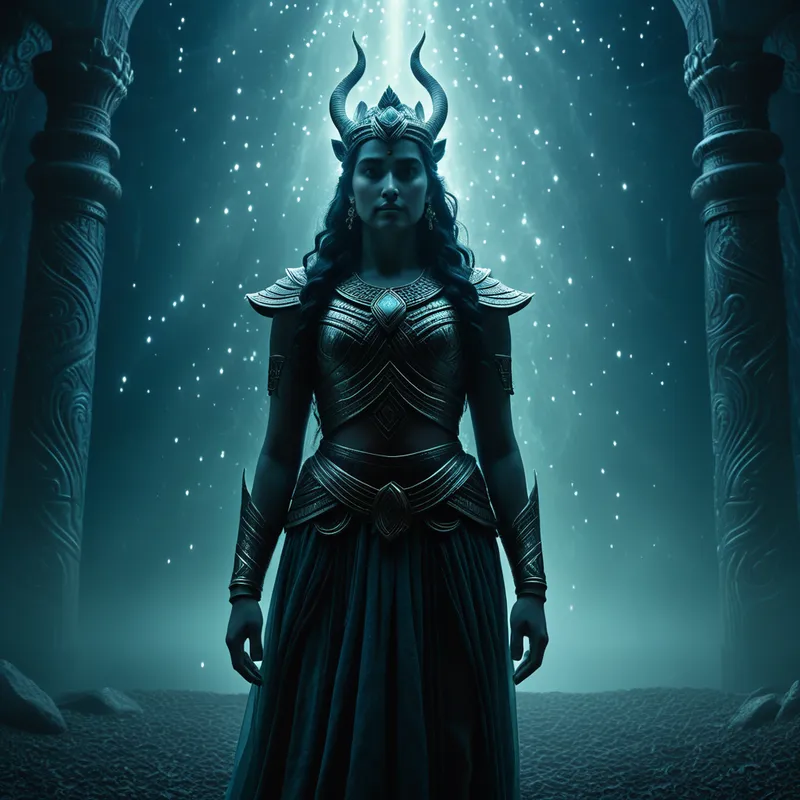
The Palm Tree of Orunmila
A sacred palm tree in Yoruba mythology that embodies Orunmila's divine wisdom, serving as a conduit for prophecy and spiritual insight.
The Tale of The Palm Tree of Orunmila
In the beginning, when [the world](/myths/the-world “Myth from Tarot culture.”/) was still soft and the paths between heaven and earth were not yet fixed, the Orisha [Orunmila](/myths/orunmila “Myth from Yoruba culture.”/) descended from the realm of Orun to [the world](/myths/the-world “Myth from Tarot culture.”/) of Aye. He came not with thunder or fire, but with a quiet purpose, carrying sixteen sacred palm nuts, the ikin, in a pouch made from the hide of wisdom. Where he chose to rest, he planted a single palm seed into the fertile soil of the nascent earth.
This seed did not grow as ordinary trees do. It drank not only from earthly springs but from the very wellspring of divine consciousness. Its roots plunged deep, weaving through the layers of the world, touching the memories of the ancestors and the blueprints of destinies yet unborn. Its trunk rose straight and true, a living axis between the realms, its rough bark etched with the patterns of all that is, was, and will be. At its crown, a fountain of fronds whispered secrets with [the wind](/myths/the-wind “Myth from Various culture.”/), and from its heart, it offered its fruit—the nourishing palm nut and the sweet, fermentable wine.
This Palm Tree became Orunmila’s silent oracle, his library of life. When a seeker came, heavy with questions of fate, Orunmila would sit in its shade. He would cast the ikin, their rattle against the [calabash](/myths/calabash “Myth from African Diaspora culture.”/) like the tapping of a code upon the Tree’s own bark. The resulting patterns, the Odu, were not mere abstractions; they were living verses sung by the Tree itself, narratives drawn from its infinite memory. The Tree did not judge, nor did it command. It revealed. It showed the seeker [the crossroads](/myths/the-crossroads “Myth from Celtic culture.”/) where their own choices intersected with the threads of destiny (ayanmo), illuminating the path of alignment and the pitfalls of divergence. The rustling leaves spoke of origins, the resilient trunk of perseverance, and the ever-replenishing fruit of the consequences, both bitter and sweet, that flow from every human action.
Cultural Origins & Context
The Palm Tree of Orunmila is not a myth of a distant, forgotten past; it is the living root system of the Ifa tradition. Ifa is the elaborate system of wisdom, philosophy, and divination presided over by Orunmila. The palm tree (ope) is its most potent natural symbol, deeply embedded in Yoruba ecology and cosmology.
In the tangible world, the oil palm is a tree of profound utility. Every part is used: the fronds for roofing and weaving, the trunk for construction, the nuts for oil and food, the sap for wine. It is a tree of sustenance and community. This earthly reality is mirrored and magnified in its spiritual counterpart. Orunmila’s Palm Tree sustains not the body, but the soul and the community’s existential orientation. It provides the “oil” of clarity to see one’s path, the “wine” of inspiration, and the “shelter” of understanding.
The myth grounds the practice of [Ifa divination](/myths/ifa-divination “Myth from Yoruba culture.”/) in a cosmic principle. The Babalawo does not invent wisdom; he is a gardener tending the roots of this eternal Tree, interpreting the language of its growth. The myth asserts that wisdom is not a human invention but a natural, organic force in the universe, as real and present as a tree, waiting to be consulted by those who approach with respect and a genuine desire to know.
Symbolic Architecture
The [Palm Tree](/symbols/palm-tree “Symbol: The palm tree symbolizes tropical paradise, relaxation, and resilience, often reflecting a sense of freedom.”/) stands as a master [symbol](/symbols/symbol “Symbol: A symbol can represent an idea, concept, or belief, serving as a powerful tool for communication and understanding.”/) of vertical [integration](/symbols/integration “Symbol: The process of unifying disparate parts of the self or experience into a cohesive whole, often representing psychological wholeness or resolution of internal conflict.”/). Its form is a map of [consciousness](/symbols/consciousness “Symbol: Consciousness represents the state of awareness and perception, encompassing thoughts, feelings, and experiences.”/).
- The Roots (Ile): Anchored deep in the [earth](/symbols/earth “Symbol: The symbol of Earth often represents grounding, stability, and the physical realm, embodying a connection to nature and the innate support it provides.”/), they represent the unconscious, the [realm](/symbols/realm “Symbol: The symbol of ‘Realm’ often signifies the boundaries of one’s consciousness, experiences, or emotional states, suggesting aspects of reality that are either explored or ignored.”/) of the ancestors (Ajogun in another context, but here, the benevolent Ara Orun), and the collective past. This is the [foundation](/symbols/foundation “Symbol: A foundation symbolizes the underlying support systems, values, and beliefs that shape one’s life, serving as the bedrock for growth and development.”/), the [source](/symbols/source “Symbol: The origin point of something, often representing beginnings, nourishment, or the fundamental cause behind phenomena.”/) of all latent potential and inherited patterns.
- The [Trunk](/symbols/trunk “Symbol: The trunk in dreams typically denotes the core structure or foundation of one’s identity, values, or beliefs.”/) (Oke): The sturdy, visible [axis](/symbols/axis “Symbol: A central line or principle around which things revolve, representing stability, orientation, and the fundamental structure of reality or consciousness.”/) is the pillar of the conscious self, the individual [life](/symbols/life “Symbol: The symbol of ‘Life’ represents a journey of growth, interconnectedness, and existential meaning, encompassing both the joys and challenges that define human experience.”/) [journey](/symbols/journey “Symbol: A journey in dreams typically signifies adventure, growth, or a significant life transition.”/). It is the realm of [effort](/symbols/effort “Symbol: Effort signifies the physical, mental, and emotional energy invested toward achieving goals and personal growth.”/), [choice](/symbols/choice “Symbol: The concept of choice often embodies decision-making, freedom, and the multitude of paths available in life.”/), and [character](/symbols/character “Symbol: Characters in dreams often signify different aspects of the dreamer’s personality or influences in their life.”/)—the “I” that navigates the world. Its verticality is the aspiration to grow, to reach upward from one’s origins.
- The [Crown](/symbols/crown “Symbol: A crown symbolizes authority, power, and achievement, often representing an individual’s aspirations, leadership, or societal role.”/) (Ori): The bursting green [fountain](/symbols/fountain “Symbol: A symbol of purification, renewal, and abundance, fountains evoke themes of life-giving water and wisdom flowing freely.”/) of fronds reaching for [the sky](/myths/the-sky “Myth from Persian culture.”/) is the realm of the Ori Inu, the higher self or divine consciousness. It is the point of [connection](/symbols/connection “Symbol: Connection symbolizes relationships, communication, and bonds among individuals.”/) with Orun, with pure [insight](/symbols/insight “Symbol: A sudden, deep understanding of a complex situation or truth, often arriving unexpectedly and illuminating hidden connections.”/), inspiration, and the boundless possibilities of [destiny](/symbols/destiny “Symbol: A predetermined course of events or ultimate purpose, often linked to spiritual forces or cosmic order, representing life’s inherent direction.”/).
The Tree teaches that true wisdom is not found in the crown alone, but in the integrity of the entire structure. Insight (the crown) must be grounded in character (the trunk), which must be nourished by an honest relationship with one’s depths (the roots). To seek prophecy while ignoring one’s foundational wounds or ethical development is to have a tree with a lofty crown but a hollow, rotting trunk.
The [palm](/symbols/palm “Symbol: The palm tree symbolizes resilience, victory, and peace, often associated with tropical climates.”/) nut, the ikin, is the concentrated seed of this entire [system](/symbols/system “Symbol: A system represents structure, organization, and interrelated components functioning together, often reflecting personal or social order.”/)—a perfect [microcosm](/symbols/microcosm “Symbol: A small, self-contained system that mirrors or represents a larger, more complex whole, often reflecting the universe within an individual.”/) containing the [pattern](/symbols/pattern “Symbol: A ‘Pattern’ in dreams often signifies the underlying structure of experiences and thoughts, representing both order and the repetitiveness of life’s situations.”/) of the [macrocosm](/symbols/macrocosm “Symbol: The universe as a whole, representing the interconnectedness of all existence and the reflection of the individual within the cosmic order.”/). In [divination](/symbols/divination “Symbol: The practice of seeking knowledge of the future or unknown through supernatural means, reflecting humanity’s desire for certainty and connection with hidden forces.”/), casting the nuts is like shaking the [Tree](/symbols/tree “Symbol: In dreams, the tree often symbolizes growth, stability, and the interconnectedness of life.”/), causing a fragment of its eternal [truth](/symbols/truth “Symbol: Truth represents authenticity, honesty, and the quest for knowledge beyond mere appearances.”/) to fall into the specific configuration of a [seeker](/symbols/seeker “Symbol: A person actively searching for meaning, truth, or a higher purpose, often representing the dreamer’s own quest for identity or fulfillment.”/)’s [moment](/symbols/moment “Symbol: The symbol of a ‘moment’ embodies the significance of transient experiences that encapsulate emotional depth or pivotal transformations in life.”/).
The Dreamer’s Resonance
To encounter the Palm Tree of Orunmila in a dream is to be called to a profound inner consultation. Psychologically, it represents [the Self](/myths/the-self “Myth from Jungian culture.”/)—the total, integrated [psyche](/myths/psyche “Myth from Greek culture.”/)—in its function as the inner oracle.
When this symbol arises, the dreamer is at a [crossroads](/myths/crossroads “Myth from Celtic culture.”/) where intellectual knowledge is insufficient. The dream asks: From what deep, ancestral ground are you growing? Is your conscious life (the trunk) aligned with your authentic values, or is it bent by the winds of expectation? Are you open to the insights from your own crown, your higher intuition, or do you ignore its whispers? The Tree’s presence suggests that the answers are not to be found externally, but within the dreamer’s own psychic architecture. It is an invitation to self-divination—to sit in the shade of one’s own soul, to respectfully cast the nuts of one’s memories, choices, and feelings, and to learn to read the Odu of one’s own life narrative.
It confronts the modern malaise of disconnection. We often live in our “crowns”—in abstract ideas and digital clouds—or are trapped in our “roots”—in compulsive patterns and unresolved history—while the integrating trunk of embodied, conscious living grows weak. The Palm Tree dreams us back into wholeness, offering its sturdy trunk as a support for our climb toward self-knowledge.

Alchemical Translation
The alchemical process mirrored in this myth is sublimation: the transformation of the base into the sublime, the material into the spiritual, without losing the essence of the original substance. The palm tree undergoes this process in reality (tree -> nut -> oil/wine -> sustenance) and in myth (tree -> symbol -> divination -> wisdom).
The work of Orunmila is the work of the alchemist-psychologist: to take the raw, often painful “nuts” of lived experience—our failures, our loves, our griefs—and through the careful, ritualized fire of conscious reflection, press from them the clarifying oil of insight and the fermentable wine of meaning. The Palm Tree is the alembic where this transformation occurs.
This is not a rejection of the earthly but its sacred transmutation. The myth insists that destiny (ayanmo) is not a pre-written script forced upon us, but a pattern of potential that interacts dynamically with our choices (our akunleyan). The divination process is the alchemical operation that reveals this interaction. It shows how the lead of our confusion can become the gold of our purpose, provided we engage in the work with the humility of a seeker and the courage of a conscious participant in our own fate.
Associated Symbols
Explore related symbols from the CaleaDream lexicon:
- [Tree of Life](/myths/tree-of-life “Myth from Kabbalistic culture.”/) — The archetypal world-axis connecting all realms of existence, embodying the interconnectedness of creation, growth, and cosmic order.
- Roots of Wisdom — The deep, often hidden foundations of knowledge that draw nourishment from ancestral experience and the unconscious mind.
- Divination Cards — Tools for externalizing and interpreting the hidden patterns of fate and the psyche, making the intangible tangible.
- Bridge — A structure spanning a divide, representing transition, connection between different states of being, and the passage to understanding.
- Mirror — A surface for reflection, revealing not just the outer visage but the inner truth, the self, and often, the nature of reality itself.
- Destiny — The pre-ordained or inherent course of events, encompassing one’s life purpose, fate, and the unfolding of a cosmic plan.
- Circle — A symbol of wholeness, eternity, unity, and the cyclical nature of life, [death](/myths/death “Myth from Tarot culture.”/), and rebirth.
- Key — An instrument for unlocking, representing access to hidden knowledge, solutions to mysteries, and the opening of new potentials.
- Temple — A consecrated space for worship and communion with the divine, representing the inner sanctuary of the soul and structured spiritual practice.
- Wisdom’s Lantern — A light held aloft to illuminate the path in darkness, symbolizing the guiding power of insight, knowledge, and enlightened reason.
- Fruit-Laden Tree — A tree abundant with produce, symbolizing fertility, the fruition of efforts, nourishment, and the tangible rewards of growth.
- Hollowed Tree Trunk — A tree that has been carved out by time or purpose, representing a vessel, a shelter, a repository of secrets, or a portal between worlds.