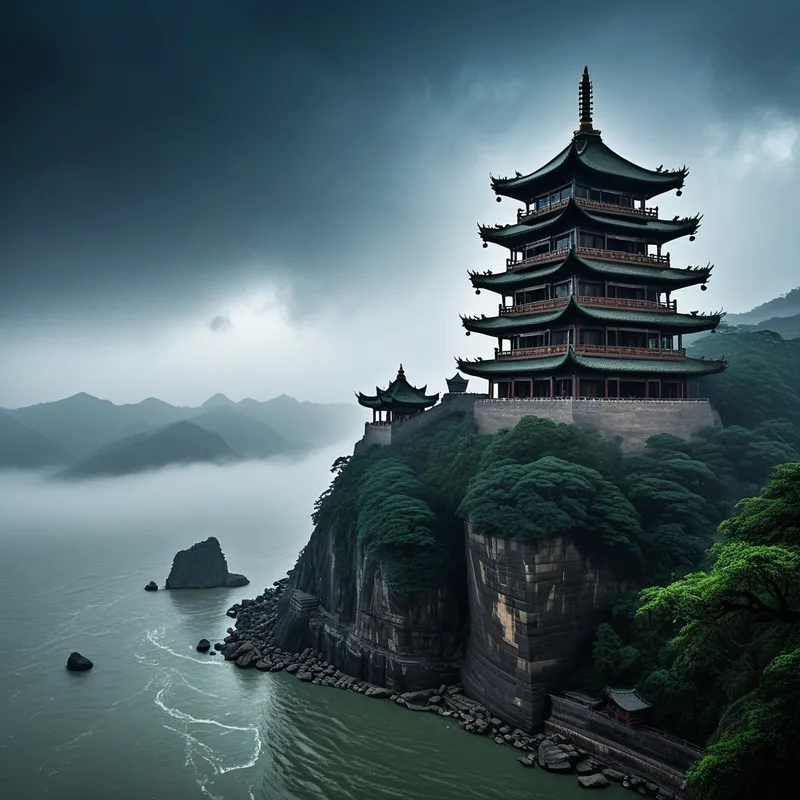
The Pagoda of Six Harmonies Myth Meaning & Symbolism
A monk builds a pagoda to subdue a raging river dragon, harmonizing chaos with cosmic order and human will.
The Tale of The Pagoda of Six Harmonies
Listen, and hear the tale of [the river](/myths/the-river “Myth from Buddhist culture.”/) that would not be tamed.
In the ancient days, where the Qiantang River meets the vast Eastern Sea, a great chaos reigned. The waters were not waters as we know them, but a living, thrashing beast. Each month, when [the moon](/myths/the-moon “Myth from Tarot culture.”/) pulled at the ocean’s heart, the river would rear up in a monstrous silver wall—a tidal bore that shattered boats, drowned villages, and salted the fields with despair. The people whispered that this was no natural current, but the wrath of a Jiangjiao, a river dragon whose restless spirit churned the depths into fury.
Into this landscape of fear came a monk named Zhi Tong. He did not arrive with an army or with thunderous proclamations. He came with silence, and with eyes that saw not just the [water](/myths/water “Myth from Chinese culture.”/)’s surface, but the turbulent qi—the vital energy—beneath. He walked the ravaged banks, feeling [the dragon](/myths/the-dragon “Myth from Chinese culture.”/)’s anguish in the tremors of [the earth](/myths/the-earth “Myth from Hindu culture.”/), hearing its roars in [the wind](/myths/the-wind “Myth from Various culture.”/) that preceded the deadly tide.
Zhi Tong understood. The dragon was not evil; it was lost, a primal force disconnected from the cosmic order, its power spilling out in destructive, lonely rage. To subdue it with force would only breed greater chaos. The dragon needed a compass, a anchor to the rhythms of heaven and earth.
So, upon the most perilous cliff overlooking the river’s treacherous bend, Zhi Tong began his work. He did not build a fortress, but a prayer—a pagoda. Stone by stone, tier by tier, he raised the [Pagoda of Six Harmonies](/myths/pagoda-of-six-harmonies “Myth from Chinese culture.”/). With each level, he inscribed seals and sutras, channeling not a warrior’s might, but a sage’s profound alignment. He harmonized the directions of the universe—north, south, east, west, heaven, and earth—into its very structure.
As the final tile was placed on the ninth and highest story, the monk climbed to its pinnacle. He did not brandish a weapon. He faced the approaching tidal bore, a mountain of water roaring with the dragon’s voice, and he began to chant. His voice was not loud, but it was precise, a needle of pure intent threading through the storm. He rang a great bronze bell, its sound a wave of pure, resonant order.
The tidal bore crashed against the cliffs… and then, a miracle of stillness. The furious wall of water seemed to listen. The chaotic, formless rage began to spiral, to shape itself around the pagoda’s unwavering presence. The dragon’s spirit, feeling the stable pull of the harmonized directions, found a path. Its wild energy was not destroyed, but redirected, guided into the river’s proper course. The waters receded, not in defeat, but in calm submission to a greater pattern. The Pagoda stood, not as a conqueror’s trophy, but as a luminous axis around which chaos had learned to dance.
Cultural Origins & Context
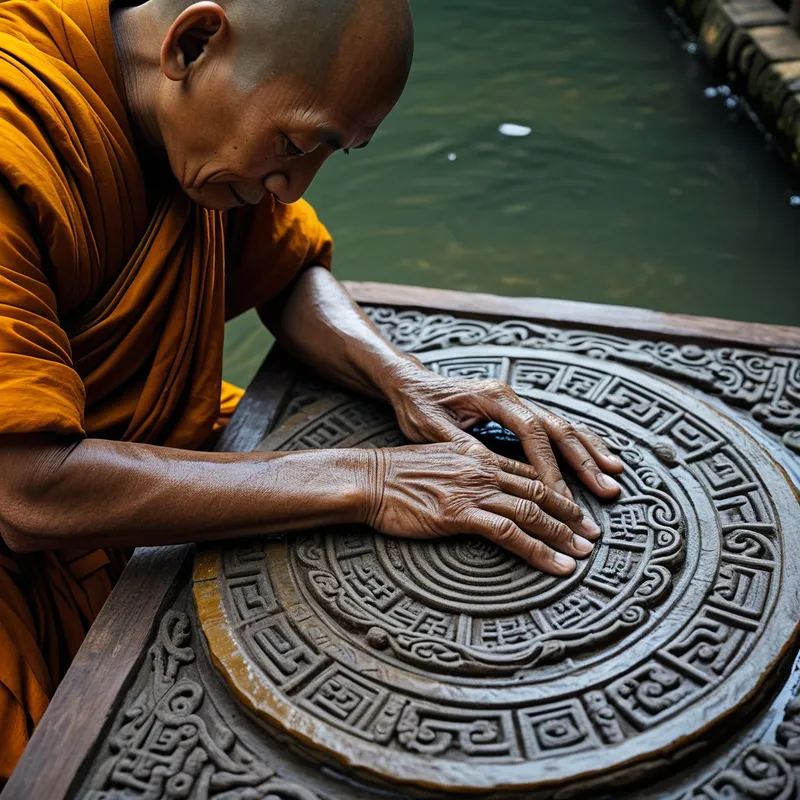
The myth of the Pagoda of Six Harmonies is rooted in the historical Liuhe Pagoda in Hangzhou, originally built in 970 AD during the Northern Song Dynasty. While the structure served the practical purpose of a lighthouse and tidal observation tower, its name and function quickly blossomed into folklore. The “Six Harmonies” (Liu He) refer to the six cosmological directives from the ancient [I Ching](/myths/i-ching “Myth from Chinese culture.”/)—the four cardinal directions plus the zenith and nadir—representing the totality and balance of the universe.
The story was passed down not in formal imperial histories, but through local temple lore, operatic performances, and the oral traditions of river communities. It was told by Buddhist monks to illustrate the power of compassionate wisdom over brute force, and by fishermen and farmers as an etiological myth explaining the (somewhat) tamed nature of the Qiantang bore. Its societal function was twofold: it provided a spiritual and psychological explanation for a terrifying natural phenomenon, transforming it from meaningless disaster into a narrative of possible harmony, and it reinforced the core Confucian-Buddhist-Daoist synthesis in Chinese thought—that human virtue, properly aligned with cosmic principle (Dao), can mediate and civilize the raw forces of nature.
Symbolic Architecture
The myth is a masterclass in symbolic [integration](/symbols/integration “Symbol: The process of unifying disparate parts of the self or experience into a cohesive whole, often representing psychological wholeness or resolution of internal conflict.”/). The raging Jiangjiao represents the untamed unconscious—[the flood](/myths/the-flood “Myth from Biblical culture.”/) of raw [emotion](/symbols/emotion “Symbol: Emotion symbolizes our inner feelings and responses to experiences, often guiding our actions and choices.”/), instinct, and psychic [energy](/symbols/energy “Symbol: Energy symbolizes vitality, motivation, and the drive that fuels actions and ambitions.”/) that, when unintegrated, wreaks havoc on the “[village](/symbols/village “Symbol: Symbolizes community, connection, and a reflection of one’s roots or origins.”/)” of the conscious ego. It is not evil, but unconscious power, dangerous because it has no [relationship](/symbols/relationship “Symbol: A representation of connections we have with others in our lives, often reflecting our emotional state.”/) to order.
The true sage does not slay the dragon; he gives the chaos a star to orbit.
Zhi Tong, the monk, embodies the emerging Self—the organizing principle of the [psyche](/myths/psyche “Myth from Greek culture.”/) that seeks wholeness. His tool is not suppression but [structure](/symbols/structure “Symbol: Structure in dreams often symbolizes stability, organization, and the framework of one’s life, reflecting how one perceives their environment and personal life.”/): the [Pagoda](/symbols/pagoda “Symbol: A Pagoda symbolizes spiritual enlightenment, cultural heritage, and the reaching of higher consciousness, often serving as a meditation or worship space.”/). Each of its nine tiers (nine being the supreme yang [number](/symbols/number “Symbol: Numbers in dreams often symbolize meaning, balance, and the quest for understanding in the dreamer’s life, reflecting their mental state or concerns.”/) in [Chinese](/symbols/chinese “Symbol: Chinese symbolism represents a rich tapestry of culture, traditions, and philosophical beliefs originating from China.”/) [numerology](/symbols/numerology “Symbol: The study of numbers’ mystical significance, suggesting divine patterns, life paths, and hidden meanings in numerical sequences.”/)) symbolizes a stage of ascending [consciousness](/symbols/consciousness “Symbol: Consciousness represents the state of awareness and perception, encompassing thoughts, feelings, and experiences.”/) and integration. The “Six Harmonies” are the foundational, non-dual [framework](/symbols/framework “Symbol: Represents the underlying structure of one’s identity, emotions, or life. It signifies the mental or emotional scaffolding that supports or confines the self.”/)—the reconciling of all opposites (above/below, left/right, within/without)—that must be established before the turbulent waters of the [psyche](/myths/psyche “Myth from Greek culture.”/) can be calmed.
The pagoda is thus a psychic [lighthouse](/symbols/lighthouse “Symbol: The lighthouse serves as a beacon of hope and guidance amidst the storms of life.”/). It does not eliminate the tidal bore (the unconscious impulses); it provides a fixed point of [awareness](/symbols/awareness “Symbol: Conscious perception of self, surroundings, or internal states. Often signifies awakening, insight, or heightened sensitivity.”/) so that those forces can be seen, navigated, and ultimately incorporated without destruction. The final act of chanting and [bell](/symbols/bell “Symbol: A bell signifies communication, awakening, and the call to attention, often associated with new beginnings or signals.”/)-ringing is the act of conscious [attention](/symbols/attention “Symbol: Attention in dreams signifies focus, awareness, and the priorities in one’s life, often indicating where the dreamer’s energy is invested.”/)—the focused, respectful engagement with the unconscious that transforms its [expression](/symbols/expression “Symbol: Expression represents the act of conveying thoughts, emotions, and individuality, emphasizing personal communication and creativity.”/).
The Dreamer’s Resonance
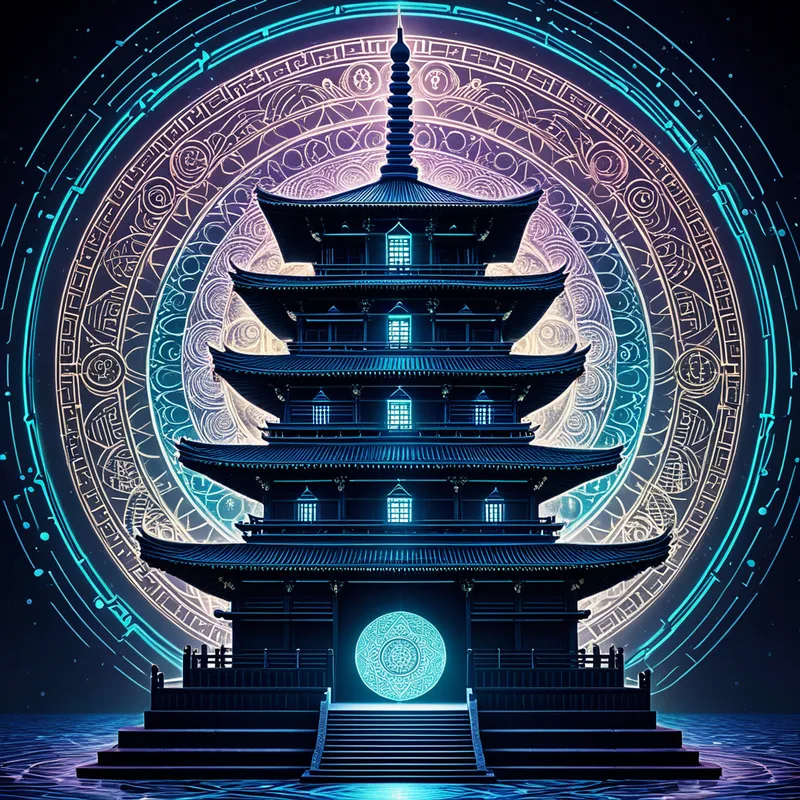
When this myth stirs in the modern dreamer, it often signals a confrontation with a “river dragon” within—a surge of long-repressed emotion, a tidal wave of anxiety, or a chaotic life circumstance that feels overwhelming and autonomous. One may dream of uncontrollable floods, of being pursued by a watery serpent, or of standing before a vast, angry sea.
Somatically, this can feel like a churning in the gut, a tightness in the chest, or a sense of being emotionally “flooded.” Psychologically, the dreamer is at the precipice where chaotic unconscious content is threatening to break into conscious life. The psyche is presenting the problem in its mythic form: a powerful, ancient force that demands recognition, not negation.
The appearance of a tower, lighthouse, or pagoda in such dreams is the psyche’s own solution emerging. It represents the dreamer’s nascent ability to build an inner structure—through mindfulness, therapy, creative expression, or ritual—that can hold and harmonize this chaos. The dream asks: Where in your life must you become Zhi Tong? Where must you build a pagoda of mindful observation to face your inner tide?
Alchemical Translation
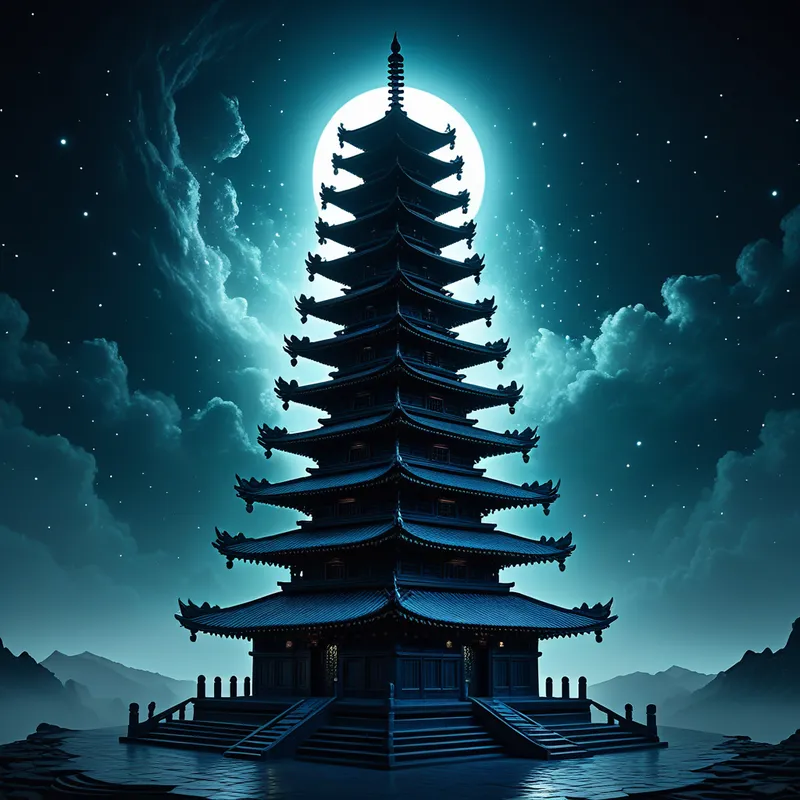
The alchemical process modeled here is the transmutation of undifferentiated, [prima materia](/myths/prima-materia “Myth from Alchemical culture.”/) energy (the dragon’s rage) into a cohesive, life-enhancing force. This is the heart of Jungian individuation.
First, the Confession (to the prima materia): The monk acknowledges the dragon’s power and its right to exist. He does not deny the chaos. In our lives, this is the critical step of shadow-work—admitting our rage, grief, or wildness without immediate judgment or repression.
Second, the Construction of [the Vessel](/myths/the-vessel “Myth from Alchemical culture.”/): Building the pagoda is the disciplined creation of a conscious attitude—a “ritual vessel” of therapy, journaling, meditation, or art. This vessel must be founded on the “Six Harmonies,” a commitment to seeing the whole picture, embracing paradox, and seeking balance.
Individuation is not the cessation of the storm, but the building of a sanctuary from which to witness its majesty without being destroyed.
Finally, the Conjunction: The chanting from the pinnacle is [the ego](/myths/the-ego “Myth from Jungian culture.”/)’s dialogue with the unconscious Self. The resonant bell is the symbol of the integrated personality finding its unique tone. The dragon’s energy, once a threat, now flows in its proper channel. In the individual, this translates as the harnessing of once-disruptive passions into focused drive, the transformation of anxiety into alertness, and the guiding of creative fury into authentic expression. The Pagoda stands forever as a testament within the psyche: a symbol that the greatest power lies not in domination, but in sacred, harmonious alignment.
Associated Symbols
Explore related symbols from the CaleaDream lexicon: