The Owl Myth Meaning & Symbolism
A tale of the Cailleach's owl, a creature of prophecy and silent witness, guarding the threshold between the living world and the underworld of Annwn.
The Tale of The Owl
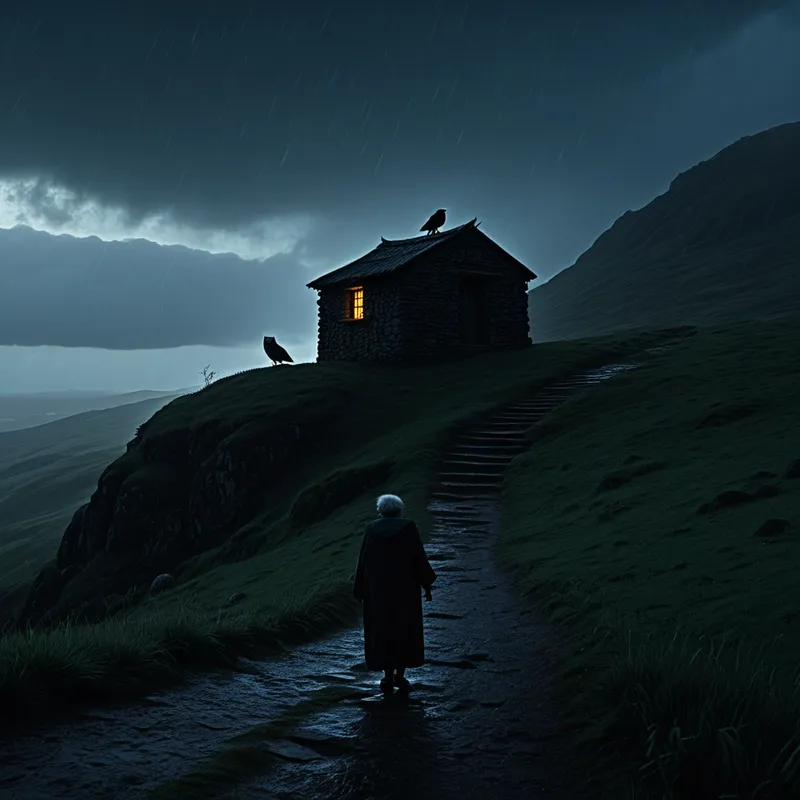
Listen, and let the peat-smoke carry you back. Before the cross of stone, before the iron of Rome, when [the world](/myths/the-world “Myth from Tarot culture.”/) was a cloak of forest and mist, there lived an knowing. Not a goddess to be worshipped on high, but a force as old as the hills she shaped—the Cailleach. Her home was not a hall of gold, but a low, stone bothy on the highest, barest shoulder of the mountain, where [the wind](/myths/the-wind “Myth from Various culture.”/) sang the oldest songs.
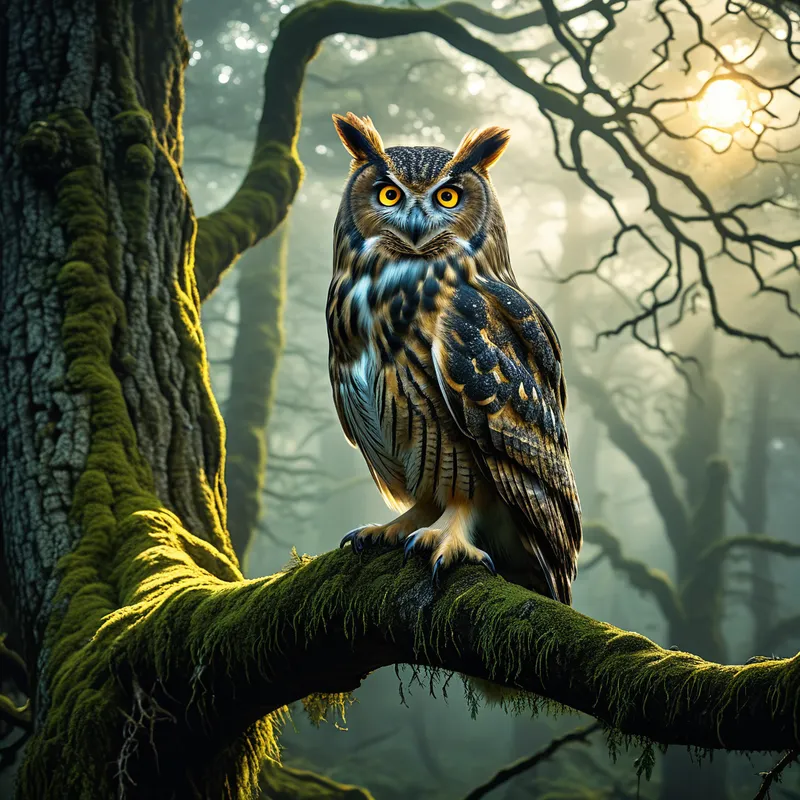
Her companion was not a hound or a horse, but an owl. No ordinary bird of the barn, but a creature woven from the twilight itself. Its feathers were the grey of impending storm and the brown of sleeping earth. Its eyes were twin pools of ancient amber, seeing not just the hare in the heather, but the path of its spirit before it was born, and [the shadow](/myths/the-shadow “Myth from Jungian culture.”/) it would leave after. The people of the glen below knew. They called it Cailleach-oidhche.
One season, the blight came. It began not on the crops, but in the souls of the people. A great forgetting. Songs lost their tune. Stories frayed at the edges. The path to the sacred well grew over with thorns. A deep, silent malaise settled in the valley, a cold that no fire could touch. The chieftain, a man once bold, now sat staring at the dying embers, his purpose drained away.
Desperate, his youngest daughter, Aisling, climbed the mountain. The wind tore at her cloak. The path vanished into scree and cloud. She climbed until her breath was ragged ice, until she stood before the stone hut at the world’s edge. No light came from within, only a profound, listening silence.
The door was open. Inside, in the gloom, sat [the Cailleach](/myths/the-cailleach “Myth from Celtic culture.”/), still as a mountain root. On her shoulder perched the great owl, unblinking. No words were exchanged. The old one’s gnarled hand gestured to a stool. Aisling sat, and the weight of the valley’s sorrow fell upon her like a physical shroud. She wept the tears the chieftain could not shed.
Then, the Cailleach-oidhche spread its wings without a sound. It flew not to the door, but to the back wall of the hut, which was not a wall at all, but the entrance to a deeper cave, a mouth of darkness. It looked back once, its eyes holding Aisling’s. The message was clear: Follow.
Into the absolute black Aisling went, guided only by the faint, ghostly rustle of feathers ahead. She felt the living rock close around her, then open into vastness. The air grew cold and still, smelling of damp clay and old roots. This was Annwn, not as a place of fear, but as the deep memory of the land itself. Here, the forgotten songs echoed in the dripping [water](/myths/water “Myth from Chinese culture.”/). The lost stories were carved into the crystalline walls. The owl glided ahead, a silent pilot through [the underworld](/myths/the-underworld “Myth from Greek culture.”/) of memory.
It led her to a still, black pool. In its depths, she did not see her reflection, but a vision: the valley, green and whole, its people remembering. They were singing the old songs to the new crops, telling the frayed stories by mended fires. The vision was not a promise, but a possibility—a seed lying dormant in the dark soil of the present despair.
The owl hooted, a soft sound that vibrated in the bones of [the earth](/myths/the-earth “Myth from Hindu culture.”/). It was time to return. The journey back was a blur. Aisling found herself outside the stone hut at dawn, the first light piercing [the mist](/myths/the-mist “Myth from Celtic culture.”/). The Cailleach was gone. But on [the threshold](/myths/the-threshold “Myth from Folklore culture.”/) lay a single, grey-brown feather.
Aisling descended, the feather clutched in her hand. She did not speak of caves or otherworlds. Instead, she sat by her father’s cold fire, and began to hum a melody she had heard in the dripping dark. Then she spoke a fragment of a story, one carved in crystal. The chieftain’s eyes, dull as slate, flickered. He added the next line. One by one, others gathered. The remembering had begun. The owl, unseen, watched from a high pine, guardian of the threshold between the deep past and the living present, its work done once more.
Cultural Origins & Context
The owl in Celtic tradition is a creature shrouded in authentic ambiguity, its lore surviving in fragments within later Irish, Welsh, and Scottish folklore, often recorded by Christian monks who viewed its associations with darkness with suspicion. It was never the subject of a single, codified “myth” as in Greek tradition, but was a potent symbolic presence woven into the fabric of a worldview that saw no firm boundary between the natural and supernatural.
Its primary custodian in narrative would have been the fili or the village seanchaí, the keeper of lore. Stories featuring the owl were likely told not for mere entertainment, but as ontological instruction. They functioned to explain the presence of wisdom in silent, dark places and to personify the uncanny knowledge that comes from the margins—the edges of the forest, the depth of the night, the realm of the ancestors. The owl’s association with figures like the Cailleach—the ultimate ancestor and shaper of the land—cements its role as a creature of primordial, often terrifying, knowledge. It was a [psychopomp](/myths/psychopomp “Myth from Greek culture.”/), guiding not just to the land of the dead (Annwn or the [Tír na nÓg](/myths/tr-na-ng “Myth from Celtic culture.”/)), but to the memory held within the land itself.
Symbolic Architecture
The owl is not a [symbol](/symbols/symbol “Symbol: A symbol can represent an idea, concept, or belief, serving as a powerful tool for communication and understanding.”/) of intellectual [knowledge](/symbols/knowledge “Symbol: Knowledge symbolizes learning, understanding, and wisdom, embodying the acquisition of information and enlightenment.”/), but of an older, more visceral form of knowing. It represents the intelligence of the unseen [matrix](/symbols/matrix “Symbol: A dream symbol representing the fundamental structure of reality, consciousness, or the self. It often signifies feelings of being trapped, controlled, or questioning the nature of existence.”/)—the patterns of the ecosystem, the cycles of decay and [regeneration](/symbols/regeneration “Symbol: The process of renewal, restoration, and growth following damage or depletion, often representing emotional healing, transformation, or a fresh start.”/), the silent [history](/symbols/history “Symbol: History in dreams often represents the dreamer’s past experiences, lessons learned, or unresolved issues that continue to influence their present.”/) held in [stone](/symbols/stone “Symbol: In dreams, a stone often symbolizes strength, stability, and permanence, but it may also represent emotional burdens or obstacles that need to be acknowledged and processed.”/) and bone.
To see in the dark is not to eliminate the shadow, but to develop a relationship with it. The owl does not fear the night; it is its native tongue.
Its silent [flight](/symbols/flight “Symbol: Flight symbolizes freedom, escape, and the pursuit of one’s aspirations, reflecting a desire to transcend limitations.”/) symbolizes knowledge that arrives without fanfare, the intuitive hit, the gut feeling that bypasses rational [analysis](/symbols/analysis “Symbol: The process of examining something methodically to understand its components or meaning. In dreams, it represents the mind’s attempt to break down complex experiences.”/). Its haunting call, often considered an [omen](/symbols/omen “Symbol: A sign or event believed to foretell the future, often seen as a warning or promise from the universe.”/) of [death](/symbols/death “Symbol: Symbolizes transformation, endings, and new beginnings; often associated with fear of the unknown.”/), is more accurately an [announcement](/symbols/announcement “Symbol: An announcement in dreams often symbolizes the arrival of new information or significant changes in one’s life.”/) of a transition—a crossing of the threshold from one state of being to another. In its link to the Cailleach, it embodies the wisdom of [the crone](/myths/the-crone “Myth from Celtic culture.”/): ruthless, unsentimental, focused on the essential truths that sustain [life](/symbols/life “Symbol: The symbol of ‘Life’ represents a journey of growth, interconnectedness, and existential meaning, encompassing both the joys and challenges that define human experience.”/) across generations, not the comforts that sustain ego in the [moment](/symbols/moment “Symbol: The symbol of a ‘moment’ embodies the significance of transient experiences that encapsulate emotional depth or pivotal transformations in life.”/). It is the [guardian](/symbols/guardian “Symbol: A protector figure representing safety, authority, and guidance, often embodying parental, societal, or spiritual oversight.”/) of the liminal [space](/symbols/space “Symbol: Dreaming of ‘Space’ often symbolizes the vastness of potential, personal freedom, or feelings of isolation and exploration in one’s life.”/), the crucial “in-between” where transformation is possible—the [doorway](/symbols/doorway “Symbol: A doorway signifies transition, opportunities for new beginnings, and the choice to walk through into the unknown.”/), the [dusk](/symbols/dusk “Symbol: A transitional period between day and night, symbolizing liminality, reflection, and the merging of opposites in artistic and musical contexts.”/), the edge of the [forest](/symbols/forest “Symbol: The forest symbolizes a complex domain of the unconscious mind, representing both mystery and potential for personal growth.”/).
The Dreamer’s Resonance
When the owl glides into the modern dreamscape, it signals an encounter with this deep, ecological [psyche](/myths/psyche “Myth from Greek culture.”/). It is not an invitation to mere study, but to a profound somatic listening.
Dreaming of an owl, especially one that is watching silently or leading the dreamer, often coincides with a life phase where intellectual understanding has hit a wall. One may be intellectually aware of a problem—a fading relationship, a stagnant career, a personal loss—but cannot feel [the way](/myths/the-way “Myth from Taoist culture.”/) forward. The owl’s presence marks the beginning of a descent into the [underworld](/myths/underworld “Myth from Greek culture.”/) of feeling and instinct. The dreamer may experience this somatically as a pull towards solitude, a fascination with darkness or shadows, or a sense of being guided by an uncanny, wordless intuition. It is the psyche’s method of forcing a confrontation with forgotten or repressed knowledge—the “blight” in the soul from the tale. The owl does not solve the problem; it guides the dreamer to the pool in the dark where the reflection of the solution lies dormant.
Alchemical Translation
The myth models the alchemical process of [nigredo](/myths/nigredo “Myth from Alchemical culture.”/), the descent into [the dark night of the soul](/myths/the-dark-night-of-the-soul “Myth from Christian Mysticism culture.”/) that is necessary for any genuine transformation. The valley’s “forgetting” is the conscious ego’s stagnation. Aisling’s climb is the first courageous step toward the neglected, ancestral wisdom (the Cailleach) within.
The treasure is always guarded by a dragon, and the wisdom is always found in the dark. The owl is both the guardian and the guide through that very darkness.
The journey through [the cave](/myths/the-cave “Myth from Platonic culture.”/) to Annwn is the heart of the work: the voluntary immersion into the personal and collective unconscious. Here, in the [prima materia](/myths/prima-materia “Myth from Alchemical culture.”/) of forgotten memories and unlived potentials, the owl acts as the [Mercurius](/myths/mercurius “Myth from Alchemical culture.”/), [the psychopomp](/myths/the-psychopomp “Myth from Various culture.”/) of depth psychology. It does not talk, because the knowledge sought is pre-verbal. It leads to the black pool—[the mirror](/myths/the-mirror “Myth from Various culture.”/) of the unconscious—where the potential future (the green valley) is seen not as a fantasy, but as a latent image within the current decay.
The return is the integration. Aisling does not bring back a magic sword or a bag of gold, but a feather—a token of the connection, and a fragment of the owl’s own nature (silent knowing). Her act of humming and storytelling is the coniunctio, the bringing together of the retrieved unconscious content with conscious life. For the modern individual, this translates to finding the “feather” after a period of depression or confusion: a new, quieter certainty, a creative impulse rooted in depth, or simply the ability to sit with the unknown without panic. One becomes, in part, the owl—a keeper of thresholds, able to navigate the dark with a little more trust, holding the wisdom that true sight often requires the absence of light.
Associated Symbols
Explore related symbols from the CaleaDream lexicon: