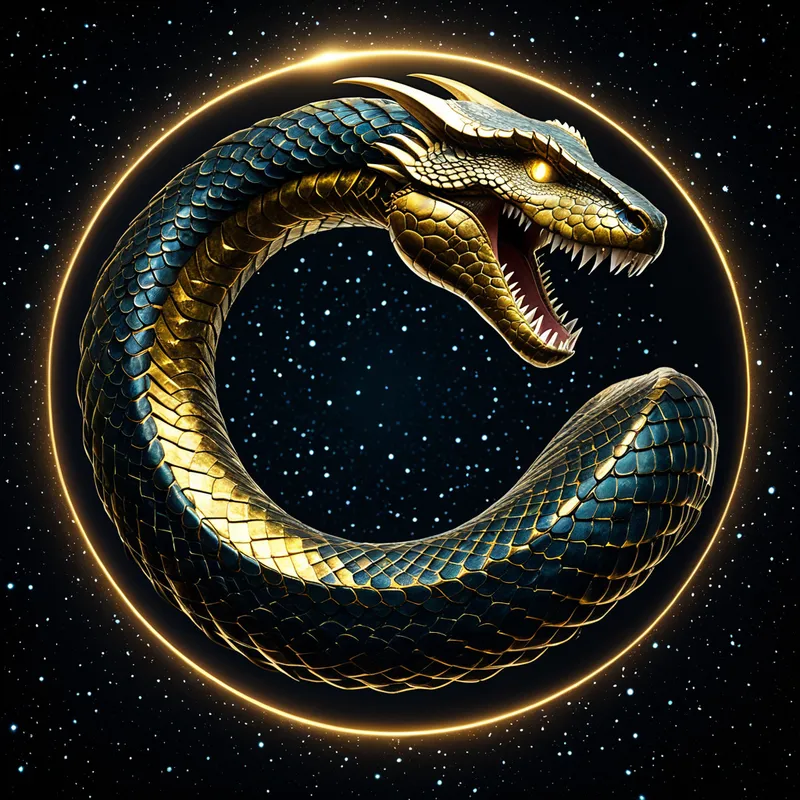
The Ouroboros Myth Meaning & Symbolism
The ancient symbol of a serpent devouring its own tail, representing the cyclical nature of existence, self-reflexivity, and the alchemical goal of psychic wholeness.
The Tale of The Ouroboros
Listen. In the silence before the first word, in the stillness at the heart of the furnace, there is a circle. It is not drawn, but lived. It is the [Ouroboros](/myths/ouroboros “Myth from Global/Universal culture.”/).
It does not begin, for its beginning is its end. It does not end, for its end is its beginning. See it now, not as a picture, but as a presence. In [the alembic](/myths/the-alembic “Myth from Alchemical culture.”/) of the cosmos, coiled within the prime matter of the soul, it stirs. Its scales are the night sky and the gleam of molten gold. Its body is [the river](/myths/the-river “Myth from Buddhist culture.”/) that flows back into its own source, the path that turns upon itself to become both traveler and destination.
There is no conflict of tooth and claw with another, only the profound, silent drama of self-encounter. The serpent, ancient and complete, turns its gaze inward. Its world is its own circumference. What does it seek? Not prey, but the source of its own being. With a motion that is both sacrifice and sustenance, it opens its maw. Not in rage, but in a gesture of ultimate turning. It does not strike; it accepts. It takes its own tail into its mouth.
Feel the moment—the closing of the circle. The sensation is not of consumption, but of completion. A shock of recognition travels the infinite loop of its spine. The eater is the eaten. The destroyer is the nourisher. The action is perpetual, a silent, spinning wheel at the axis of all things. It is the breath held and released in the same instant, the seed containing the tree that will bear the seed. It rests in perfect motion, a mystery wrapped in the simplest of forms: the circle, the cycle, [the self](/myths/the-self “Myth from Jungian culture.”/).
This is its only tale. It does not conquer lands or woo gods. Its epic is the revolution of its own form. Its kingdom is the boundary of its skin, which is also the boundary of [the world](/myths/the-world “Myth from Tarot culture.”/). It is the myth that is not told, but shown: the image that swallows all stories and gives birth to them again, forever.
Cultural Origins & Context
The Ouroboros is a migrant symbol of immense antiquity, but it found a profound and systematic home in the esoteric tradition of Western Alchemy. Its earliest known appearances are in ancient Egyptian and Gnostic iconography, but it was the alchemists of the medieval and Renaissance periods who adopted it as their quintessential emblem.
It was not a myth told in taverns or recorded in epic poetry. It was a secret language, passed hand to hand in illuminated manuscripts like the Chrysopoeia of Cleopatra. It was etched into laboratory vessels and whispered about in the cloisters of monasteries. The tellers of this “myth” were not bards, but practitioners—the alchemists themselves. For them, it was not mere folklore; it was a functional diagram of reality.
Its societal function was hermetic—sealed. It served as a compact thesis for initiates, a visual axiom that conveyed the core principles of the [Magnum Opus](/myths/magnum-opus “Myth from Alchemical culture.”/). In a culture ostensibly dominated by linear Christian teleology, the Ouroboros preserved a pagan, cyclical, and deeply psychological understanding of nature and the self. It was the signature of a hidden process, asserting that transformation was not a linear march to a distant heaven, but an endless, refining cycle of death and rebirth contained within a single, self-sufficient system.
Symbolic Architecture
The [symbol](/symbols/symbol “Symbol: A symbol can represent an idea, concept, or belief, serving as a powerful tool for communication and understanding.”/) is an entire cosmology in a single line. Its primary meaning is the union of opposites: creation and destruction, beginning and end, active and passive, are fused in one continuous act. The [serpent](/symbols/serpent “Symbol: A powerful symbol of transformation, wisdom, and primal energy, often representing hidden knowledge, healing, or temptation.”/), often depicted as half-light and half-dark, embodies this [synthesis](/symbols/synthesis “Symbol: The process of combining separate elements into a unified whole, representing integration, resolution, and the completion of a personal journey.”/).
The Ouroboros whispers the first and last law: “The All is One.” In devouring itself, it becomes the vessel that contains itself. There is nothing outside the process.
Psychologically, it represents the self-sustaining [nature](/symbols/nature “Symbol: Nature symbolizes growth, connectivity, and the primal forces of existence.”/) of the [psyche](/myths/psyche “Myth from Greek culture.”/) and the process of individuation. The “[tail](/symbols/tail “Symbol: A tail in dreams can symbolize instincts, connection to one’s roots, or the hidden aspects of personality.”/)” is the unconscious, instinctual origins of the self. The “head” is the conscious, devouring intellect seeking understanding. The act of consumption is [the ego](/myths/the-ego “Myth from Jungian culture.”/)‘s attempt to integrate and understand its own [depths](/symbols/depths “Symbol: Represents the subconscious, hidden emotions, or foundational aspects of the self, often linked to primal fears or profound truths.”/). The result is not annihilation, but a state of autonomous, self-nourishing wholeness. It is the [archetype](/symbols/archetype “Symbol: A universal, primordial pattern or prototype in the collective unconscious that shapes human experience, behavior, and creative expression.”/) of self-reflexivity—the mind thinking about itself, the [soul](/symbols/soul “Symbol: The soul represents the essence of a person, encompassing their spirit, identity, and connection to the universe.”/) seeking its own [source](/symbols/source “Symbol: The origin point of something, often representing beginnings, nourishment, or the fundamental cause behind phenomena.”/).
It also symbolizes eternal return and the cyclical nature of all processes: the seasons, the orbits of planets, the inhalation and exhalation of [life](/symbols/life “Symbol: The symbol of ‘Life’ represents a journey of growth, interconnectedness, and existential meaning, encompassing both the joys and challenges that define human experience.”/), and the alchemical stages of [nigredo](/myths/nigredo “Myth from Alchemical culture.”/), [albedo](/symbols/albedo “Symbol: In alchemy, the whitening stage representing purification, spiritual ascension, and the emergence of consciousness from darkness.”/), and [rubedo](/myths/rubedo “Myth from Alchemical culture.”/), which repeat at higher levels of refinement.

The Dreamer’s Resonance
When the Ouroboros appears in a modern dream, it rarely manifests as a literal serpent. Its presence is felt in the pattern of the dream narrative and the dreamer’s somatic experience.
The dreamer may find themselves in a loop—revisiting the same room, having the same conversation, or running down a corridor that bends back to its start. This is not mere repetition, but a sign of a psychic process attempting to complete itself. Somatically, the dreamer might feel a swirling sensation in the gut or chest, a literal “churning” of emotions or ideas that feeds back into itself. They may dream of mirrors reflecting mirrors, of meeting a double who is both self and other, or of a ring, wheel, or [mandala](/myths/mandala “Myth from Buddhist culture.”/) that feels intensely significant and self-contained.
This dream resonance indicates that the psyche is engaged in a profound act of self-metabolism. An old pattern, wound, or complex is being re-consumed by awareness to be digested and transformed into energy for growth. The dream is the symbolic furnace where this recycling occurs. The feeling upon waking may be one of eerie peace, claustrophobic entrapment, or awe at a self-evident truth—all reflections of the Ouroboric process of turning inwards to process the contents of one’s own being.
Alchemical Translation
For the modern individual, the myth of the Ouroboros models the most intimate alchemy: the transmutation of the personality through self-confrontation and integration. The “base lead” of our fragmented, contradictory selves is the serpent’s disparate body. The “philosopher’s gold” of wholeness is the perfect, autonomous circle.
The process begins with the circumambulatio—the conscious decision to walk the circle of the self. This means facing one’s own “tail”: the repressed memories, shadow aspects, and instinctual drives we would rather ignore. The “devouring” is the act of bringing this material into the light of consciousness, not to destroy it, but to acknowledge it as part of the whole self.
The goal is not to escape the cycle, but to become the cycle—to consciously participate in the endless work of self-creation and self-renewal.
This is the core of psychic transmutation. We break down (the nigredo of confronting [the shadow](/myths/the-shadow “Myth from Jungian culture.”/)) in order to purify (the albedo of insight) and recombine (the rubedo of a renewed attitude). But the work is never finally “done.” Like the Ouroboros, we continually encounter new layers of ourselves to integrate. The [triumph](/myths/triumph “Myth from Roman culture.”/) is not in reaching a static state of perfection, but in achieving the [opus circulatorium](/myths/opus-circulatorium “Myth from Alchemical culture.”/)—the circular work—whereby we gain the resilience and wisdom to sustain our own growth. We become both [the vessel](/myths/the-vessel “Myth from Alchemical culture.”/) and the elixir, the process and the product, forever engaged in the sacred act of self-completion.
Associated Symbols
Explore related symbols from the CaleaDream lexicon: