The Otherworld Feast Myth Meaning & Symbolism
A hero is invited to a feast in the Otherworld, breaks a sacred taboo, and must undertake a perilous journey to restore cosmic balance.
The Tale of The Otherworld Feast
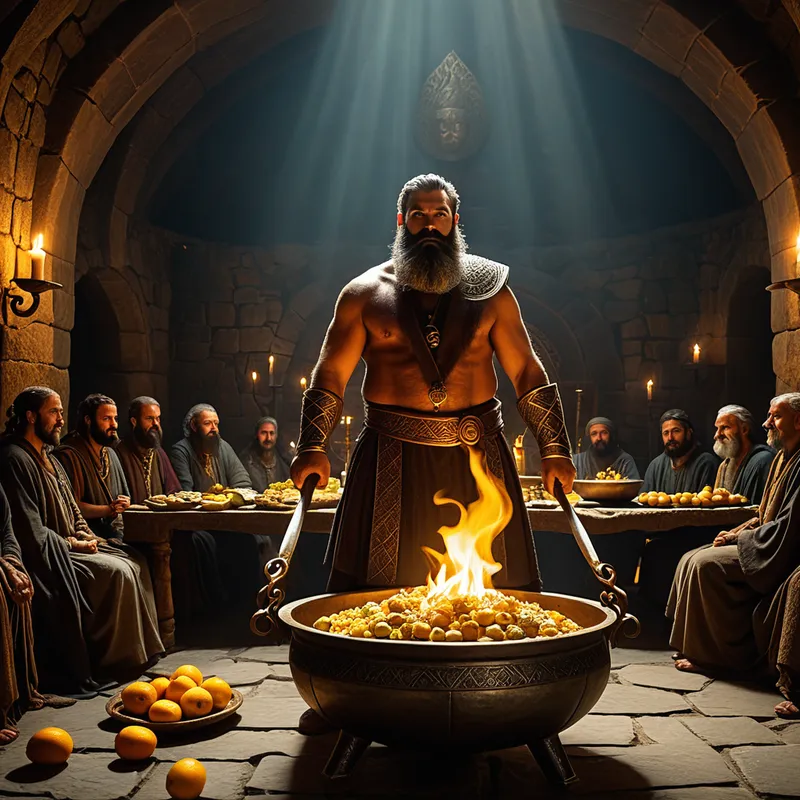
Listen now, and let the fire’s crackle become the rustle of oak leaves in a forgotten time. The air grows thick, not with mist, but with the scent of roasting boar and mead sweet enough to steal a man’s years. This is not a tale of our sunlit world, but of [the world](/myths/the-world “Myth from Tarot culture.”/) that presses against it, the [sidhe](/myths/sidhe “Myth from Celtic culture.”/), where time flows like honey and a feast can last a lifetime or a single breath.
A hero, let us call him Conn, weary from the hunt, stumbles upon a clearing where the twilight does not deepen but glows with its own silver light. From the side of a great green hill, a door of ancient oak stands open, and from within pours laughter and the melody of a harp that plucks at the very strings of the heart. A figure emerges—taller than any man, clad in robes the colour of sunset. It is [The Dagda](/myths/the-dagda “Myth from Celtic culture.”/) himself, his eyes holding the patience of mountains. “Welcome, son of mortality,” his voice rumbles like distant thunder. “You have found the Feast of [Manannán mac Lir](/myths/manannn-mac-lir “Myth from Celtic culture.”/). Enter, and be our guest. Eat, drink, and know joy. But heed this: do not, by word or deed, refuse the hospitality offered. To do so is to break the bond between our worlds.”
Conn steps across [the threshold](/myths/the-threshold “Myth from Folklore culture.”/), and his breath catches. The hall is vast, its roof held aloft by pillars of living crystal. The Tuatha Dé Danann are gathered, their beauty fierce and terrible. He is seated at a table of polished yew, and before him is placed food that sings with flavour and drink that illuminates the soul. For what feels like an age, he basks in this perfection. Yet, as a platter of shimmering, translucent fish is passed, a memory surfaces—a vow made to a dying kinsman never to eat the food of [the sea](/myths/the-sea “Myth from Greek culture.”/). His mortal oath clashes with the divine law of the feast.
Trembling, Conn pushes the platter away. “I cannot,” he whispers.
The music dies. The laughter turns to stone. The warmth of the hall drains away, replaced by a cold that seeps into the bone. The Dagda’s kindly face hardens. “You have refused the feast,” he intones, and his words are a sentence. “The bond is broken. The waters of life recede from your world. Your land shall wither, your people shall hunger, until the debt is paid.” The glorious hall, the benevolent hosts, they fade like a dream upon waking. Conn finds himself alone, not in the clearing, but in a blighted, grey version of his own kingdom, the first man to ever bring a curse back from [the Otherworld](/myths/the-otherworld “Myth from Celtic culture.”/). His journey is no longer one of wonder, but of desperate atonement.
Cultural Origins & Context
The motif of the [Otherworld](/myths/otherworld “Myth from Celtic culture.”/) Feast is not a single, codified myth, but a pervasive narrative pattern woven through the surviving fragments of Celtic lore, primarily from early Irish and Welsh cycles like the Ulster Cycle and the Mabinogion. These stories were the province of the fili and bards, custodians of history, law, and cosmic truth. They were not mere entertainment; they were a psychic and social technology.
Told in the chieftain’s hall or at seasonal gatherings, these tales served multiple functions. They mapped the invisible geography of the spirit world, defining the fragile, ritualized protocols that governed the relationship between humanity and the powerful, capricious beings of the sidhe. The feast narrative, in particular, reinforced the supreme cultural value of hospitality (feich), which was less a social nicety and more a sacred contract ensuring cosmic and social order. To break the rules of the feast was to threaten that order, necessitating a heroic quest to restore it—a narrative that mirrored the community’s need for individuals to rectify profound transgressions.
Symbolic Architecture
At its [heart](/symbols/heart “Symbol: The heart symbolizes love, emotion, and the core of one’s existence, representing deep connections with others and self.”/), the Otherworld Feast is a masterful depiction of the [psyche](/myths/psyche “Myth from Greek culture.”/)’s encounter with the numinous—the overwhelming, divine [aspect](/symbols/aspect “Symbol: A distinct feature, quality, or perspective of something, often representing a partial view of a larger whole.”/) of the unconscious. The feast hall is [the Self](/myths/the-self “Myth from Jungian culture.”/) in its potential wholeness, a state of blissful [integration](/symbols/integration “Symbol: The process of unifying disparate parts of the self or experience into a cohesive whole, often representing psychological wholeness or resolution of internal conflict.”/) where all inner conflicts are harmonized. The [food](/symbols/food “Symbol: Food in dreams often symbolizes nourishment, both physical and emotional, representing the fulfillment of basic needs as well as deeper desires for connection or growth.”/) and drink are the nourishing, transformative energies of the deep unconscious, offering wisdom, vitality, and [connection](/symbols/connection “Symbol: Connection symbolizes relationships, communication, and bonds among individuals.”/) to the eternal.
The taboo is the price of wholeness: one must surrender a part of one’s old identity to partake of the new.
The taboo—the single, absolute rule—represents the necessary [condition](/symbols/condition “Symbol: Condition reflects the state of being, often focusing on physical, emotional, or situational aspects of life.”/) for engaging with this profound power. It is [the ego](/myths/the-ego “Myth from Jungian culture.”/)’s [boundary](/symbols/boundary “Symbol: A conceptual or physical limit defining separation, protection, or identity between entities, spaces, or states of being.”/) and test. Conn’s mortal vow represents a prior, conscious commitment, an [identity](/symbols/identity “Symbol: Identity represents the sense of self, encompassing personal beliefs, cultural background, and social roles.”/) construct (“I am a man who keeps his oaths”). His refusal is not mere disobedience, but the tragic [collision](/symbols/collision “Symbol: A sudden, forceful impact between objects or forces, often representing conflict, unexpected change, or the meeting of opposing elements in life.”/) of two legitimate yet incompatible loyalties: the loyalty to his personal, [human](/symbols/human “Symbol: The symbol of a human represents individuality, complexity of emotions, and social relationships.”/)-scale morality versus the loyalty to the transpersonal, archetypal law of the Self. The resulting [curse](/symbols/curse “Symbol: A supernatural invocation of harm or misfortune, often representing deep-seated fears, guilt, or perceived external malevolence.”/)—the blighted land—symbolizes the psychic stagnation that occurs when we touch the transformative power of the unconscious but, through fear or rigidity, refuse its terms. The inner [life](/symbols/life “Symbol: The symbol of ‘Life’ represents a journey of growth, interconnectedness, and existential meaning, encompassing both the joys and challenges that define human experience.”/) becomes a wasteland.
The Dreamer’s Resonance
When this mythic pattern stirs in the modern dreamer, it often manifests not as a literal banquet, but as an encounter with overwhelming, awe-inspiring beauty or abundance that comes with a subtle, unspoken condition. You dream of finding a hidden room in your house filled with priceless art, but a voice says you must never speak of it. You are offered a perfect job or relationship, but a sense of dread whispers that accepting it will require you to abandon a core part of your current life.
The somatic experience is key: the initial euphoria of the “feast,” followed by a chilling, gut-wrenching anxiety as the “taboo” is sensed or broken. This is the psyche signaling a critical threshold. The dream is staging a confrontation between the ego’s existing structure and an emergent possibility from the Self that is too large to be assimilated without cost. The “curse” in the dream—the ensuing chaos, pursuit, or decay—is the painful but necessary deconstruction of the old attitude, making space for the quest that must follow. It is the soul’s way of initiating a process it knows the conscious mind would otherwise avoid.

Alchemical Translation
The myth models the alchemical [nigredo](/myths/nigredo “Myth from Alchemical culture.”/), the blackening, and the subsequent journey of individuation. Conn’s initial acceptance into the feast is the inflation—the tantalizing, premature taste of wholeness before the ego is prepared. The breaking of the taboo is the inevitable, humbling catastrophe that shatters this inflation.
His expulsion into the blighted land is the nigredo: [the dark night of the soul](/myths/the-dark-night-of-the-soul “Myth from Christian Mysticism culture.”/), where all previous certainties fail, and one is confronted with [the shadow](/myths/the-shadow “Myth from Jungian culture.”/) of one’s own actions. The quest to lift the curse is the long, arduous work of albedo and [rubedo](/myths/rubedo “Myth from Alchemical culture.”/). He must not simply apologize; he must undertake perilous journeys, gather allies, face guardians, and ultimately offer a sacrifice that truly balances his initial refusal.
The feast is offered to all; the transformation is earned only by those who consent to be unmade by its terms.
For the modern individual, this translates to those pivotal life moments when a profound opportunity for growth—a calling, a relationship, a creative awakening—presents itself, but its acceptance demands the death of a cherished self-image, a comfortable wound, or a long-held grievance. The “Otherworld” is the territory of the authentic Self. We are all invited to its feast. The myth warns us that to approach it while clutching the talismans of our smaller story is to invite a creative crisis. Yet, it also promises that within the resulting wasteland lies the only path to a restored, and now truly earned, sovereignty.
Associated Symbols
Explore related symbols from the CaleaDream lexicon: