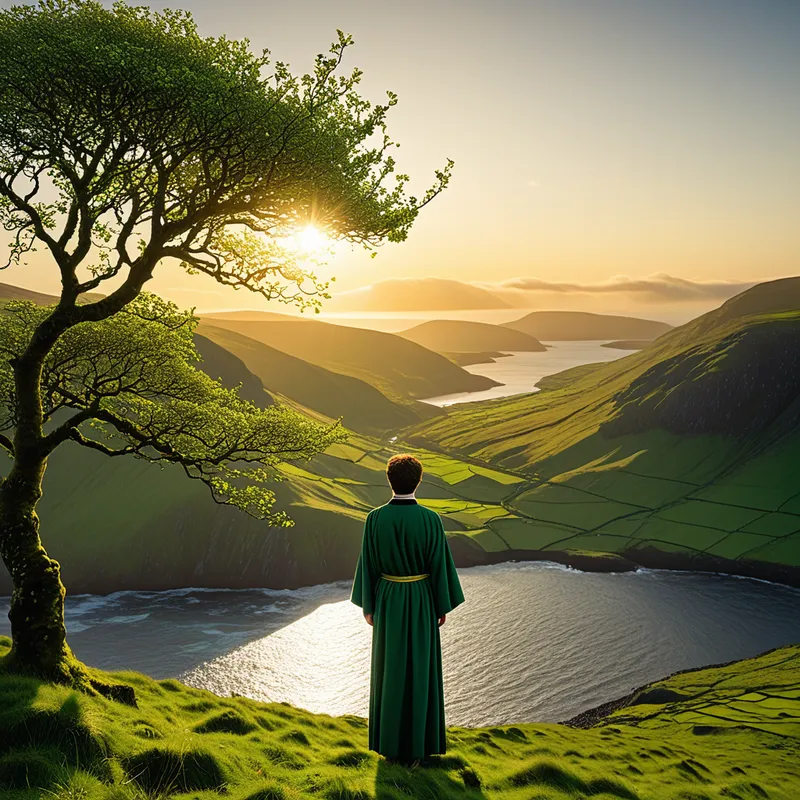
The Otherworld Myth Meaning & Symbolism
A journey to a timeless, paradisiacal realm beyond the sea or under the hills, where heroes seek wisdom, love, or healing, and return forever changed.
The Tale of The Otherworld
Listen now, and let the hearth-fire grow dim. Let the world of plough and market fade. We speak of the places that are always just over your shoulder, at the edge of your sight, where the veil is thin as morning mist. We speak of the Sídhe.
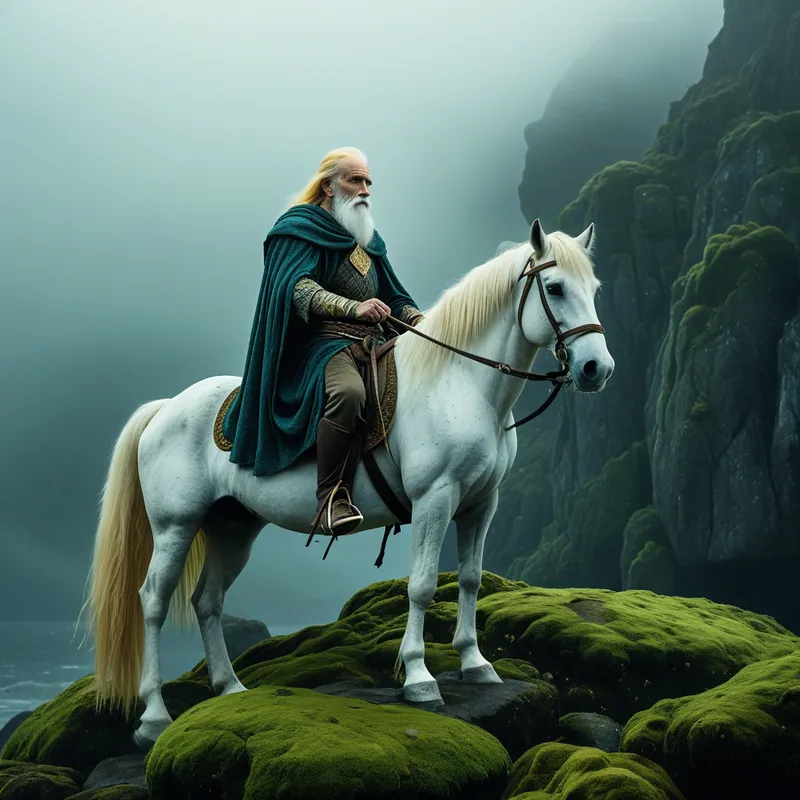
It begins not with a beginning, for it has always been. It begins with a call. A sound on the wind that is not the wind—a melody from a harp that makes the heart ache for a home it has never known. It is the sound that reached the ears of the mighty Oisín, as he hunted with the Fianna. Through the forest she came, a woman riding a horse whiter than snow, with a mane like frothing sea-foam. Her hair was the color of ripe wheat under the sun, and her eyes held the depth of twilight lakes. She was Niamh of the Golden Hair, and she had crossed the sea of glass from Tír na nÓg to find him.
“Come with me, Oisín,” she said, her voice the chime of distant bells. “To a land where time is but a story, where sorrow is unknown, where the trees bear fruit year-round and the very air is mead. Come and be my king.” And Oisín, whose heart was brave but weary of mortal strife, looked into her eyes and saw an end to all longing. He mounted behind her, and the white horse turned, not back along the path, but towards the western sea. The waves did not part; they became like solid, shimmering crystal, and the horse’s hooves rang upon it as on a road of silver. The world of men dissolved into a pearlescent haze.
They arrived in a land where the sun never fully set, casting a perpetual golden hour. The grass was emerald velvet, the flowers sang softly, and feasts appeared without being served. For what felt like three weeks, Oisín lived in joy with Niamh, hunting strange, gentle beasts, feasting, and listening to music that wove itself into the soul. But a thorn of memory pricked him: his father, Fionn, and his comrades. A homesickness, deep and old, took root.
Niamh, with sorrow in her eyes, gave him her white steed to return for a visit. “But you must not let your feet touch the soil of the mortal world,” she warned. “If you do, the years you did not live here will find you in an instant.” Oisín promised. He rode back across the sea of glass, but the Ireland he found was strange. The forts were smaller, the people seemed frail. He asked for Fionn mac Cumhaill, and they stared as if he spoke of a giant from the dawn of time. While trying to help some men move a great stone, his girth strap broke. He tumbled from the saddle. The moment his body struck the earth, the centuries descended. The handsome warrior withered in seconds, his skin parchment, his muscles dust, his hair a white cloud. The white horse screamed and vanished. Oisín, now a blind, ancient man, was left alone on a roadside, the taste of apple-wine from Tír na nÓg still a ghost on his tongue, the touch of Niamh’s hand a fading dream in his bones.
Cultural Origins & Context
The myth of the Otherworld is not a single story but a foundational pattern woven through the tapestry of Celtic cultures, from Ireland and Scotland to Wales and Brittany. These narratives were the lifeblood of an oral tradition, preserved and performed by the fili and bards. They were not mere entertainment; they were maps of cosmology, morality, and the soul’s potential.
The Otherworld—known as Tír na mBeo, Annwn in Wales, or Avalon in later Arthurian lore—existed in a parallel dimension. It was accessible through specific liminal points: ancient burial mounds (sídhe), mist-shrouded lakes, deep forests, or most commonly, far across the western sea. This reflects the Celtic worldview, where the spiritual was interleaved with the physical, not separate from it. The stories served to explain the unknown—the origins of sovereignty, the nature of death, the source of artistic inspiration, and the perils of breaking geasa. They reinforced cultural values: hospitality, bravery, loyalty, and the tragic, beautiful tension between human longing and divine law.
Symbolic Architecture
The Otherworld is the ultimate symbol of the unconscious psyche in its totality—not just the personal shadow, but the collective, timeless realm of archetypes, potential, and primordial memory. It is the Self in its unmanifest state.
The journey to the Otherworld is not a voyage to a different place, but a descent into a deeper layer of one’s own being. The paradise offered is the bliss of psychic wholeness, before the ego’s burdens of time, responsibility, and separation.
The white horse and the sea of glass represent the vehicle of consciousness and the threshold of the unconscious mind. Niamh is the anima, the soul-guide who invites the ego (Oisín) into a relationship with the depths. Tír na nÓg itself symbolizes the state of psychic integration—a place where opposites (joy/sorrow, life/death) are harmonized. The prohibition against touching the earth is the critical condition for navigating the unconscious: one cannot integrate its contents by fully “grounding” them in ego-reality all at once. It is a process of careful translation. Oisín’s fatal dismount is the catastrophic collapse of the ego overwhelmed by the raw, unmediated power of time (the repressed life) when it attempts to force a permanent reunion or to act from the unconscious in the conscious world without the necessary vessel.
The Dreamer’s Resonance
When this myth pattern stirs in modern dreams, it signals a powerful encounter with the numinous contents of the personal and collective unconscious. The dreamer may find themselves in inexplicably beautiful, serene landscapes that feel more “real” than waking life—a classic signature of the Self. Alternatively, they may dream of encountering a mesmerizing, otherworldly figure who offers a gift, a secret, or an invitation.
The somatic experience is key: a profound feeling of “homecoming” mixed with awe, or a chilling, magnetic dread. This is the psyche’s reaction to approaching its own core. Dreams of losing the way back, or of a beloved guide vanishing at a crucial moment, mirror Oisín’s dilemma. They speak to the ego’s terror of being subsumed by the unconscious, of losing its identity in the quest for wholeness. The dream is not a prescription to abandon one’s life, but an indicator that a deep, transformative process is underway—a call to build a stronger vessel (the conscious personality) that can withstand the beauty and the terror of the depths without shattering.
Alchemical Translation
The alchemical process mirrored in the Otherworld journey is that of solutio (dissolution) and coagulatio (re-solidification). Oisín’s initial journey is the solutio: the ego’s structures dissolve in the waters of the unconscious (the sea of glass). He experiences the unio mentalis, a psychic marriage with the anima in the golden realm of potential. But alchemy does not end in dissolution. The work is incomplete without the return.
The true alchemical gold is not found by staying in the paradise of the unconscious, but in the courage to return, transformed, to the mortal world—even knowing it will mean suffering and death to the old self.
Oisín’s tragic return is a failed coagulatio. He attempts to bring the unconscious treasure (his love, his experience) back to the conscious world, but his vessel—his old identity and his literal physical form—cannot contain it. The alchemical lesson for the modern individual is the necessity of building the vas, the vessel. This is the disciplined, conscious personality that can engage with the depths, receive their inspiration and healing (the apples of immortality), and then consciously integrate that energy into a life of meaning in time-bound reality. The goal is not to become an eternal youth in a hidden realm, but to let the timeless wisdom of the Otherworld slowly transform one’s mortal life. It is to become, like the true fili, a bridge between the worlds, carrying the haunting melody of the Sídhe within, while keeping your feet firmly, and wisely, on the ground.
Associated Symbols
Explore related symbols from the CaleaDream lexicon: