The Origin of the Piranha Myth Meaning & Symbolism
A myth of a betrayed creator god whose spilled blood transforms into the piranha, fierce guardians of the river's sacred balance.
The Tale of The Origin of the Piranha
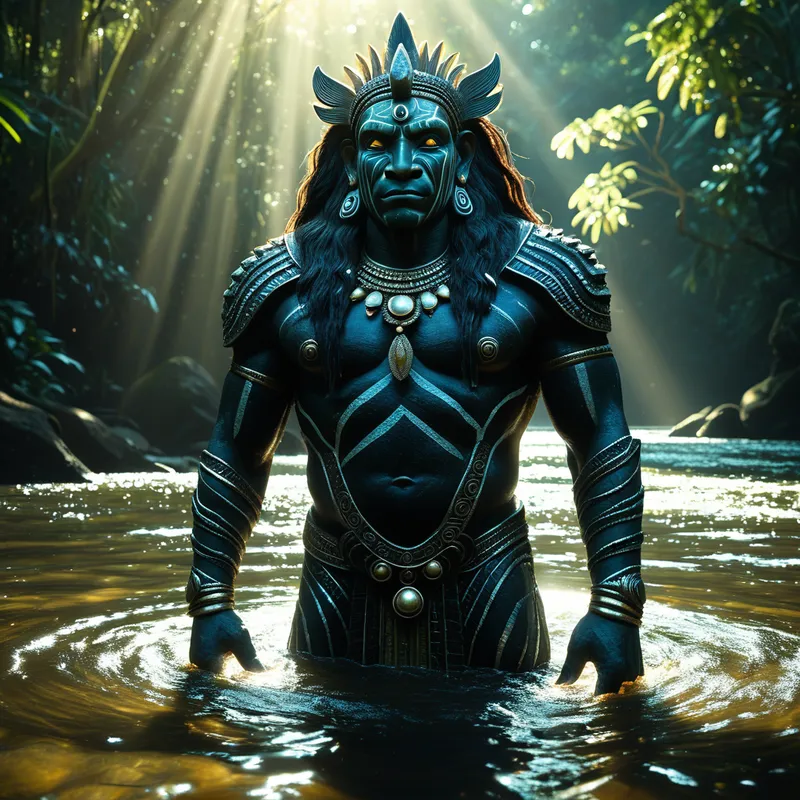
Listen. Before the world was as it is, when the river was young and the forest breathed with a single, green lung, there was a being. He was not a man, but the spirit of the river’s generosity. His name is lost to the currents now, but the elders say his skin was the color of wet clay at dusk, and his hair flowed like the black water of the flooded forest. He was the one who taught the first people to fish—not with spears of violence, but with woven baskets of respect, with songs that asked permission of the fish-people to share their flesh.
He walked the riverbed, and where his feet touched, fat pacu and gentle tambaqui would rise, offering themselves. The people ate, and were grateful. The river god was content, for his purpose was fulfilled: life sustained life in a sacred exchange.
But in the deep shadows of the igarapé, where light fell in shattered pieces, another watched. This was the spirit of the dry season, a being of hunger and brittle earth. He saw the people’s contentment and burned with a jealous fire. “Why should they have such plenty without struggle?” he hissed to the still air. “Why should the river give so freely? Let them know lack. Let them know the bite of need.”
One day, as the river god bent to bless a shoal, his heart open and unguarded, the spirit of drought took a thorn from a pupunha palm—a thorn hardened by relentless sun. With a whisper of malice, he drove it deep into the river god’s side.
There was no cry of pain, but a profound silence. The river god looked down, not at his assailant, but at the wound. From it welled not blood as humans know it, but a liquid, shimmering essence—the very substance of his life-giving power. It fell, drop by heavy, golden drop, into the waiting river.
Where each drop struck the water, it did not dissolve. It convulsed. The golden light shattered into a thousand silver fragments. These fragments twisted, grew tails, and sprouted rows of teeth like tiny, sharpened flints. Their eyes were black, empty of the god’s kindness, holding only a single, relentless purpose. They were the piranha.
The river god, growing pale, spoke his last decree to the swarming, silver cloud his blood had become. “You are my children, born of betrayal. You are my wrath, and you are my guardians. You will remind all who enter these waters: take only what you need, with reverence and skill. For the river gives, but it also judges. It sustains, but it can reclaim. You are the teeth of the balance.”
With that, his form dissolved into the current, becoming the river’s gentle, deep flow. And the piranha, his final, fierce gift, spread throughout the waters, a living testament to the truth that life and death, generosity and ferocity, are two currents in the same sacred stream.

Cultural Origins & Context
This myth originates from the oral traditions of various Indigenous peoples of the Amazon basin, including the Tupi-Guarani and other cultural groups. It was not a story for children’s amusement, but a foundational narrative told by shamans and elders during rites of passage or before communal fishing expeditions. Its telling was a ritual act, aligning the community with the ecological and spiritual laws of their world.
The storyteller, often a pajé, would recite it by firelight, the river’s murmur a constant backdrop. Its function was profoundly pedagogical and regulatory. It explained the existence of a feared predator, not as a random evil, but as a necessary, sacred component of the ecosystem, born from a divine wound. It encoded the ethics of sustainable hunting: take only what you need, do so with skill to avoid attracting the “teeth of the balance,” and always maintain reverence. The piranha became the embodiment of a natural law—the consequence of excess, greed, and broken reciprocity.
Symbolic Architecture
At its heart, this is a myth of profound alchemy: the transmutation of a wound into a guardian, of spilled life into a new form of life-enforcing law.
The sacred is not only what nourishes; it is also what delimits. The boundary between life and death is the sharpest tooth of all.
The river god represents the Primordial Nurturer, the archetype of endless, easy bounty. His betrayal by the spirit of drought signifies the inevitable intrusion of lack, envy, and the reality of limitation into the paradise of pure giving. The wound is the end of innocence, the piercing of the illusion that resources—be they material, emotional, or spiritual—are infinite.
The piranha are the symbolic offspring of this traumatic intersection. They are not mere monsters; they are animated boundaries. They represent the necessary, often fierce, protective mechanisms that arise when our innate generosity is exploited or our wholeness is violated. Psychologically, they symbolize the aggressive defense of the psyche’s integrity—the healthy anger that says “no more,” the instinct that guards personal boundaries once they have been fatally crossed.
The Dreamer’s Resonance
When this myth stirs in the modern dreamscape, it often surfaces during times of perceived exploitation or violated trust. To dream of a peaceful body of water suddenly teeming with piranha is to dream of a relationship, a workplace, or a personal situation where you feel your life-energy (the river god’s blood) is being drained, and your innate generosity is being met with predatory selfishness.
The somatic experience is one of visceral dread and constriction—a feeling of being “swarmed” by tiny, cutting demands or betrayals. The dream is not a prophecy of attack, but a diagnostic image from the deep Self. It signals that an inner “river god” has been wounded. The rising piranha are the psyche’s autonomous response, crafting a fierce, collective defense from the very substance of the injury. The dream asks: Where have you failed to set boundaries? Where has your kindness been met with the thorn of envy or entitlement? The piranha are the nascent, often frightening, formation of the strength required to defend your inner sanctum.

Alchemical Translation
The individuation process modeled here is the transformation of victimhood into empowered guardianship. The initial state is one of undifferentiated, flowing generosity (the river god). The catalyst is a betrayal that causes a fundamental loss of this innocent state (the wound). The critical alchemical operation is not healing the wound in the sense of making it disappear, but transmuting its output.
One does not heal by sealing the wound, but by allowing its essence to be reforged into a sentinel.
The golden blood—the life-force, the libido, the creative energy—is not lost. It is changed in nature. From a passive, giving fluid, it becomes an active, discerning, and formidable force. For the modern individual, this means recognizing that the pain, anger, or resentment born from betrayal or violation carries within it the latent energy for self-protection and the establishment of sacred law within one’s own psyche.
The “piranha” we must welcome are not externalized aggression, but internalized principles of fierce respect. They are the clear, sharp “no” that protects the “yes.” They are the discernment that allows us to be generous without being self-annihilating. To integrate this myth is to stop lamenting the loss of naive trust and to begin honoring the sophisticated, protective intelligence that has arisen in its place. We become, like the river itself, a complex system capable of both nurturing life and enforcing the balance that makes all life possible.
Associated Symbols
Explore related symbols from the CaleaDream lexicon:
- River — The flowing, life-giving substance of the psyche and the world; the domain of the nurturing god and the medium of transformation.
- Blood — The essence of life, spirit, and vitality; here, it is the sacred substance that is betrayed, spilled, and alchemically transformed into a new form of power.
- Fish — The inhabitants of the unconscious; in this myth, they are the direct offspring of divine essence, representing instincts born from a sacred wound.
- Transformation — The core alchemical process of the myth, where one state of being (generosity) is violently changed into another (fierce guardianship).
- Balance — The ultimate purpose of the piranha’s creation; they are not agents of chaos but of ecological and psychic equilibrium.
- Wound — The necessary rupture that ends innocence and initiates the alchemical process; the source from which new, defensive instincts are born.
- God — The archetypal principle of boundless provision and sacred authority, whose violation changes the fundamental rules of engagement with the world.
- Sacrifice — The river god’s ultimate offering of his own form and innocence to establish a law of balance for all future generations.
- Shadow — The spirit of drought represents the denied aspect of lack, envy, and necessary limitation that inevitably challenges the light of pure generosity.
- Guardian — The final identity of the piranha; they are protectors of a sacred order, born from pain to enforce a deeper wisdom.
- Boundary — The psychological function of the piranha; they represent the necessary, sharp delimitation between self and other, giving and draining.
- Rebirth — The myth is not about an ending, but a rebirth of divine principle in a new, more complex and resilient form.