The Origin of Death Bantu Myth Meaning & Symbolism
A foundational Bantu myth where a failed message from the creator god brings mortality to humanity, explaining the origin of death.
The Tale of The Origin of Death Bantu
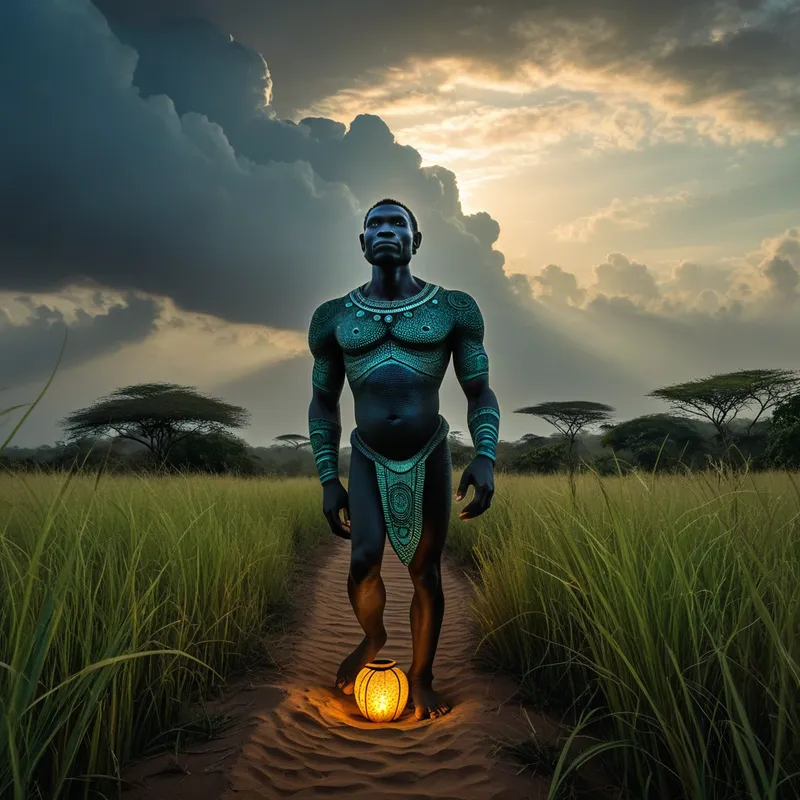
Listen. In the time before time, when the world was soft and new, there was no shadow of parting. Nzambi, who molded the first people from the red clay of the riverbank, breathed into them the warm breath of life and set them in a garden of endless bounty. They knew no sickness, no withering, no final sleep. When their forms grew weary, they would shed them like a serpent sheds its skin, stepping forth renewed, fresh from the source.
But Nzambi, who dwells in the vault of the sky, saw a flaw in this perfect circle. Life without end was a song with no rhythm, a story with no chapter. A deep thought moved in the heart of the creator. A change must be sent. A message.
So Nzambi called two messengers from the multitude of creatures. To the Chameleon, whose skin holds all colors, the god gave a weighty task. “Go down to the children of clay,” Nzambi said, voice like distant thunder. “Tell them this: ‘You shall die, but you shall rise again. Like the moon, you will wax and wane, but your light will return.’” The message was a promise wrapped in a mystery—death as a temporary sleep, a transformation, not an end.
The Chameleon set out. But it is the nature of the chameleon to move with a deliberate, ponderous grace, to watch the world with one eye at a time. It stopped to taste the air, its colors shifting with each new leaf, each sunbeam. The path was long, and the message, a profound secret, seemed to slow its steps even further.
Impatience stirred in the sky. Seeing the delay, Nzambi chose a second messenger: the swift Lizard. To this creature, whose feet patter like rain on dry leaves, the god gave a different word. “Run! Fly to my people and tell them: ‘You shall die, and that will be the end. As a flame goes out, so shall you.’”
The Lizard darted forward, a blur of motion over the red earth. It outpaced the slow, careful chameleon with ease. It reached the village, where the people sat in the eternal afternoon, and delivered its stark, final pronouncement: “You shall die, and that is all.”
The words fell like stones into still water. A great silence followed, then a wail of terror and grief that rose to the very sky. The people felt a coldness enter their bones for the first time. They understood finitude.
Only then did the Chameleon arrive, creeping into the circle of despair. It opened its mouth to deliver the original message of cyclical rebirth. But the people shook their heads, tears on their faces. “It is too late,” they said. “The lizard’s word has already entered our hearts and taken root. We have heard and believed the final word. Your message of return cannot un-hear what we now know.”
And so it was. The first death came, and the body did not rise. It returned to the clay. The chameleon’s message, the promise of resurrection, was forever too late. Death had become a one-way Door, closed and locked by the speed of a hasty word and the slowness of a careful one.

Cultural Origins & Context
This myth, in its many variations, is foundational across numerous Bantu-speaking peoples of Central, Eastern, and Southern Africa. It is not a single, fixed story but a core narrative pattern—a “mythologem”—that explains the most fundamental human condition: mortality. The names change (Nzambi, Nyambe, Leza), and the messengers vary (often chameleon and lizard, but sometimes hare, dog, or frog), but the architecture of the tale remains.
It was not written but breathed, passed down through generations in the oral tradition. Elders would recount it during initiations, funerals, and communal gatherings under the vast African sky. Its function was not merely etiological (explaining why we die) but profoundly pedagogical. It taught about the consequences of failed communication, the cosmic weight of time, and the acceptance of a fate that, while tragic, establishes the sacred rhythm of human life—the rhythm of remembrance, legacy, and the preciousness of a finite existence. It placed humanity in a relational cosmos, where our mortal state results from a specific, albeit flawed, divine interaction.
Symbolic Architecture
At its [heart](/symbols/heart “Symbol: The heart symbolizes love, emotion, and the core of one’s existence, representing deep connections with others and self.”/), this is a myth about the failure of [transmission](/symbols/transmission “Symbol: A symbol of communication, transfer, or passage of energy, information, or influence between entities or states.”/) and the [birth](/symbols/birth “Symbol: Birth symbolizes new beginnings, transformation, and the potential for growth and development.”/) of existential [consciousness](/symbols/consciousness “Symbol: Consciousness represents the state of awareness and perception, encompassing thoughts, feelings, and experiences.”/). The divine intent—a cyclical, alchemical view of [death](/symbols/death “Symbol: Symbolizes transformation, endings, and new beginnings; often associated with fear of the unknown.”/) as [rebirth](/symbols/rebirth “Symbol: A profound transformation where old aspects of self or life die, making way for new beginnings, growth, and renewal.”/)—is corrupted in its [delivery](/symbols/delivery “Symbol: Delivery in dreams often symbolizes the process of bringing something new into your life, such as ideas, changes, or emotions.”/). The two messengers embody a fatal polarity in the psyche.
The chameleon represents the contemplative, integrative function. It holds the holistic truth but is lost in the process of perception, becoming distracted by the multiplicity of life. Its slowness is not laziness, but a deep engagement with the present moment—a moment that costs eternity.
The lizard embodies the reactive, impulsive function. It acts with swift certainty but carries a simplified, absolute, and terrifying truth. It does not understand the message it carries, only the command to deliver it.
The myth suggests that our [mortality](/symbols/mortality “Symbol: The awareness of life’s finitude, often representing transitions, impermanence, or existential reflection in dreams.”/) is not a [punishment](/symbols/punishment “Symbol: A dream symbol representing consequences for actions, often tied to guilt, societal rules, or internal moral conflicts.”/), but a tragic misunderstanding cemented into [reality](/symbols/reality “Symbol: Reality signifies the state of existence and perception, often reflecting one’s understanding of truth and life experiences.”/). The true message—that of transformation—remains in the [cosmos](/symbols/cosmos “Symbol: The entire universe as an ordered, harmonious system, often representing the totality of existence, spiritual connection, and the unknown.”/), but we are bound by the [word](/symbols/word “Symbol: Words in dreams often represent communication, expression, and the power of language in shaping our realities.”/) we first accepted and internalized. This creates the core [human](/symbols/human “Symbol: The symbol of a human represents individuality, complexity of emotions, and social relationships.”/) [tension](/symbols/tension “Symbol: A state of mental or emotional strain, often manifesting physically as tightness, pressure, or unease, signaling unresolved conflict or anticipation.”/): the [intuition](/symbols/intuition “Symbol: The immediate, non-rational understanding of truth or insight, often described as a ‘gut feeling’ or inner knowing that bypasses conscious reasoning.”/) of something more (the [chameleon](/symbols/chameleon “Symbol: Chameleons symbolize personal change, adaptability, and the complexity of identity.”/)‘s promise) locked in struggle with the visceral [reality](/symbols/reality “Symbol: Reality signifies the state of existence and perception, often reflecting one’s understanding of truth and life experiences.”/) of an ending (the [lizard](/symbols/lizard “Symbol: A lizard symbolizes adaptability, survival instincts, and the ability to shed old skin to embrace new beginnings.”/)‘s decree).
The Dreamer’s Resonance
When this myth pattern stirs in the modern Dream, it often manifests as dreams of missed opportunities, fatal delays, or irreversible messages. You dream of rushing to deliver crucial news but finding the door locked, the recipient gone. You dream of moving through glue, watching a vital event unfold without you. Alternatively, you may deliver a message that causes unintended devastation, waking with a gasp of guilt.
Somatically, this can feel like a weight in the chest, a constriction of time, or a profound sense of existential anxiety—the “coldness” the first people felt. Psychologically, you are encountering what James Hillman called the “Fate complex.” The dream is not about a literal message, but about confronting the limits of your own life, the choices that feel irrevocable, or the painful gap between a idealized possibility (endless renewal) and a harsh, accepted reality (finality). It is the psyche working through its relationship with limitation itself.

Alchemical Translation
For the individual, this myth models the crucial psychic shift from seeing death (both literal and metaphorical—the end of phases, relationships, identities) as a purely external, catastrophic decree, to understanding it as an integral part of the soul’s Journey.
The lizard’s hasty word represents the ego’s initial, terrified interpretation of limitation: absolute annihilation. It is the voice of panic that says any ending is a failure. The chameleon’s lost message represents the Self’s deeper knowledge: that endings are transitions, necessary for rebirth.
Individuation requires us to perform the sacred, internal ritual of welcoming the late-arriving chameleon. We must, in our own psychic space, hear the second message. This is the alchemical work: to hold the lizard’s truth (“this will end”) simultaneously with the chameleon’s promise (“this will transform”). We transmute the lead of perceived finality into the gold of meaningful cycle.
We cannot change the fact of mortality, but we can change our relationship to it. By integrating both messages, we move from being passive orphans of a cosmic miscommunication to becoming conscious participants in a sacred drama. We accept the Wound as the very place where meaning—precisely because it is framed by an ending—can shine most brightly. Our life ceases to be an interrupted eternity and becomes a complete, beautiful, and finite story.
Associated Symbols
Explore related symbols from the CaleaDream lexicon:
- Death — The central theme of the myth, transformed from a cyclical return into a permanent ending due to the failed message, representing the fundamental human condition of mortality.
- Chameleon — The slow, deliberate messenger of renewal who becomes distracted, symbolizing the lost potential, contemplative wisdom, and the holistic truth that arrives too late.
- Lizard — The swift messenger of finality, whose hasty delivery cedes the irrevocable word of absolute death into the human heart, representing impulsive action and sealed fate.
- Message — The divine communication that is fatally altered in transit, symbolizing the corruption of pure intent and the gap between cosmic truth and human understanding.
- Door — The threshold between life and death, which in the myth becomes a one-way passage, closed by the first message received, representing irreversible transition.
- God — Nzambi or the sky deity, whose decision to send a message sets the drama in motion, representing the cosmic order and the inscrutable source of fate.
- Fate — The seemingly predetermined outcome established by the order of the messages, symbolizing the human confrontation with a reality that feels decreed and unchangeable.
- Journey — The path the messengers take from the divine realm to humanity, which becomes a race with cosmic consequences, representing the perilous transmission of truth.
- Wound — The psychic and existential injury inflicted upon humanity by the news of permanent death, representing the foundational grief and vulnerability of the human condition.
- Tree — Often the cosmic tree or the tree of life implied in the original garden, representing the lost state of cyclical renewal and connection to the eternal source.
- Origin — The myth is fundamentally an origin story, explaining not the beginning of life, but the beginning of life’s defining limit, exploring the genesis of our existential awareness.
- Shadow — The dark knowledge of mortality that falls across humanity, representing the integrated acceptance of ending as part of the whole self.