The Olympian Gods Myth Meaning & Symbolism
The story of the Olympian Gods is a cosmic drama of order wrested from chaos, a family saga of power, passion, and the eternal negotiation between divine law and human fate.
The Tale of The Olympian Gods
Listen. Before the world was as you know it, there was only a yawning, formless dark—Chaos. From its depths, the first beings stirred: the Earth, Gaia, vast and solid, and the starry sky, Ouranos, who pressed down upon her. Their union birthed the Titans, ancient and terrible, and the one-eyed Cyclopes, and the hundred-handed ones. But Ouranos, fearing their power, imprisoned his monstrous children deep within the Earth, in the pit of Tartarus. Gaia groaned in pain, and from her anguish sprang a plot of revenge.
She fashioned a sickle of adamant and gave it to her youngest Titan son, Cronus. When Ouranos came to lie with Gaia, Cronus emerged from hiding and with one savage stroke, severed sky from earth. The rule of the Titans began. But a prophecy echoed in Cronus’s ears: he too would be overthrown by his own child. So, when his sister-queen Rhea bore their children—Hestia, Demeter, Hera, Hades, Poseidon—he opened his maw and swallowed each whole, imprisoning them in the dark of his belly.
Rhea, heartsick and furious, sought Gaia’s counsel. When her sixth child was born, she wrapped a stone in swaddling clothes and gave it to Cronus, who devoured it without a glance. The true infant, Zeus, was spirited away to a cave on Crete, where the earth itself hid him. He was nursed by the goat Amalthea and his cries were drowned by the frenzied dancing of armored youths, the Curetes.
Zeus grew strong, and when the time was ripe, he returned in disguise to his father’s court. With a potion given by the Titaness Metis, he caused Cronus to disgorge his siblings, whole and full-grown, and then the stone. An alliance was forged. Zeus freed the Cyclopes and the Hundred-Handers from Tartarus. In gratitude, the Cyclopes forged his weapons: the thunderbolt for Zeus, the trident for Poseidon, and the helm of darkness for Hades.
The war that followed—the Titanomachy—shook the cosmos. The Titans hurled mountains; the Olympians unleashed lightning and sea. The Hundred-Handers, with their three hundred hands, pelted the Titans with countless rocks. Finally, they were cast down and imprisoned in Tartarus, guarded by the very monsters they once feared.
But the cosmos was not yet settled. The earth-giant Typhon, sired by Tartarus, rose in a final, cataclysmic rebellion. The very gods fled in terror, transformed into animals. Only Zeus stood firm, his thunderbolts flashing like the end of the world, until he buried Typhon beneath Mount Etna, where his fiery breath still stirs.
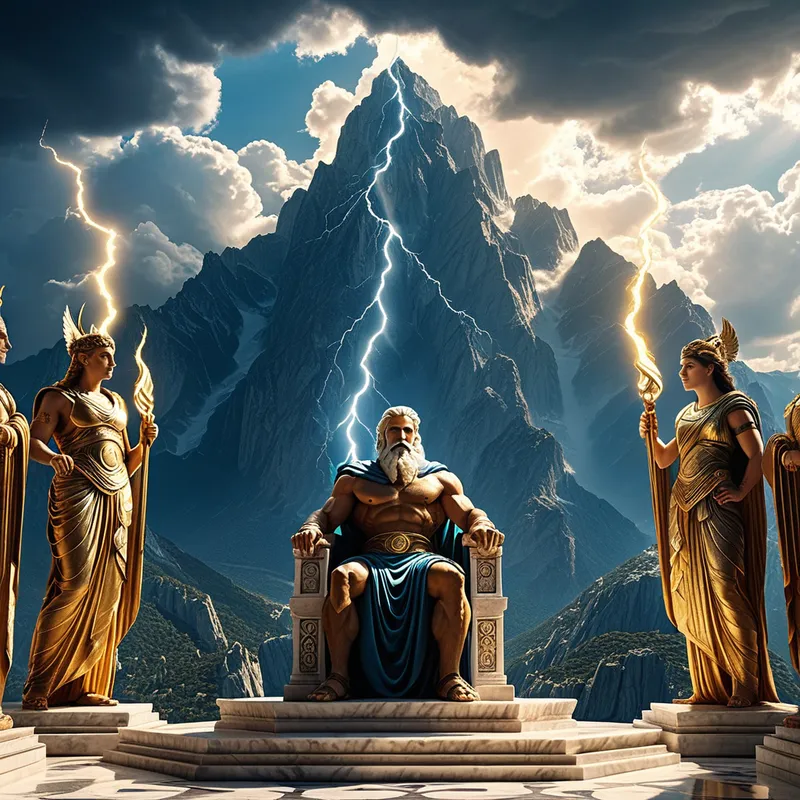
With order secured, the three brothers drew lots for their realms. Zeus won the sky, Poseidon the sea, and Hades the underworld. The earth and Mount Olympus were common to all. There, on the sunlit peak, above the clouds and the strife of mortals, the Olympians established their eternal court—a pantheon of passion, law, art, and wrath, forever presiding over the brilliant, tragic, beautiful drama of existence.
Cultural Origins & Context
This foundational myth was not a single, canonical text, but a living tapestry woven from countless local traditions, epic poetry, and ritual practice across the Greek world. Its primary vessels were the oral bards, like the legendary Homer, and later poets like Hesiod. In his Theogony, Hesiod provided a systematic, though not exclusive, genealogy of the gods, giving structure to the divine chaos.
The myth functioned as a cosmic charter. It explained the origin of the world (cosmogony) and the current world order (cosmology), justifying why Zeus and his pantheon were the rightful sovereigns. It was recited at religious festivals, embedded in civic identity, and served as the ultimate reference point for ethics, politics, and natural phenomena. The struggle from Chaos to Ouranos to Cronus to Zeus mirrored a Greek philosophical ideal: the movement from brute, tyrannical force (Bia) toward a sovereignty based on cunning (Metis), alliance, and the establishment of law (Themis). The pantheon itself reflected a polytheistic worldview where different aspects of life—war, love, wisdom, the harvest—required distinct, and often competing, divine authorities.
Symbolic Architecture
Psychologically, the Olympian saga is the archetypal drama of consciousness establishing itself. It is the psyche’s own evolution from undifferentiated, unconscious potential (Chaos, the primal parents) through a stage of monolithic, devouring authority (Cronus) to a more complex, differentiated, and dynamic governance (the Olympian council).
The victory of Zeus is not the triumph of good over evil, but of a more conscious, complex order over a simpler, more absolute one. It is the establishment of a psyche capable of holding contradiction.
Cronus represents the tyranny of the past, the old order that consumes its own future to maintain control. His act of swallowing his children symbolizes how unexamined patterns, traumas, or parental complexes can literally “eat” our potential, imprisoning our nascent capacities (the infant gods) in the darkness of the unconscious. Zeus’s rebellion is the necessary, violent act of differentiation—the ego’s emergence that says, “I am not you.” His weapons, forged by the once-imprisoned Cyclopes, signify that the tools for liberation often come from integrating the very aspects of ourselves we or our “family systems” have deemed monstrous or unfit.
The resulting Olympian pantheon is a map of a mature, if conflicted, psyche. It is no longer a monolithic unit but a society of archetypes: Zeus (authority, consciousness), Hera (commitment, resentment), Athena (strategic wisdom), Apollo (rational light and order), Artemis (instinctual wildness), Ares (raw aggression), Aphrodite (desire and connection), Hephaestus (creative ingenuity from wounding), Hermes (communication and trickery). Their endless squabbles and alliances model the internal negotiations of a full human life.
The Dreamer’s Resonance
When this mythic pattern stirs in modern dreams, it often signals a profound restructuring of the inner hierarchy. Dreaming of a devouring, Saturnine figure may point to a crushing life structure—a job, a relationship, an internal critic—that is consuming one’s vitality. The dream-ego may feel trapped in a dark, enclosed space, symbolizing the “belly of Cronus.”
Dreams of epic battles between towering forces, or of being given a powerful, elemental tool (a lightning bolt, a trident), can indicate the psyche mobilizing for a necessary revolution. The emergence of a guiding, protective animal (like Amalthea the goat) or supportive, noisy defenders (the Curetes) symbolizes instinctual and resilient parts of the self rising to protect nascent consciousness.
A dream of arriving at a luminous, elevated place with a council of distinct, powerful figures suggests the consolidation of a new inner order. The dreamer is not becoming a single “ruler,” but is learning to host a diverse, often quarrelsome, but ultimately cooperative pantheon of their own capacities, having moved from being a subject of a tyrant to the curator of a republic of the soul.

Alchemical Translation
The alchemical journey mirrored in this myth is the separatio followed by a new coniunctio. The first stage is the necessary, often painful, separation from the primal unity—the cutting of Ouranos from Gaia, the escape from Cronus. This is the individuation impulse, breaking free from the unconscious identification with family, tribe, or outdated self-image.
The stone Cronus swallowed and disgorged is the Lapis Inutilis, the rejected thing that becomes the cornerstone. Our rejected, hardened experiences become the foundation of our sovereignty.
The war and the drawing of lots represent the conscious ordering of the psychic realms. The modern individual undergoes this when they stop seeing their emotions (Poseidon’s realm), their dark or depressive thoughts (Hades’s realm), and their aspirations and authority (Zeus’s realm) as a chaotic mess, and instead begin to “assign” them their proper domain, acknowledging their power and jurisdiction. This is not repression, but conscious administration.
The final, ongoing stage is life on Olympus. This is the opus of holding the tension of the opposites within one’s own council. It is the ability to let Athena’s wisdom counsel Ares’s rage, to allow Aphrodite’s allure to temper Hera’s rigidity, to use Hermes’s trickery to serve Hephaestus’s craftsmanship. The individual becomes the vessel where the divine drama plays out consciously, no longer a victim of capricious fate, but a participant in the eternal negotiation between order and passion, law and desire, that defines a soul in full, radiant, and conflicted bloom.
Associated Symbols
Explore related symbols from the CaleaDream lexicon: