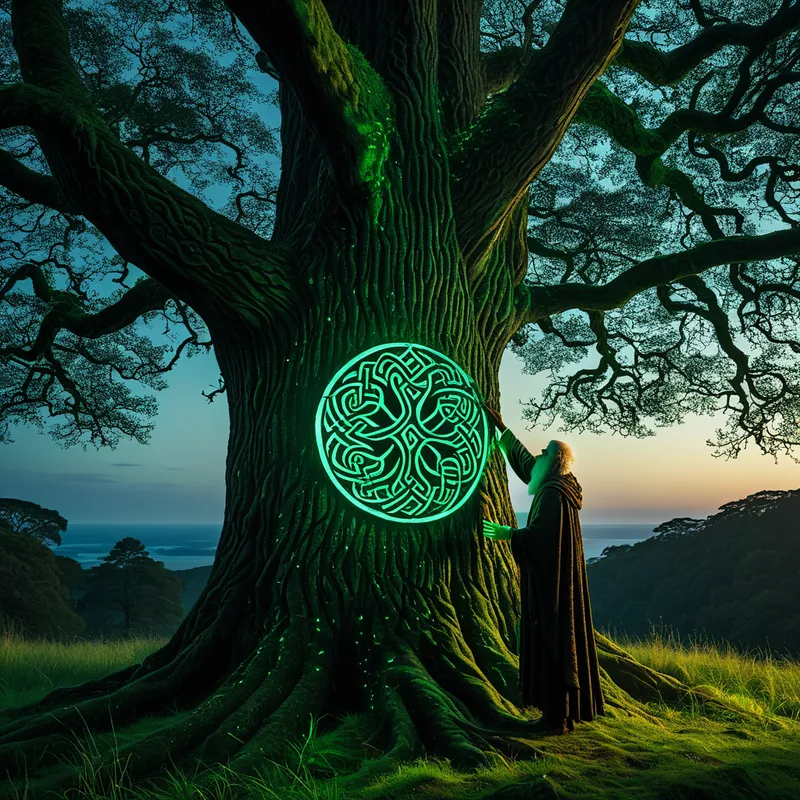
The Ogham Tree Alphabet Myth Meaning & Symbolism
The myth of the god Ogma, who carved the first Ogham letters on birch, beech, and oak, creating a sacred alphabet from the whispers of the trees.
The Tale of The Ogham Tree Alphabet
Listen. The world was younger then, and the green cloak of the forest was the only scripture. The gods walked where the shadows were deep and the light fell in dappled pools. Among them was Ogma Sun-Face, whose words could bind a man with joy or strike him dead with grief. Yet, for all his silver-tongued craft, he felt a hollow yearning. The songs of the bards were beautiful, but they faded on the wind. The laws of the kings were strong, but they crumbled like old leaves. There was no mark, no sign, to hold a thought as an oak holds an acorn.
This longing drew him into the heart of the Fid Nemid, the sacred grove where the trees spoke in the rustle of leaves and the groan of boughs. He walked for nine days and nine nights, his ears straining not for bird-song, but for the groan of roots in the dark earth, the whisper of sap rising. He came to a clearing where three trees stood as sentinels: the slender, pale Beith (Birch), the wise, broad Luis (Rowan), and the mighty, sovereign Duir (Oak).
Here, Ogma knelt. He pressed his palm, the hand that had wielded mighty swords, against the cool skin of the birch. A shiver passed through the wood into his bones. He heard it—not with his ears, but in his blood. It was a sound of pure beginning, a white flash of potential. From his belt, he took his dagger. Not to harm, but to listen. He let the blade, an extension of his will, trace the sound he felt. A single, straight line, scored vertically along a central stem. The first fid, the first wood-letter, was born: ᚁ, Beith.
Emboldened, he turned to the rowan. Its whisper was different—a humming, protective chant, a lattice of red berries and fierce magic. His dagger moved, adding a diagonal stroke to the stem. ᚂ, Luis, was carved, a sigil of warding and sight. Finally, he faced the oak. Its voice was not a whisper but a deep, resonant boom, the sound of kingship and enduring truth. The cut for the oak was strong, a horizontal stroke across the stem. ᚇ, Duir, the doorway.
And so it continued. For each tree of the grove, he listened. The fiery quickness of the alder, the sweet sorrow of the willow, the sharp justice of the hawthorn—each revealed its essence, its sound, its shape. He carved them not on parchment, but on the living wood itself, on wands of hazel and staves of yew. The forest gave him its alphabet. The vertical stem was the world-tree, the spine of reality. The marks upon it were the unique songs of its children. When he was done, twenty feda stood as a company. He had not invented a language; he had translated the soul of the green world into a form the mind of humankind could hold. The first secret was no longer just to be heard, but to be seen.

Cultural Origins & Context
The Ogham script, as a historical reality, is found carved on stone monuments, primarily in Ireland and western Britain, dating from roughly the 4th to 7th centuries CE. The myth of its divine origin, however, is preserved in later medieval Irish manuscripts like the Lebor Gabála Érenn (The Book of Invasions) and the Auraicept na n-Éces (The Scholar’s Primer). These texts were compiled by Christian monks, who preserved the native lore by weaving it into a pseudo-historical framework.
The myth served a crucial societal function: it sacralized knowledge and memory. In an oral culture where the fili (poet-seer) held immense power, Ogham was not merely a writing system. It was a cryptic, ritual tool. The story of Ogma, a god of eloquence, creating it from trees, rooted the very concept of writing—of making the ephemeral permanent—in the most sacred element of the Celtic world: the forest. It legitimized the fili’s art, suggesting their most potent spells and genealogies were not human inventions, but revelations from the natural order itself.
Symbolic Architecture
At its core, the Ogham myth is about the birth of consciousness from the womb of the unconscious, represented by the untamed forest. Ogma’s journey is one of deep listening—a descent into the selva oscura to retrieve a system of order.
The alphabet is a net cast upon the chaos of experience, and the Ogham net was woven from living branches.
Each tree is not just a letter but a complete symbolic complex: a territory of meaning, medicine, and myth. The vertical stem upon which the characters are built is the axis mundi, the connection between the underworld of roots (ancestors, instincts), the middle world of the trunk (present reality, community), and the upper world of branches (aspiration, divinity). The marks are the specific qualities that manifest at that intersection. Thus, to know the Ogham was to possess a map of both the outer forest and the inner psychic landscape. It models a participatory consciousness, where knowing a thing’s name—its fid—means understanding its essence and its place in the interconnected whole.
The Dreamer’s Resonance
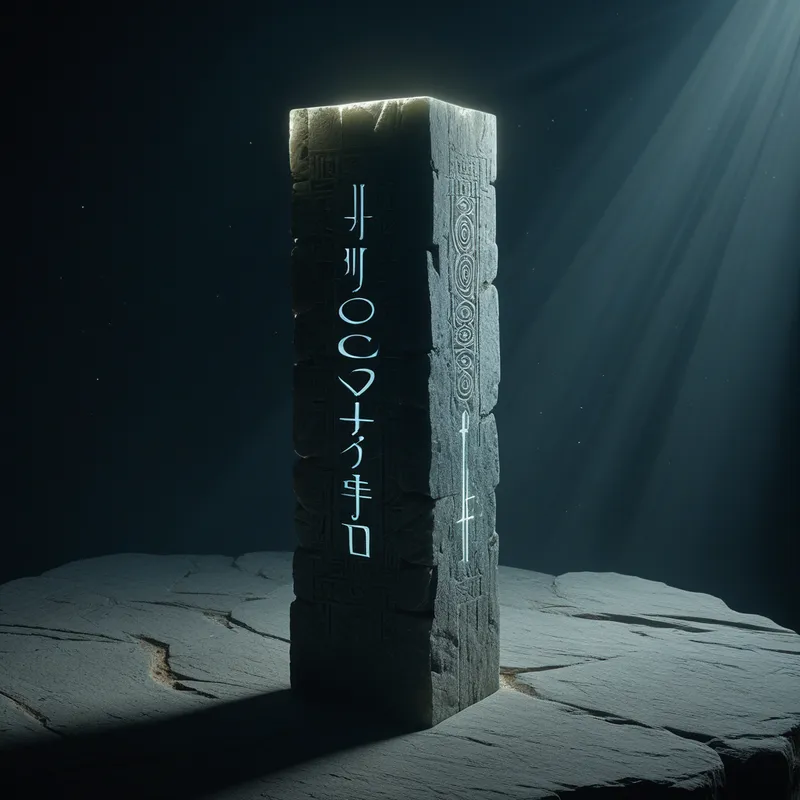
When this myth pattern stirs in the modern psyche, it often manifests in dreams of forgotten languages, of finding messages carved into wood or stone, or of being in a dense, sentient forest where the trees communicate. This is the somatic signal of a deep psychological process: the emergence of a new form of self-knowledge from the instinctual, vegetative layers of the unconscious.
The dreamer may be struggling with a feeling that their experience is ephemeral, ungrounded, or inarticulate. The forest in the dream is the untamed complexity of their inner life. The act of finding or deciphering the Ogham script represents the psyche’s own attempt to create a personal “alphabet”—a unique symbolic system to name, organize, and ultimately integrate the raw, “green” material of their instincts, emotions, and intuitions. It is a dream of moving from chaotic feeling to legible meaning, of building a spine of identity (the central stem) upon which the various aspects of the self (the tree-letters) can find their ordered place.

Alchemical Translation
The alchemical journey modeled here is the opus of giving form to the formless. Ogma begins with a yearning (the nigredo, or blackening, of felt lack). His retreat into the forest is the solutio, a dissolution into the primal, undifferentiated waters of the unconscious. His deep listening is the crucial stage of mortificatio—the death of his old, purely oral mode of being. He must be silent to hear the new language.
The transmutation occurs at the moment the dagger meets the bark: the coniunctio of conscious will (the god) with unconscious content (the tree’s song), producing the transcendent third—the sacred character.
For the modern individual, this is the process of individuation. The “forest” is the totality of one’s unlived life, memories, and complexes. The “listening” is active imagination or profound self-reflection. The “carving” is the act of creation—writing in a journal, painting, composing music, or simply constructing a coherent personal narrative. One does not invent the self from nothing; one discovers its inherent, archetypal patterns (the trees) and learns to inscribe them into the substance of daily life. The resulting “Ogham” is one’s own unique philosophy, a living alphabet of meaning that roots consciousness in the deep earth of the soul, allowing one to speak—and to know—what was once only a whisper in the dark.
Associated Symbols
Explore related symbols from the CaleaDream lexicon: