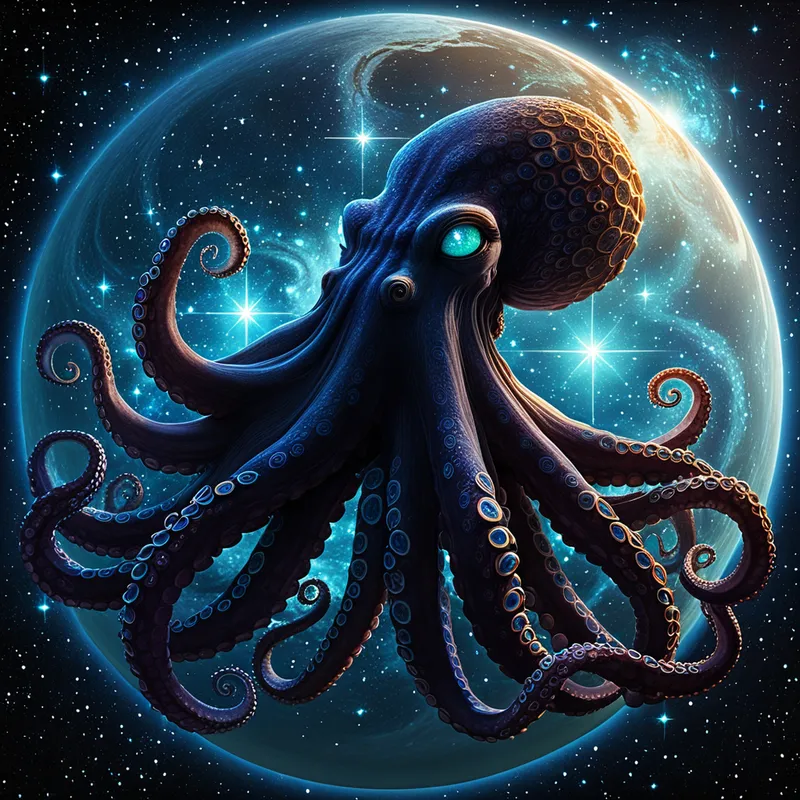
The Octopus Myth Meaning & Symbolism
A primordial entity of formless potential sacrifices its cosmic body to birth the world, weaving consciousness from the depths of chaos.
The Tale of The Octopus
Before the sun knew its path, before the moon learned to wane, there was only the Deep. Not an ocean, for there was no land to contain it, but the Deep itself—a silent, boundless, dreaming void. And within that void, there was One. It had no name we could speak, for speech was not yet born. The poets of the lost ages, those who whispered to the waves, called it Protokyklos.
Protokyklos was vastness given form, yet formless. It was the Octopus of the Void. Its body was the color of forgotten space, and its eight arms were not limbs but rivers of potential, swirling in the silent dark. It did not swim, for there was no medium but itself. It was the medium. In its great, watchful eye—a single, luminous orb at its center—swam the ghost-lights of all things that might be: mountains yet unstacked, seas yet unsalted, the laughter of gods yet unconceived.
But to be all potential is to be nothing. A loneliness deeper than any abyss settled upon Protokyklos, a longing for contrast, for otherness, for a song other than its own eternal hum. This longing became a pain, a beautiful, rending agony. And from that agony, Protokyklos made its choice.
It drew its vast arms inward, embracing the core of its own being. Then, with a sigh that would later become the wind, it began to unravel. It did not tear, but willingly loosened the weave of its own substance. The first arm dissolved, streaming out as a shimmering nebula of star-stuff, pinpricks of light igniting in its wake—the first constellations. The second arm poured forth as the sweet waters, gathering in the hollows of newborn space. The third became the salt of the seas, a bitter gift of memory. The fourth arm sank, heavy and dark, becoming the bedrock of the world.
Arm by sacred arm, Protokyklos sacrificed its singular, cosmic body. Its flesh became the fertile earth, its ink the dark soil where roots would clutch. Its nerves became the silver paths of rivers, and its great, beating heart-muscle settled at the world's core, a fiery forge. Finally, only its central eye remained, hovering in the now-articulated sky. It looked upon what it had made—a world of separation, of land and sea and sky, of future conflict and future love. In its gaze was no regret, only a profound, quiet knowing.
Then, the eye too dissolved. It did not vanish, but fractured into a billion gleaming fragments. These fragments fell like gentle rain. Some became the bright, curious eyes of all living creatures. Others sank into the deepest trenches of the new oceans, becoming the luminous beings that light the abyss. The greatest fragment, retaining the core of its vision, became the sun—so that the world would always be seen, and never again be alone in the dark.
Where Protokyklos once was, only a faint, echoing pattern remained in the fabric of reality: eightfold symmetry, a whisper of tentacles in the spiral of galaxies, in the curl of fern and shell. The Octopus was gone. The world was here. And in every pulsing vein of life, in every conscious glance, a tiny piece of its original, lonely vision flickered on.
Cultural Origins & Context
This myth of Protokyklos does not reside in the canonical texts of Hesiod or Homer. It is a paroimia, a shore-story, whispered by the fishermen and sponge-divers of the Aegean islands and the coastal communities of Asia Minor. It was not written but breathed, passed from elder to child during the mending of nets under the twilight sky, its truth held not in papyrus but in the rhythm of the waves against the hull.
Its societal function was foundational yet intimate. For a people whose lives were dictated by the capricious sea, the myth provided a cosmology of belonging. It answered the child's question, "Where did the world come from?" not with a violent clash of titans, but with a generative, willing dissolution. It taught that the sea was not a hostile emptiness, but the very flesh of the creator, making every sailor's journey a navigation across a divine body. The octopus, a creature of remarkable intelligence and shape-shifting ability observed in their daily lives, became a fitting vessel for a god who valued fluidity over rigid form, intelligence over brute force. This was a myth for those who understood that to create, one must sometimes let go of one's very self.
Symbolic Architecture
The Octopus, Protokyklos, is the ultimate symbol of the unmanifest, the pleroma. It represents consciousness before it identifies with any single thought, form, or identity—pure, boundless potential.
The creator must become the sacrifice; the self must be distributed to become the world.
Its eight arms symbolize infinite possibility and connection. Unlike the rigid, singular path, the tentacle explores, feels, and adapts simultaneously in all directions. This is the intelligence of the unconscious mind itself—not linear, but networked, feeling its way through the dark. The central eye represents the spark of awareness, the witness that observes the void and feels the ache of loneliness that initiates all creation.
The act of dissolution is not a death, but an alchemical distribution. The myth posits that creation is not an act of assembly from without, but a graceful deconstruction from within. Every element of our world, from the stone to the star, is imbued with the sentient substance of the creator. This makes the universe not a machine, but a distributed consciousness, a thought that Protokyklos is still thinking.
The Dreamer's Resonance
When this myth stirs in the modern psyche, it often surfaces in dreams of profound dissolution and re-weaving. To dream of being a vast octopus in space, or of watching one unravel into light, is to touch a core process of psychic deconstruction.
This is not the terrifying fragmentation of psychosis, but the necessary dissolution of an outgrown self. The dreamer may be undergoing a life transition where their old identity—their career, their primary relationship, their long-held self-concept—no longer contains them. The somatic feeling is one of both profound loss and eerie peace; a letting-go that is also a becoming. The tentacles in the dream often represent attachments, talents, or roles that must be voluntarily released, not cut, so their essence can flow into new forms. The dream is the psyche's way of saying, "You must distribute this singular, lonely 'I' to participate in a wider, more connected existence."
Alchemical Translation
For the individual, the myth of Protokyklos models the final, terrifying, and glorious stage of individuation: the sacrifice of the ego to the Self.
We spend our first half of life building the octopus—constructing a coherent identity, strong arms of competence, relationships, and achievements. We become a defined, bounded self. Yet, to reach our fullest potential, we must perform the act of Protokyklos. We must willingly deconstruct the very ego we worked so hard to create.
Individuation is not about building a better fortress of the self, but about learning to become a generous universe.
This alchemical translation means allowing our talents (the arms) to flow out into the world as contributions, not possessions. It means letting our rigid self-definition dissolve to discover we are also the community, the art, the love we put forth. The "central eye"—our core awareness—ceases to be a judge perched in a citadel and becomes a sun, a illuminating presence that shines on all aspects of life without clinging to any. We realize we are not just the thinker, but also the thought, not just the lover, but the love itself. In distributing ourselves, we stop being a lonely god in a void and become, at last, a living part of the interconnected, conscious cosmos we inhabit. The myth teaches that our end goal is not to be a perfect, isolated individual, but to become a world.
Associated Symbols
Explore related symbols from the CaleaDream lexicon: