The Oath of the Horatii Myth Meaning & Symbolism
Three Roman brothers swear an oath to fight three Alban brothers, their kin, to settle a war, leading to victory, murder, and a trial by the gods.
The Tale of The Oath of the Horatii
Hear now, of a time when the dust of the Seven Hills tasted of iron and destiny. The air between Rome and Alba Longa was thick, not with summer haze, but with the unsaid challenge of two peoples sprung from the same Trojan blood. War loomed, a great beast pacing the border, but the kings, weary of spilling the life of whole armies, sought a cleaner cut. Let the dispute be settled by champions. Let three stand for three.
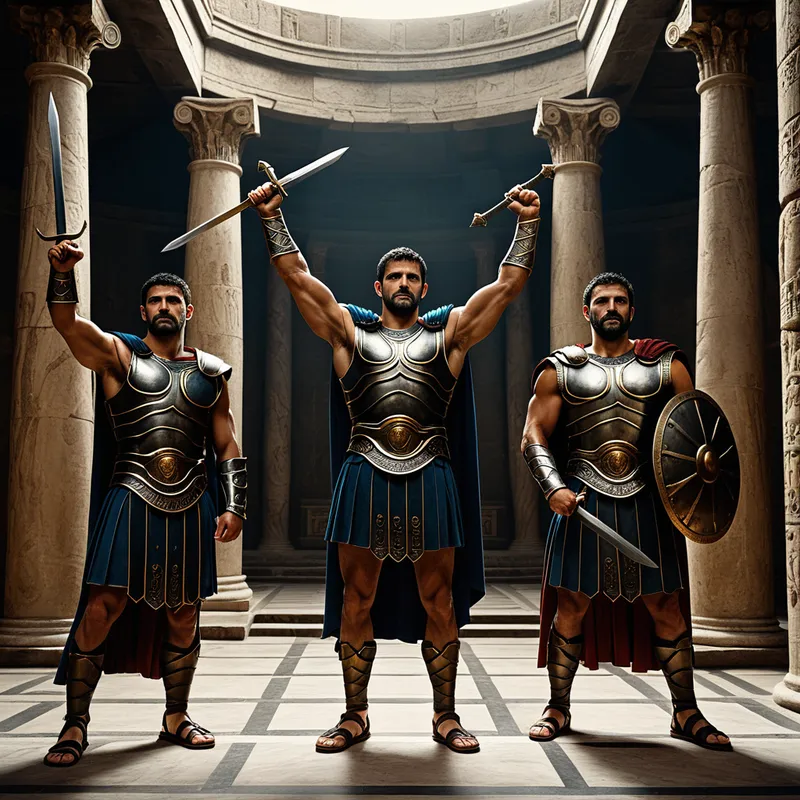
From Rome stepped forth the Horatii—triplets, born of a single breath, their hearts beating in a unison known only to the womb. Publius Horatius looked upon his sons, not with a father’s tenderness, but with the flinty gaze of the state. In the dim light of their hearth, he presented three swords. The steel was cold, the edges hungry. “Swear,” his voice echoed in the silent room, a sound like stone grinding on stone. “Swear by the Lares and the Manes, by the soil of your fathers. Swear to conquer or die for Rome.”
Their hands, calloused and identical, rose as one. The oath was not spoken in shouts, but in a low, terrible vow that seemed to draw the warmth from the very fire. It was a sound that bound their fates tighter than any chain.
Across the field, the chosen champions of Alba Longa were the Curiatii. And here the knife of fate twisted, for between these six young men ran not just the blood of rivalry, but the blood of family. A sister of the Horatii, Camilla, was pledged to one of the Alban triplets. Her heart was a field of battle before the first sword was drawn.
The armies formed two silent walls of bronze and hope. The six champions met in the no-man’s-land, a space charged with the weight of two cities. No parley, no cry. The clash was sudden—a horrific dance of shield and blade. Two of the Horatii fell quickly, run through by the skillful Curiatii. The Roman hearts sank into the mud. But the Alban brothers were wounded, their strength bleeding out into the dust.
The last Horatius, Publius, stood alone. He saw not a trio of enemies, but a single problem to be solved. He fled. A gasp of shame went up from the Roman line. But this was no retreat; it was the strategy of the wolf. He ran, and the wounded Curiatii, separated by their injuries, pursued him one by one. Turning with the fury of a cornered beast, he slew each brother as they stumbled after him. One. Two. Three. The field, once host to six, now belonged to one.
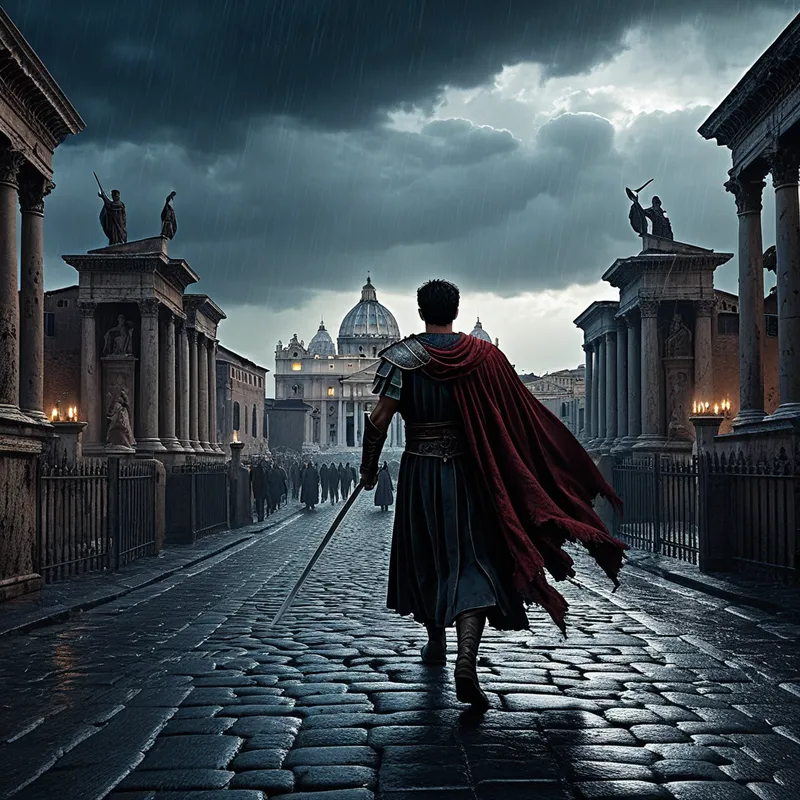
He returned to Rome, draped in the spoils of his cousins. The city roared its salvation. But at the gate, his sister Camilla saw the cloak she had woven for her beloved Alban fiancé upon her brother’s shoulder. Her wail tore through the victory cheers. She cursed Rome, she cursed her brother, she cursed the day of his birth. And in that moment, the hero vanished, and only a furious, blood-stained man remained. Publius drew his still-wet sword and ran her through. “So perish any Roman woman who mourns an enemy,” he snarled.
The victory procession halted. The savior stood trial for murder. His father, the same who demanded the oath, defended him before the people. The weight of the public service, the terrible necessity of his act, held against the private crime. He was spared, but made to pass beneath a yoke, a ritual of cleansing. The hero walked, burdened not by wood, but by the silent ghosts of two sisters—one of Rome, and one of his own blood.
Cultural Origins & Context
This stark narrative is not Greek, but quintessentially Roman, preserved for us by the historian Livy. It served as a foundational legend for the early Roman Republic, embodying the core values of patria potestas and virtus. The story was not mere entertainment; it was civic education. It was told to illustrate the absolute supremacy of the state’s needs over individual and familial bonds. The father, Horatius, represents the old order transferring its authority to the sons, who must consume their personal identities for the public good.
The myth functioned as a cultural container for Rome’s deepest anxieties about civil war and familial strife (the conflict with kin, the Alban cousins). It provided a terrifying but noble template: when the community demands it, even love must be sacrificed on the altar of duty. The trial and ritual purification at the end are crucial—they show that even necessary horrors require atonement, reintegrating the blood-stained hero back into the lawful society he protected through lawless violence.
Symbolic Architecture
At its heart, this is a myth of the fractured self. The six champions—two sets of triplets—symbolize a profound internal split. They are mirror images, kin, representing conflicting loyalties within a single psyche: the patriotic self versus the familial self, the dutiful self versus the loving self.
The oath is the moment the conscious ego chooses one totality over another, signing a contract with a fate that demands the death of other, equally valid, parts of the soul.
The lone survivor’s tactic—feigning retreat to divide and conquer—is the strategy of a consciousness under siege by overwhelming emotional complexes. He cannot face them all at once; he must deal with them sequentially. The slaying of Camilla is the most potent symbol. She represents the heart’s natural allegiance, the part of us that mourns what duty destroys. Her murder is the psyche’s brutal suppression of compassion and personal attachment when it is deemed a threat to the chosen, rigid identity. The trial represents the inevitable psychic backlash—the Self’s court that judges the ego’s extreme actions, demanding integration and purification.
The Dreamer’s Resonance
To dream of this oath is to dream of an impossible choice. The dreamer may find themselves in a sterile, official space (the temple), forced to swear allegiance to a cause that feels alien to their heart. The somatic sensation is of coldness, rigidity in the jaw and hands, a closing off of the chest.
Dreaming of being the sole survivor, dragging heavy, symbolic cloaks, speaks to a recent, pyrrhic victory. You have won a battle—perhaps for career, principle, or independence—but at the cost of relationships or inner peace. The weight is tangible. Dreaming as Camilla, witnessing the betrayal and giving voice to the wail, indicates a profound feeling of grief for a connection or a soft, vulnerable part of the self that has been murdered by your own actions or choices. The dream is the psyche’s stage, replaying this ancient drama to show you where you have sacrificed wholeness for a singular, harsh loyalty.

Alchemical Translation
The alchemical process here is one of calcinatio—a burning down to ash. The old, integrated identity (the six as a whole family) is incinerated in the conflict. The oath is the application of intense heat, the fire of a supreme, conscious decision.
The individuation journey modeled here is brutal: to become an individual, one must first become a murderer of one’s own latent possibilities.
The survivor’s path is the ablutio, the washing. The trial and passing beneath the yoke are not punishments, but the necessary rituals of cleansing. The ego, having committed the terrible but necessary act of choosing one path and killing the others (the Curiatii, Camilla), cannot simply celebrate. It must submit to a process that acknowledges the gravity of its deed. This is the integration of the shadow—the recognition that the hero and the murderer are the same man. The final stage is not a triumphant return, but a sober reintegration. The fused swords of the Horatii and Curiatii become a single, more complex weapon: a consciousness that has faced its own capacity for ruthless choice and heartbreaking sacrifice, and carries that knowledge not as a trophy, but as a solemn, enduring weight. The individual is no longer simply a son, a brother, or a citizen, but a vessel containing the memory of all those roles, now transcended and mourned.
Associated Symbols
Explore related symbols from the CaleaDream lexicon: