
The Oak of Dodona Myth Meaning & Symbolism
A sacred oak tree, gifted by Zeus, whispers divine prophecies through the rustling of its leaves, guiding heroes and seekers to their fate.
The Tale of The Oak of Dodona
Listen. Before the marble temples, before the philosophers’ debates in the sun-drenched agora, there was the voice in the leaves. In the wild, mist-shrouded highlands of Epirus, where the wind carries the scent of earth and storm, stood a grove unlike any other. At its heart was an oak, but no ordinary tree. This was the Oak of Dodona, and its roots drank from the first waters of the world.
The story begins not with a planting, but with a theft and a gift. They say the blacksmith god Hephaestus, in a fit of divine rage, once struck his father, Zeus, on the head. From that mighty brow sprang Athena, fully armed and shouting her war cry. The sound was so terrible, so raw with power, that it drove the Gorgons from their home. One of them, fleeing across the sea to the land of the Hyperboreans, fell into an exhausted sleep beneath a towering oak. As she slept, the tree absorbed her lingering essence—her ancient terror, her primal power.
Years passed. Two black doves, sacred to Zeus, took flight from the city of Thebes in Egypt. One flew to Libya to found the oracle of Ammon. The other, her wings beating against the northern gales, flew until she alighted upon the branches of that same oak in Epirus. And there, in a human voice, she spoke: “Here is the place where Zeus wills an oracle to be.”
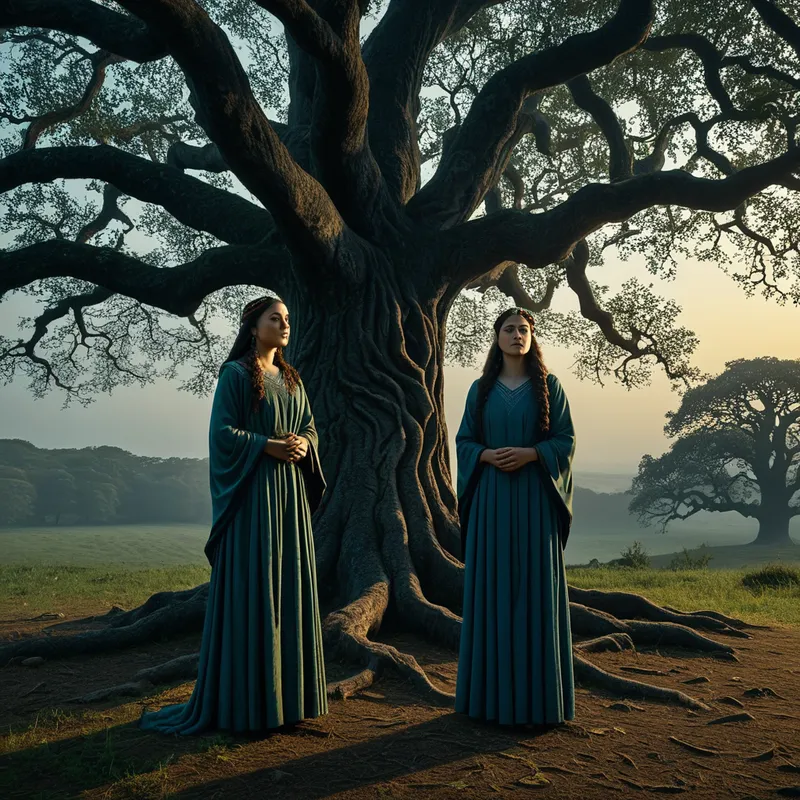
Thus, the oak was consecrated. It became the mouthpiece of the Sky Father himself. No priestess sat in a trance here; the prophecy was in the listening. The wind, the breath of Zeus, would stir the sacred branches. The leaves, touched by the Gorgon’s ancient magic, would rustle and sigh. To the untrained ear, it was merely weather. But to the Peleiades, the priestesses who served the grove, each susurration was a syllable, each gust a sentence. They would lie upon the earth, ears pressed to the roots, or stand for hours in silent vigil, translating the arboreal whispers into guidance for kings and shepherds alike.
Heroes came to this remote sanctuary. Jason sought its counsel before embarking on his impossible quest. The oak advised him to take the enchantress Medea with him, a piece of advice that spelled both his triumph and his doom. The tree did not speak of easy paths, but of necessary ones. Its voice was the voice of the world-soul, older than the gods of Olympus, speaking through the grain of the wood and the language of the air. To stand before it was to stand at the threshold of knowing, where the answer was not given, but heard—if one had the patience, and the humility, to listen.
Cultural Origins & Context
The sanctuary at Dodona predates the classical pantheon we know from Homer. Its origins are chthonic, rooted in earth-worship. This was originally a shrine to a pre-Hellenic earth goddess, later syncretized with Dione. Zeus arrived here not as the Olympian patriarch, but as Zeus Naios or Zeus Chthonios, a god intimately connected to the fertile soil and the storms that watered it. The oak was his natural altar.
The myth was passed down not as a single, codified story, but as an etiological legend explaining a real, historical practice. Herodotus recorded the tale of the two doves from the priestesses themselves. For centuries, Dodona functioned as a vital, if remote, center of divination. Its methods were uniquely austere. Unlike the theatrical, priestess-mediated revelations at Delphi, Dodona’s oracle was indirect, environmental. Interpretation was everything. The sound of bronze cauldrons arranged around the tree, clanging in the wind, also formed part of the oracle’s voice. This was divination stripped to its bare elements: wind, metal, wood, and human attention.
Societally, it served as a check on the more political Delphi. If Delphi was the oracle of the state, of colonization and war, Dodona was the oracle of the personal, the agricultural, and the foundational. Farmers asked about crops, individuals about journeys and marriages. It represented a more intimate, though no less fateful, connection to the divine will, accessible to all who made the arduous journey into the mountains.
Symbolic Architecture
At its core, the Oak of Dodona is a profound symbol of animated wisdom. It represents the belief that consciousness and voice are not exclusive properties of the human mind, but are woven into the very fabric of the world. The tree is the axis where heaven (Zeus’s wind) meets earth (the Gorgon-touched roots), and meaning is generated in that intersection.
The first oracle is not a voice that tells, but a presence that sounds. To hear it, one must become still enough for the inner noise to settle, leaving only the resonant truth of the world.
The Peleiades symbolize the necessary human component: the act of translation. The raw, ambiguous “sounding” of the universe requires a psyche to receive, contain, and interpret it. They are the mediators between pure, unconscious nature and conscious understanding. The bronze cauldrons add another layer: technology as an extension of nature’s voice, not a replacement for it. They amplify and complicate the signal, much like our own minds filter and shape intuition through memory and fear.
Psychologically, the oak is the Senex archetype in its most natural form. It is the internal, ancient, patient source of guidance that does not command but suggests, speaking in the subtle language of synchronicity, gut feelings, and those quiet “knowings” that arise when we are truly centered. Its prophecy is often ambiguous because true inner guidance requires our engagement and choice to complete its meaning.

The Dreamer’s Resonance
When the Oak of Dodona appears in a modern dream, it rarely manifests as a literal tree. More often, it is the experience of the oracle. The dreamer may find themselves in a place where inanimate objects seem to communicate—a bookshelf whose titles suddenly form a coherent message, a radio emitting static that resolves into a personally significant phrase, or the wind through a window carrying a forgotten name.
This dream pattern signals a critical somatic and psychological process: the body and the unconscious are attempting to transmit information that the conscious, rational mind has been overriding. The “rustling leaves” are the somatic whispers—the gut clench, the sudden chill, the inexplicable sense of rightness or dread. The dream is an amplification of these subtle signals, staging them in a mythological framework to grab the dreamer’s attention.
The emotional tone is key. If the dream carries awe and a sense of profound listening, it indicates a nascent connection to this inner oracle, a readiness to trust intuition. If the dream is fraught with frustration—the words are just out of reach, the wind is howling but meaningless—it speaks to a blockage. The dreamer may be intellectually seeking answers (“going to the oracle”) but is unable to quiet their own internal noise to hear the response. The psyche is dramatizing the very act of listening itself.

Alchemical Translation
The alchemical process modeled by Dodona is not the dramatic solve et coagula (dissolve and coagulate) of other myths, but the slow, patient work of separatio and coniunctio applied to perception itself. It is the individuation of the listening faculty.
First, Separatio: The seeker must journey to the “remote grove”—a state of psychological withdrawal from the consensus reality of the outer world and its ready-made answers. This is the difficult isolation, the leaving behind of familiar shores. In this quiet, one confronts the raw, uninterpreted “sound” of the Self: the chaotic rustle of impulses, memories, fears, and desires. It feels like nonsense, mere psychic weather.
Then, the Coniunctio: This is where the work of the Peleiades begins. It is the sacred marriage of this raw, natural phenomenon (the tree’s sound) with the human capacity for meaning-making (the priestess’s interpretation). The ego does not command the unconscious; it enters into a respectful dialogue with it. One learns the “language” of one’s own leaves—how anxiety feels versus intuition, how a true inner prompting differs from a fearful reaction.
The ultimate transmutation is not of lead into gold, but of noise into voice, and of hearing into knowing. The oak does not grant a new truth; it reveals that the truth was always there, sounding through you, waiting for you to attend.
The modern individual’s “oracle” is this integrated state where body, feeling, and intellect are in conversation. A decision made from this place is not a calculated gamble, but an alignment with a deeper current of one’s own nature and fate. The prophecy of Dodona is ultimately this: your path is not written in stone tablets to be deciphered, but is spoken in the living language of your own being, moment by moment. The task is not to seek the oracle, but to become the sacred grove where the wind can speak.
Associated Symbols
Explore related symbols from the CaleaDream lexicon: