The Nue Myth Meaning & Symbolism
A monstrous chimera haunts the Emperor, until a warrior's divine arrow pierces the night, revealing the power of confronting the formless shadow.
The Tale of The Nue
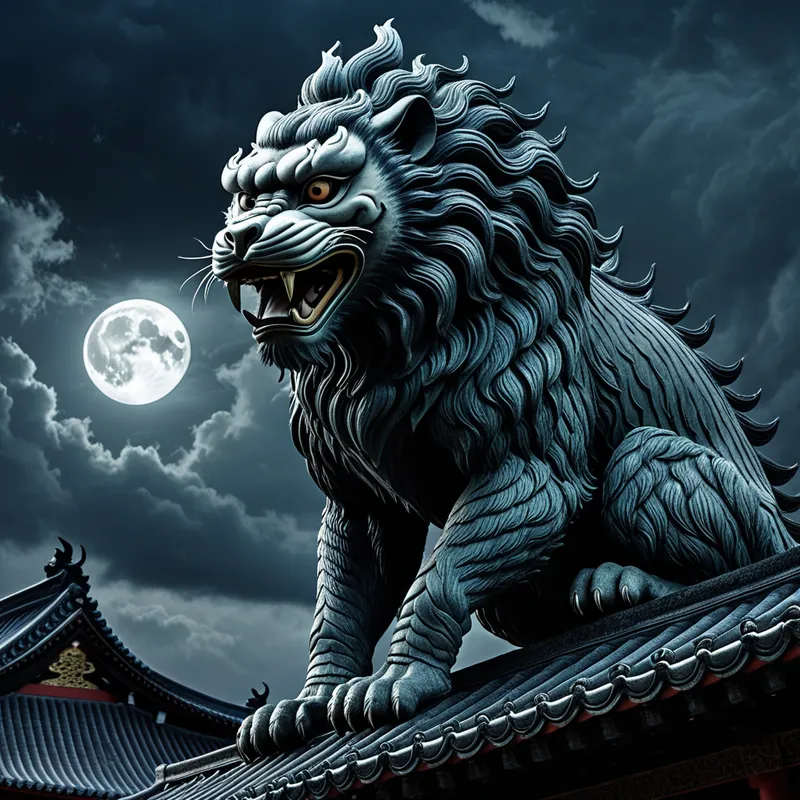
In the deep heart of the Heian night, when [the world](/myths/the-world “Myth from Tarot culture.”/) of men should be at rest, a terror took wing. It began not with a sight, but with a sound—a long, low, mournful cry that seeped through the cedar screens of the Seiryō-den, chilling the blood of even the most seasoned courtier. Night after night, it came. A haunting, unearthly lament that coiled around the heart of the Tennō himself, bringing with it a sickness of the spirit, a fevered dread that no physician could cure. The source was a shadow against [the moon](/myths/the-moon “Myth from Tarot culture.”/), a monstrous shape that rode the black clouds over the palace: the Nue.
The creature was an abomination against nature, a living puzzle of nightmares. It had the head of a chattering, grimacing monkey, the body of a sturdy, low-slung [tanuki](/myths/tanuki “Myth from Japanese culture.”/), the striped, powerful legs of a tiger, and for a tail, the sinuous, hissing length of a serpent. It was not one beast, but all, a cacophony of forms given a single, malignant purpose. Its cry was the sound of the world’s discord, and it poured that discord directly into the Emperor’s chambers.
The court was paralyzed by fear. Priests chanted until their voices were hoarse; shamans danced until their feet bled. Their rituals scattered like paper in [the wind](/myths/the-wind “Myth from Various culture.”/) before the creature’s palpable malice. The order of the realm, mirrored in the perfect geometry of the palace, was being undone by this formless chaos. In this hour of despair, the call went out. Not to a priest, but to a warrior.
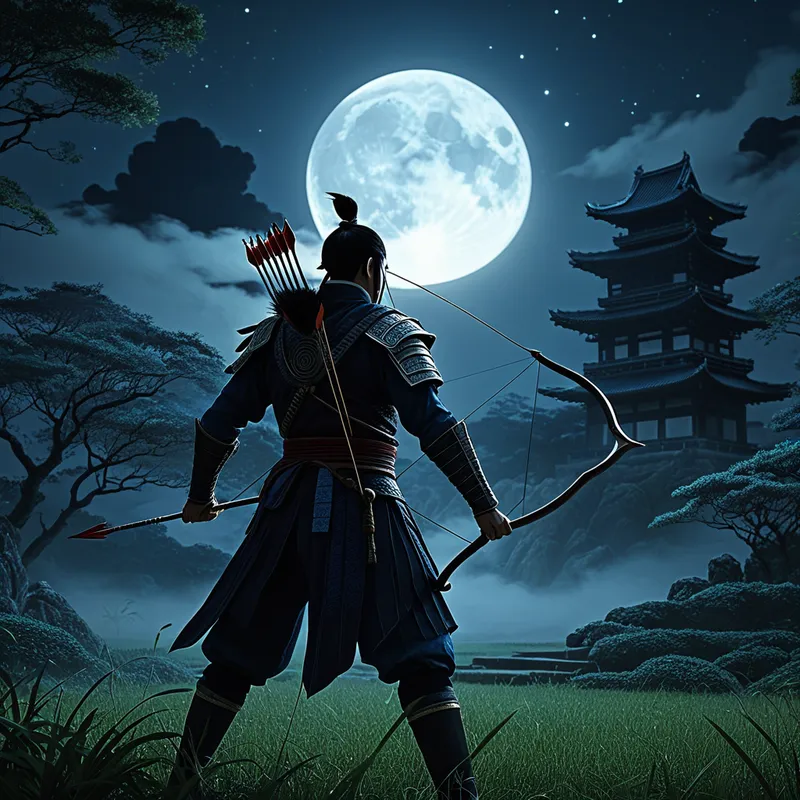
He was Minamoto no Yorimasa, a man whose soul was tempered in [the way](/myths/the-way “Myth from Taoist culture.”/) of the bow and the brush. He did not come with incantations, but with a quiet certainty. On a night pregnant with storm, he took his position in the southern garden, his faithful retainer I no Hayata at his side. The air was thick, electric. Then, the cloud descended—a roiling mass of darkness blotting out the stars. From within, two points of baleful light fixed upon the palace.
Yorimasa did not see a monkey, a tanuki, a tiger, or a snake. He saw the heart of the disturbance. He drew his bow, a motion as fluid as a calligrapher’s stroke, and invoked Hachiman Daibosatsu. His voice was a calm ripple in the terrified silence. He nocked an arrow, its tip a promise of order. He breathed in the chaos, and breathed out purpose. The bowstring sang a single, piercing note that cut through the monster’s mournful drone.
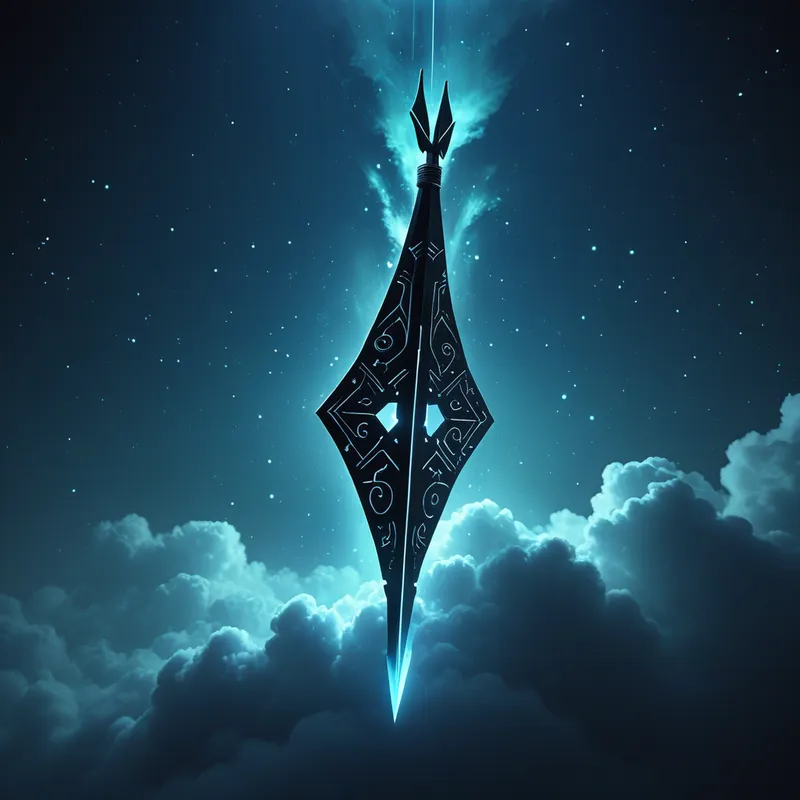
The arrow found its home in [the shadow](/myths/the-shadow “Myth from Jungian culture.”/). A shriek, not mournful now but furious and pained, tore the night. The dark cloud convulsed and began to fall. As it crashed upon the roof tiles, the formless terror took on weight and substance. It was the Nue, revealed in all its grotesque glory, writhing. Before it could rise, I no Hayata was upon it, his sword finishing what the arrow had begun. The cry was silenced. The dawn that followed was the sweetest the palace had ever known.
Cultural Origins & Context
The legend of the Nue is immortalized in the Heike Monogatari, an epic war tale that blends history with profound mythic resonance. While the Heian court (794-1185 CE) is the story’s setting, the tale was solidified in the tumultuous Kamakura period that followed. It was a story told by biwa hōshi, blind lute priests who were the keepers of history and morality.
The myth served a crucial societal function. On one level, it is a foundational story of the Minamoto clan, showcasing Yorimasa’s loyalty and divine favor, legitimizing the rising warrior class’s role as protectors of imperial order. On a deeper, cultural level, the Nue embodies the Heian aristocracy’s deepest fears: invisible pestilence, political instability, and the intrusion of untamed, chaotic nature into their refined, walled world. The creature is the ultimate yōkai—not merely a physical threat, but a psychic poison that attacks the very center of civilized authority. The story’s preservation reveals a cultural understanding that order is not a default state, but a fragile achievement that must be actively defended against the formless shadows that perpetually seek to undermine it.
Symbolic Architecture
The Nue is not a random [monster](/symbols/monster “Symbol: Monsters in dreams often symbolize fears, anxieties, or challenges that feel overwhelming.”/). It is a precise symbolic equation: the [chimera](/symbols/chimera “Symbol: The Chimera symbolizes the blending of oppositional forces, embodying complexity and the multifaceted nature of reality.”/). It represents the unintegrated [shadow](/symbols/shadow “Symbol: The ‘shadow’ embodies the unconscious, repressed aspects of the self and often represents fears or hidden emotions.”/) complex—those rejected, animalistic, and unconscious aspects of [the self](/myths/the-self “Myth from Jungian culture.”/) that, when denied, coalesce into a terrifying, composite form. Each animal part is a disowned instinct: the monkey’s cunning intelligence turned to mischief, the tanuki’s earthy sensuality become gluttony, the [tiger](/symbols/tiger “Symbol: The tiger symbolizes power, courage, and primal instincts, often representing untamed energy and aggression.”/)’s raw power and anger, the [serpent](/symbols/serpent “Symbol: A powerful symbol of transformation, wisdom, and primal energy, often representing hidden knowledge, healing, or temptation.”/)’s primal wisdom and poison.
The true horror of the chimera is not its strength, but its incoherence. It is a parliament of instincts, each screaming over the other, creating only a dissonant cry that paralyzes the conscious mind.
The Emperor’s sickness is the sickness of a [psyche](/myths/psyche “Myth from Greek culture.”/) under siege by its own unrecognized contents. The [palace](/symbols/palace “Symbol: A palace symbolizes grandeur, authority, and the pursuit of one’s ambitions or dreams, often embodying a desire for stability and wealth.”/) represents the conscious ego—ordered, refined, and utterly vulnerable to what it has excluded. Yorimasa, the [hero](/symbols/hero “Symbol: A hero embodies strength, courage, and the ability to overcome significant challenges.”/), symbolizes the conscious will and focused [attention](/symbols/attention “Symbol: Attention in dreams signifies focus, awareness, and the priorities in one’s life, often indicating where the dreamer’s energy is invested.”/) required to face this shadow. His [bow and arrow](/symbols/bow-and-arrow “Symbol: A classic symbol of precision, focus, and the pursuit of goals.”/) represent discrimination and directed [consciousness](/symbols/consciousness “Symbol: Consciousness represents the state of awareness and perception, encompassing thoughts, feelings, and experiences.”/)—the [ability](/symbols/ability “Symbol: In dreams, ‘ability’ often denotes a recognition of skills or potential that one possesses, whether acknowledged or suppressed.”/) to pinpoint the [source](/symbols/source “Symbol: The origin point of something, often representing beginnings, nourishment, or the fundamental cause behind phenomena.”/) of the disturbance amidst the confusing cloud of symptoms. He does not fight the cloud; he aims for the luminous eyes within it, the nascent consciousness hiding in the shadow itself.
The Dreamer’s Resonance
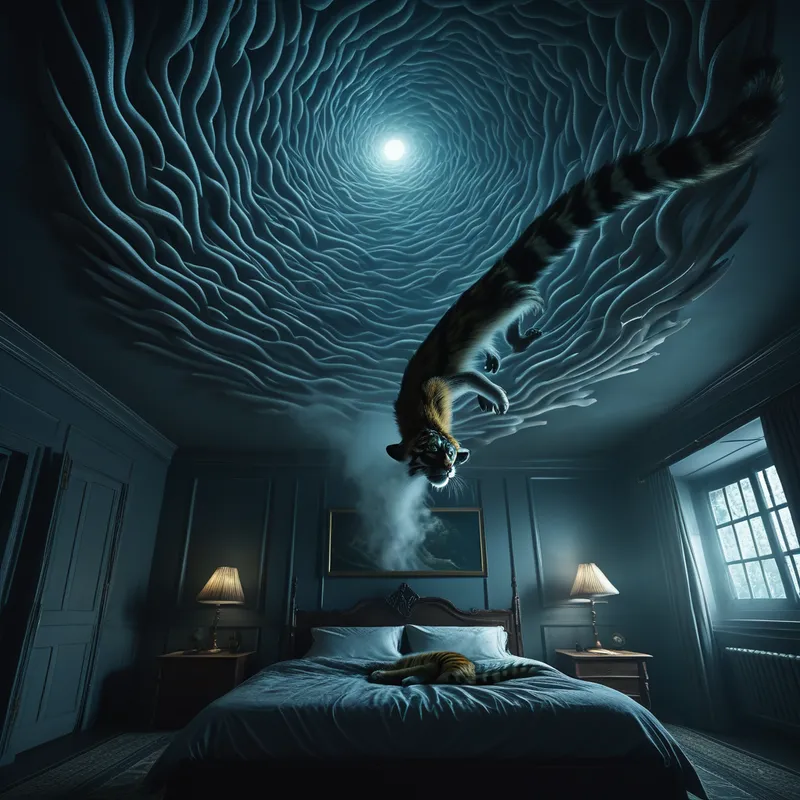
When the pattern of the Nue manifests in modern dreams, the dreamer is in a state of psychic poisoning. They may dream of a looming, shapeless threat, a haunting sound with no source, or a sickening feeling that permeates their dream-home (the modern palace). They might see grotesque hybrid creatures or feel pursued by a malice that is frustratingly undefined.
Somatically, this echoes the Emperor’s fever: a sense of chronic anxiety, low-grade depression, or a feeling of being “haunted” by something one cannot name. The psychological process is one of coagulation. The scattered, repressed aspects of the self—unexpressed anger (tiger), cunning strategies turned against oneself (monkey), neglected bodily needs (tanuki), or toxic patterns (serpent)—are gathering into a coherent, and therefore confrontable, form. The nightmare is the birth pang of this formation. The terrifying clarity of [the chimera](/myths/the-chimera “Myth from Greek culture.”/), while frightening, is a step forward from the formless dread. It means the unconscious is presenting its bill, demanding to be seen in full, composite horror, so that it may finally be addressed.
Alchemical Translation
The myth of the Nue is a perfect model for the alchemical stage of [nigredo](/myths/nigredo “Myth from Alchemical culture.”/)—the confrontation with the black, chaotic shadow. The process of individuation requires this encounter. We cannot integrate what we cannot see.
Yorimasa’s journey is [the ego](/myths/the-ego “Myth from Jungian culture.”/)’s journey into this nigredo. First, he witnesses the chaos without fleeing (standing in the garden). Second, he invokes a higher principle (Hachiman, the transcendent function that connects his clan’s purpose to divine will). Third, he aims—he applies conscious discrimination to identify the core of the disturbance. The arrow is the liberating insight, the act of naming the nameless fear. “You are my repressed rage, my neglected cunning, my denied instinct.”
The arrow does not destroy the shadow; it pins it to reality, forcing it to take a shape that can be engaged. Integration begins not with love, but with accurate sight.
Finally, I no Hayata’s sword represents the necessary, often brutal, work of assimilation. The conscious self must actively grapple with, “kill,” and metabolize these shadow contents. The [triumph](/myths/triumph “Myth from Roman culture.”/) is not the death of the animal instincts, but the death of their monstrous, autonomous form. Their energy is then freed to serve the whole self. The dawn that follows is the albedo—the whitening, the clarity and peace that comes when the cacophony within is silenced, and the disparate parts of the soul are brought under the sovereignty of a consciousness that is no longer afraid of the dark.
Associated Symbols
Explore related symbols from the CaleaDream lexicon: