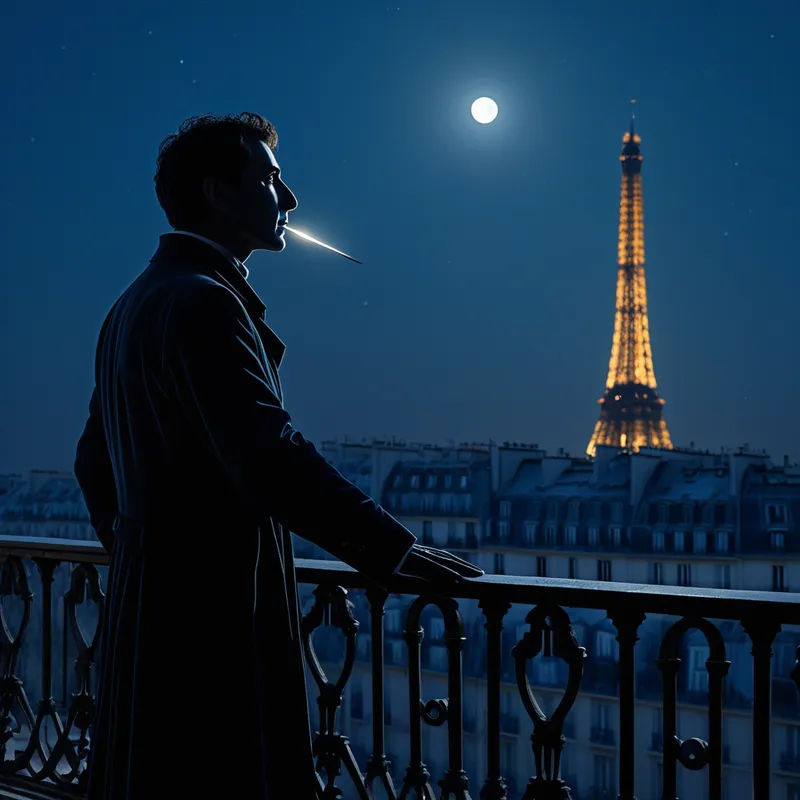
The Nose of Cyrano de Bergerac Myth Meaning & Symbolism
A soul of fire trapped behind a mask of flesh, whose greatest love letters were signed with another man's name, and whose truth was only heard in the dark.
The Tale of The Nose of Cyrano de Bergerac
Listen, and let the cobblestones of old Paris whisper. In the gaslight and shadow of a world caught between sword and pen, there walked a man who was a walking contradiction. His name was Cyrano de Bergerac, but the world knew him first by his silhouette—a profile carved not from modest clay, but from a grand, defiant promontory. His nose was not a mere feature; it was a peninsula, a monument, a declaration of war against the ordinary.
By day, he was a whirlwind of bravado, a master of the blade and the blistering wit. He was a Cadet of Gascogne, his spirit as sharp as his sword, defending the honor of his impossible nose in a hundred duels, composing ballads mid-fight. The air around him crackled with challenge and verse. Yet, when the moon rose over the rooftops, a different man emerged. In the velvet darkness of a convent garden, beneath the sighing branches of a linden tree, this titan of daylight became a ghost of longing.
For his heart belonged to Roxane, a woman whose beauty was matched only by her love for eloquence. And Cyrano, whose soul was a cathedral of poetry, believed his face was a grotesque gargoyle upon its walls. He saw only the mask, never the man behind it. So, when a handsome but tongue-tied comrade, Christian de Neuvillette, confessed his own love for Roxane, a tragic pact was forged in the dim light of a tavern. Christian would have the face to win her eye; Cyrano would furnish the soul to win her heart.
Thus began the great deception, the most beautiful lie ever told. Night after night, Cyrano, hidden in shadow, fed the words of angels to his friend. Love letters dripping with starlight and passion were delivered under Cyrano’s secret hand. From a balcony, cloaked in night, Cyrano’s voice, disguised, poured out his own heart’s truth while Christian mouthed the words in silhouette. Roxane fell in love—with the soul she heard, believing it belonged to the face she saw.
Years flowed like the Seine. Christian died in battle, a secret half-kept on his lips. Cyrano, his own heart entombed, remained Roxane’s devoted friend, the guardian of a ghost. Only when death finally came for Cyrano, not by sword but by a coward’s falling timber, did the truth stumble into the light. Visiting her mourning friend, Roxane recognized at last the voice from the dark garden, the style of the letters, the soul she had always loved. The mask of flesh fell away too late. With his last breath, Cyrano dueled not a man, but Death itself, and his final defiance was to speak of the one adornment he would take to heaven unblemished: his panache—his white plume of spirit. The nose was the fortress; the poetry was the man. And in the end, only the truth, fragile and fatal, remained.
Cultural Origins & Context
This is not a myth from a lost antiquity, but a modern myth born from the collision of history and art. The seed was a real man, Savinien de Cyrano de Bergerac (1619-1655), a libertine writer, duelist, and pioneering author of proto-science fiction. The flower is the 1897 verse drama Cyrano de Bergerac by Edmond Rostand. Rostand took the historical figure’s flamboyance and literary genius and wove around it a timeless fable of concealed love and tragic identity.
Its passage into “Global/Universal” culture is a testament to its archetypal power. Passed down not by shamans but by actors, on stages from Broadway to Tokyo, and through countless film adaptations, it functions as a societal mirror. In an age increasingly obsessed with image—from portraiture to photography to the digital selfie—Cyrano’s plight speaks to the universal human fear that our inner reality is betrayed by our outer form. It is a myth for the romantic and the intellectual, a story that validates the power of the word over the superficial glance, while tragically acknowledging the world’s cruel preference for the latter.
Symbolic Architecture
The Nose is the central, overwhelming symbol. It is not a flaw, but a Shadow made flesh—an aspect of the self perceived as grotesquely visible, alienating, and defining. It represents any part of our identity we believe renders us unlovable: shyness, awkwardness, a past trauma, an unconventional mind, a physical trait. Cyrano’s entire life is a dance with this shadow—he defiantly embraces it publicly (the duels) yet allows it to imprison him privately (his silence with Roxane).
The greatest prison is the one whose bars are forged from our own believed inadequacies.
The poetry, then, is the authentic Self, the luminous soul trapped behind the bars of perception. The love letters are the soul’s clandestine messages to the world, the true voice smuggled out under a false flag. Christian represents the empty Persona—the acceptable, handsome, but ultimately soulless facade society rewards. The tragedy is that Cyrano, the poet, believes the world wants the persona, not the self. He becomes the ghostwriter of his own life, authoring a beautiful story from which he has erased his own name.
The Dreamer’s Resonance
To dream in the pattern of Cyrano is to dream of hidden communication and mistaken identity. You may dream of speaking vitally important truths, but your voice makes no sound. You may send a letter, but the handwriting changes to someone else’s. You may look in a mirror and see a distorted or masked face that does not match your inner feeling.
Somnatically, this is the process of the authentic self straining against a constructed identity. It is the throat chakra constricting—the words are there, piled up behind the tongue, but they cannot pass the gatekeeper of shame or fear of rejection. Psychologically, the dreamer is navigating the tension between their inner reality (the poet) and the outer image they feel compelled to project (the acceptable face). It is a dream of profound loneliness, where the dreamer’s deepest gifts are expressed, but never received as their own. The heart is in exile, sending messages home in bottles signed with another’s name.
Alchemical Translation
The alchemical journey here is not of transforming lead into gold, but of transmuting the perceived flaw into the vehicle of the spirit—the Nigredo of shadow into the Albedo of authentic expression. Cyrano’s initial state is one of radical dissociation: his brilliant soul (the anima, the inner feminine creative force) is split from his embodied, flawed masculine form. He projects his anima onto Roxane and his worth onto Christian.
The alchemical fire is the love itself, which forces the work. Through the act of writing the letters, Cyrano is unknowingly performing a sacred rite: he is giving concrete form (the written word) to his hidden, liquid gold (his love and poetic soul). The tragedy is that he gives the credit away. The final, fatal revelation is the Coniunctio, the sacred marriage—but it is a marriage of his two split selves. Roxane, at last, recognizes the poet in the man. The nose and the poetry are integrated in her perception, and thus, in his dying moment, in his own.
Individuation is the moment you stop ghostwriting your life and claim authorship, even if the first edition is published posthumously to your old identity.
For the modern individual, the myth instructs: your “nose”—your wound, your difference, your awkward truth—is not the obstacle to your connection. It is the very architecture of your unique bridge. The alchemy occurs when you dare to speak your poetry through your perceived flaw, not instead of it or from behind it. The goal is not to cut off the nose to fit the face, but to realize that the soul’s landscape is mountainous, not plain, and its grand contours cast the longest, most interesting shadows. The triumph is not in being loved despite your nose, but in realizing that your true voice, your panache, was the prize all along.
Associated Symbols
Explore related symbols from the CaleaDream lexicon: