
The Norse myth of Skadi Myth Meaning & Symbolism
A giantess of winter seeks vengeance for her father's death, leading to a marriage of frost and fire that forges a new path of solitude and strength.
The Tale of The Norse myth of Skadi
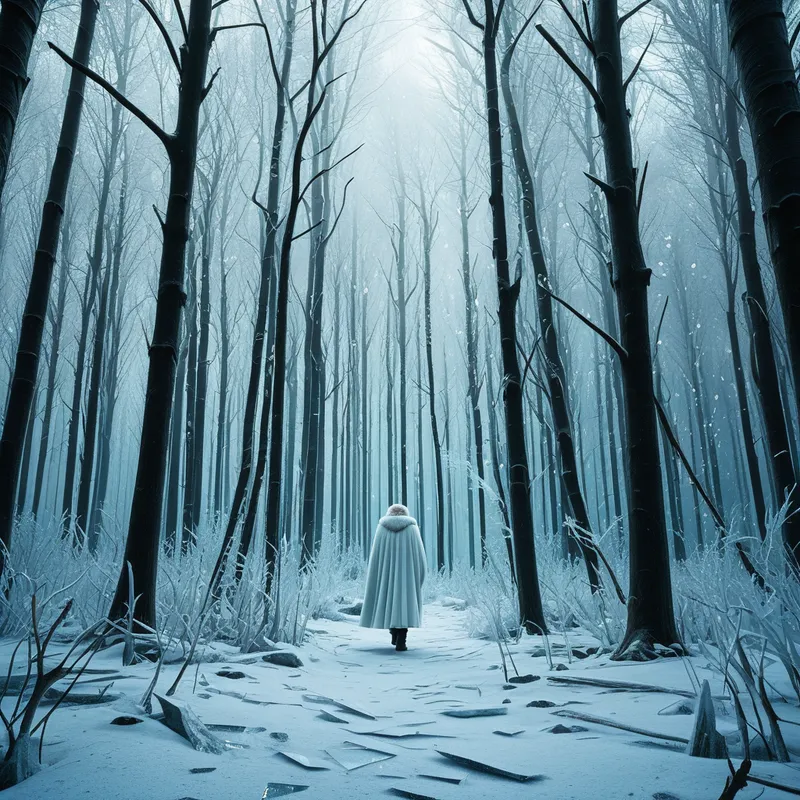
Hear now the tale that begins not in the golden light of Asgard, but in the deep, echoing silence of Jotunheim. Where the wind carves stone and the cold is a living thing, there dwelled Skadi, daughter of the frost-giant Thjazi. Her world was one of stark peaks, of solitude that sang, of tracks across virgin snow. She was the huntress of the high places, at home in the howling gale.
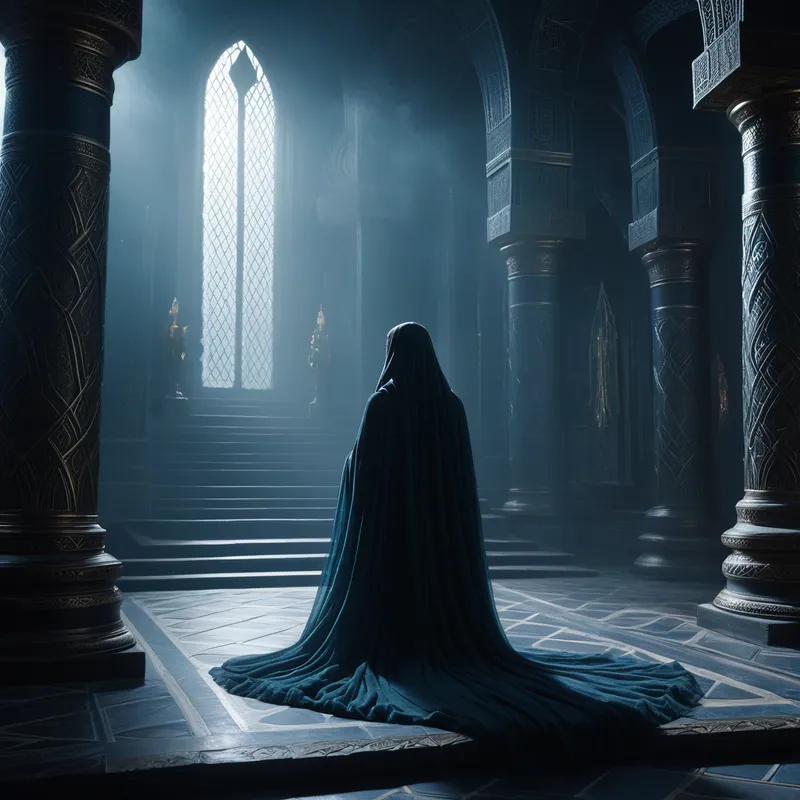
Then came the news, carried on a bitter wind: her father was slain. The gods of Asgard had tricked him, and the trickster Loki had guided the fatal blow. Grief, colder than any mountain ice, locked around her heart. But Skadi’s grief did not weep; it armored itself in iron resolve. She took up her father’s gleaming helm, strung her great bow, and strode from her frozen halls. Her destination: the shining gates of Asgard itself. She went not to plead, but to demand a blood-price. The very walls of the gods’ realm trembled at her approach, not from fear of her army, for she came alone, but from the sheer, glacial force of her wrath.
The gods, gathered in their glittering hall, beheld her. Here was no cowering supplicant, but an embodiment of the wild world they had wronged. To avert her fury, they offered compensation. She could choose a husband from among them, but by a cruel twist, she must choose by their feet alone, seeing nothing else. In the shadowy hall, the gods lined up behind a curtain. Skadi moved down the line, her eyes scanning the ground. She sought the most beautiful feet, believing they must belong to Baldr, the most radiant of them all. Her hand fell upon a pair of feet, clean and finely shaped. “This one,” she declared.
The curtain was drawn back. The feet belonged to Njord, god of the gentle sea, of warm shores and summer winds. Her heart, forged in frost, sank. But a bargain was struck. Njord, too, had his condition: for nine nights, they would dwell in her mountain home, Thrymheim; for the next nine, in his seaside hall, Noatun.
In Thrymheim, the wolves howled a lullaby Njord could not bear. “The mountains are too harsh,” he mourned, “the wolves’ song is a shriek to me.” In Noatun, Skadi lay awake, tortured by the shrieking of gulls and the sighing of the tide. “The sea’s cry is the weeping of the lost,” she said. “I cannot rest where the land does not hold me fast.” Their worlds, of shifting wave and unmoving stone, could not be reconciled. The marriage of frost and fire melted into a chill understanding: they were fundamentally, eternally, other to one another.
Yet, from this failed union, Skadi carved her own fate. She returned to her mountains, but not unchanged. The gods, in a final gesture, made her laugh—a sound as rare and startling as ice cracking in spring. The trickster Loki tied a goat to his testicles, and his antics broke her stern composure. And they gave her a further gift: they took her father’s eyes and cast them into the heavens, where they shine as twin stars. So Skadi took her place not as a wife in a foreign hall, but as a goddess in her own right, the sovereign of the winter hunt, the untamed spirit of the high, lonely places where the soul goes to find itself.
Cultural Origins & Context
This myth is preserved primarily in the Poetic Edda and the later Prose Edda of Snorri Sturluson. It emerges from a Norse worldview that did not simplistically oppose gods and giants, but saw them as intertwined, necessary opposites in the cosmic balance. The giants (Jotnar) represented the raw, untamed, and often destructive forces of nature, while the Æsir represented order, culture, and cosmos.
Skadi’s story functioned as a mythic negotiation between these realms. It was a tale told in the long winter nights, explaining the harshness of the season and the stark beauty of the mountains. It served as a social narrative about marriage alliances (often fraught between clans), the payment of weregild (man-price) for slain kin, and the profound difficulty of integrating fundamentally different ways of life. Skadi’s ultimate independence and divine status also hint at a cultural recognition of feminine autonomy and power residing outside the domestic sphere, in the wilderness itself.
Symbolic Architecture
Skadi is the archetype of the Shadow made conscious and sovereign. She represents the part of the psyche that is forged in grief, hardened by injustice, and which withdraws to the high, cold places of isolation to preserve its integrity.
The journey from vengeance to sovereignty is a path walked alone, where the heat of rage is cooled into the clear, hard diamond of resolve.
Her father, Thjazi, can be seen as an old, perhaps outmoded, structure of the Self—a dominant inner figure whose death (through the tricks of Loki, the chaotic, transformative principle) creates a crisis. Her initial drive is pure, reactive emotion: a cold, focused rage seeking retribution. The forced marriage to Njord symbolizes the ego’s attempt to integrate this powerful, wounded energy (Anima in its untamed form) with its opposite: the adaptable, nurturing, social-oriented aspect (the Animus as the peaceful provider). The failure of this union is not a tragedy, but a profound truth: some aspects of the self cannot be domesticated or lived with comfortably on a daily basis. They require their own realm.
Her laughter, provoked by Loki’s grotesque comedy, is crucial. It is the moment the rigid, armored psyche cracks, allowing a release of tension and a connection to the absurd. It is the thaw that permits movement. The stellar transformation of her father’s eyes signifies the alchemical sublimation of her attachment: the personal loss is transmuted into an eternal, guiding perspective in the inner firmament.
The Dreamer’s Resonance
To dream of Skadi is to dream of a season of the soul. It often manifests when one is processing a deep, cold grief or a profound sense of betrayal that has led to emotional withdrawal. The dreamscapes are of immense, empty landscapes—frozen tundras, sheer cliff faces, vast halls devoid of warmth.
Somatically, the dreamer may feel a literal chill, a stiffness, or a sense of being “frozen” in a situation. Psychologically, they are in the “Thrymheim phase”: having retreated to a psychic fortress to nurse their wounds and gather their strength. The conflict with the “Njord” element—perhaps dreams of suffocating warmth, clamoring social demands, or the unsettling fluidity of emotion—signals the painful, necessary failure of trying to force reconciliation before the self is ready. This dream pattern marks the process of moving from reactive vengeance to a chosen, empowered solitude.
Alchemical Translation
The Skadi myth models the individuation process of differentiation through isolation. The modern individual is constantly pressured to integrate, to adapt, to make peace with inner and outer conflicts. Skadi’s path offers a different alchemy: the Opus Contra Naturam (work against nature) of honoring the part that will not blend.
The true marriage is not between self and other, but between the self and its own unassailable, mountainous core.
The first stage is Nigredo: the blackening, represented by Thjazi’s death and Skadi’s vengeful grief. The old identity is shattered. The second is Albedo: the whitening, her ascent to Asgard and the failed marriage—an attempt at purification through opposition that only clarifies the essential difference. The third is Rubedo: the reddening, not found in union with Njord, but in her return to the mountains, now as a conscious choice. Her laughter is the spark of the lapis philosophorum, the philosopher’s stone—the realization that wholeness includes the part that stands apart.
For the modern seeker, Skadi’s journey teaches that healing does not always mean coming in from the cold. Sometimes, it means learning to build a sacred hearth in the heart of the winter itself, to become the sovereign of one’s own necessary solitude. It is the transmutation of the wound into a watchtower, granting a clearer, colder, and more truthful view of one’s entire world.
Associated Symbols
Explore related symbols from the CaleaDream lexicon: