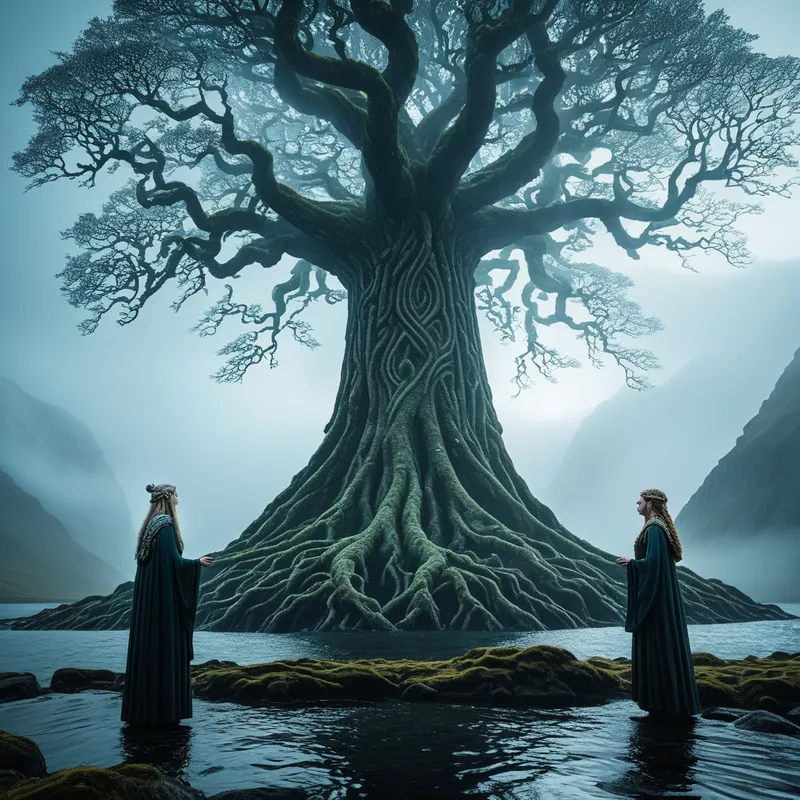
The Norns at Urðarbrunnr Myth Meaning & Symbolism
Three sisters at the Well of Fate carve runes into the World Tree, weaving the past, present, and future of all beings from gods to mortals.
The Tale of The Norns at Urðarbrunnr
Listen, and let your mind travel to the roots of [the world](/myths/the-world “Myth from Tarot culture.”/). Not in [the earth](/myths/the-earth “Myth from Hindu culture.”/) you know, but in the dark, silent places where the great arteries of existence pulse with a slow, green fire. Here, beneath the third and deepest root of the [Yggdrasil](/myths/yggdrasil “Myth from Global/Universal culture.”/), lies a place where the air is thick with the scent of wet stone and ancient moss. This is [Urðarbrunnr](/myths/urarbrunnr “Myth from Norse culture.”/), a well so deep its waters are not [water](/myths/water “Myth from Chinese culture.”/) at all, but liquid memory, pooled potential, the silent substance of what was and what shall be.
To this place, when the cosmos was young and the first gods were still learning their own names, came [three sisters](/myths/three-sisters “Myth from Native American culture.”/). They did not arrive from any direction the ravens could report. They simply were, as the well simply was. The first, Urðr, had hair the color of ash and eyes that held the stillness of a long-settled forest floor. The second, Verðandi, moved with the fluid grace of a sapling in [the wind](/myths/the-wind “Myth from Various culture.”/), her gaze sharp and immediate. The third, [Skuld](/myths/skuld “Myth from Norse culture.”/), was veiled, her form hinting at shapes not yet formed, her presence a whisper of inevitable consequence.
They did not speak to one another. They did not need to. Their work was a silent symphony. From the murky, star-flecked depths of the well, they drew up the silvery mud—the ørlög. With hands that knew no hesitation, they began to daub this sacred clay upon the root of the Yggdrasil where it breached the well’s rim. But this was no mere anointing. As their fingers moved, the mud resolved into lines, into curves, into the stark, angular shapes of [runes](/myths/runes “Myth from Norse culture.”/). They carved the story of the tree’s suffering, of the serpent Níðhöggr gnawing below, of the eagle screaming from the highest branch.
Then, from the same waters, they drew threads—gossamer filaments that glimmered with the color of dawn, the grey of twilight, and the profound black of the space between stars. Urðr held the spindle, the thread already spun, dense with completed actions. Verðandi measured it, her touch determining its current tension, its present length. Skuld held the shears, but she did not cut. Not yet. She merely held them, a silent promise, while with her other hand she guided the thread onto the growing tapestry that was not a tapestry, but the very bark and sapwood of the Tree.
They wove the life-thread of a newborn jarl in [Midgard](/myths/midgard “Myth from Norse culture.”/), its beginning bright and strong. They wove the fraying strand of an aging jötunn in Jötunheimr. They wove the glittering, perilous cord of Loki, tangled and knotted with brilliance and spite. They wove the destiny of Odin himself, who would one day come to this very well, sacrifice his eye, and hang from the Tree to gain the wisdom of [the runes](/myths/the-runes “Myth from Norse culture.”/) they carved. They wove it all into the Yggdrasil, so that to feel the bark was to feel the thrum of all happening, all at once. The only sounds were the drip of well-water, the soft scratch of runes being etched into living wood, and the whisper of fate passing through timeless fingers.
Cultural Origins & Context
This vision of the [Norns](/myths/norns “Myth from Nordic culture.”/) is stitched together from fragments found primarily in the Poetic Edda, specifically in the Völuspá (The Prophecy of the Seeress) and Fáfnismál (The Lay of Fáfnir). These poems were compiled in the 13th century from much older oral traditions. The myth was not a Sunday sermon but a foundational layer of the Norse worldview, recited by skalds and seeresses around fires in longhouses, under skies alive with the aurora that might have seemed like threads of Verðandi’s weaving.
Its societal function was profound and twofold. First, it provided a cosmological explanation for the nature of time and causality. Time was not a linear river but a woven tapestry, where past deeds (Urðr) directly shaped present reality (Verðandi), which in turn determined future necessity (Skuld). Second, it established a critical tension central to the Norse heroic ethos: the interplay of inexorable fate (ørlög) and personal honor. One’s thread was spun, but how one carried that thread—with courage, wisdom, or treachery—was the measure of a person. The myth taught that while the destination might be written, the dignity of the journey was the hero’s to forge.
Symbolic Architecture
Psychologically, the myth presents a complete model of the [psyche](/myths/psyche “Myth from Greek culture.”/)’s [relationship](/symbols/relationship “Symbol: A representation of connections we have with others in our lives, often reflecting our emotional state.”/) with time and [the Self](/myths/the-self “Myth from Jungian culture.”/). The Norns are not external deities but profound internal archetypes governing the process of [consciousness](/symbols/consciousness “Symbol: Consciousness represents the state of awareness and perception, encompassing thoughts, feelings, and experiences.”/).
Urðr symbolizes the personal and [collective unconscious](/symbols/collective-unconscious “Symbol: The Collective Unconscious refers to the part of the unconscious mind shared among beings of the same species, embodying universal experiences and archetypes.”/)—the vast, watery well of all that has happened to us, our ancestral inheritance, our traumas, and our forgotten joys. It is the stored data of existence. Verðandi represents the ego-consciousness in the act of [perception](/symbols/perception “Symbol: The process of becoming aware of something through the senses. In dreams, it often represents how one interprets reality or internal states.”/) and [decision](/symbols/decision “Symbol: A decision in a dream reflects the choices one faces in waking life and can symbolize the pursuit of clarity and resolution.”/). She is the [moment](/symbols/moment “Symbol: The symbol of a ‘moment’ embodies the significance of transient experiences that encapsulate emotional depth or pivotal transformations in life.”/) of [choice](/symbols/choice “Symbol: The concept of choice often embodies decision-making, freedom, and the multitude of paths available in life.”/), the point where the [weight](/symbols/weight “Symbol: Weight symbolizes burdens, responsibilities, and emotional loads one carries in life.”/) of the past meets the possibility of the future. Skuld embodies the teleological pull, the future’s imperative shaped by the debts (skuld literally means “[debt](/symbols/debt “Symbol: A symbolic representation of obligations, burdens, or imbalances that extend beyond financial matters into psychological and moral realms.”/)”) incurred by past and present actions.
The Well of Urðr is the psyche itself, and the Norns are the process by which the unconscious becomes conscious, and consciousness, in turn, shapes destiny.
The Yggdrasil is the symbolic [structure](/symbols/structure “Symbol: Structure in dreams often symbolizes stability, organization, and the framework of one’s life, reflecting how one perceives their environment and personal life.”/) of the individuated Self—the total, living [system](/symbols/system “Symbol: A system represents structure, organization, and interrelated components functioning together, often reflecting personal or social order.”/) of the psyche. The runes carved into it are the formative patterns, the core complexes and archetypal dynamics that define our being. The weaving is the ongoing [integration](/symbols/integration “Symbol: The process of unifying disparate parts of the self or experience into a cohesive whole, often representing psychological wholeness or resolution of internal conflict.”/) of [life](/symbols/life “Symbol: The symbol of ‘Life’ represents a journey of growth, interconnectedness, and existential meaning, encompassing both the joys and challenges that define human experience.”/) experiences into the [structure](/symbols/structure “Symbol: Structure in dreams often symbolizes stability, organization, and the framework of one’s life, reflecting how one perceives their environment and personal life.”/) of who we are. We are both the [tree](/symbols/tree “Symbol: In dreams, the tree often symbolizes growth, stability, and the interconnectedness of life.”/) being inscribed and, potentially, the weaver who must take [responsibility](/symbols/responsibility “Symbol: Responsibility in dreams often signifies the weight of duties and the expectations placed upon the dreamer.”/) for the [pattern](/symbols/pattern “Symbol: A ‘Pattern’ in dreams often signifies the underlying structure of experiences and thoughts, representing both order and the repetitiveness of life’s situations.”/).
The Dreamer’s Resonance
When this myth stirs in modern dreams, it often manifests during life passages where the weight of time is felt: a major decision, the aftermath of a consequential mistake, a midlife reckoning, or the approach of a significant ending.
Dreaming of three women, especially of varying ages, by a body of water or a large tree can signal this archetypal constellation. The dreamer might be shown a book being written, a tapestry being woven, or a tree with names carved into its bark. The somatic feeling is often one of profound gravity—a sense of things being “set” or “decided.” This is not a nightmare, but a solemn dream. It indicates the psyche is actively engaged in the process of norn-work: reviewing the clay of the past (Urðr), assessing the current thread of life (Verðandi), and confronting the inevitable consequences taking shape ahead (Skuld). The psychological process is one of reconciling with one’s own history and accepting agency within the bounds of what one has already become.
Alchemical Translation
The alchemical process modeled here is the transmutation of blind fate into conscious destiny. The base material is the primal mud of Urðarbrunnr—our unexamined life, our genetic and psychological inheritance, our [karma](/myths/karma “Myth from Hindu culture.”/). [The Norns](/myths/the-norns “Myth from Norse culture.”/) represent the stages of the Opus.
First, Calcinatio (Urðr): The past is brought up from the well and examined. This is the often-painful process of confronting one’s history, burning away illusions about one’s origins and victimhood to find the essential ore of experience.
Second, [Solutio](/myths/solutio “Myth from Alchemical culture.”/) (Verðandi): The present moment dissolves rigid identities. Here, in the fluidity of conscious choice, we can re-measure our thread. This is the stage of flexibility, adaptation, and taking present responsibility for how we hold our story.
Third, Coagulatio (Skuld): The future is given form. By integrating the work of the first two stages, the shears of Skuld are no longer a threat of arbitrary cut-off, but the tool that defines a meaningful shape. The future coagulates not as a predetermined sentence, but as a destiny shaped by wisdom.
Individuation is the journey from being a passive leaf on Yggdrasil to becoming, in some small, holy measure, a tender of its roots at the well.
The ultimate alchemical goal is not to escape the weave but to become a conscious participant in it. Like Odin, we must make the sacrifice (of our one-eyed ego certainty) to drink from the well and learn the runes. We then return to our lives not to cut the thread, but to weave with greater artistry, understanding that every present choice is a rune carved into the tree of the world, and into the root-system of our own soul.
Associated Symbols
Explore related symbols from the CaleaDream lexicon: