
The Nomad Myth Meaning & Symbolism
A timeless story of a wanderer who leaves the known world to seek a truth that can only be found in the unmapped wilderness of existence.
The Tale of The Nomad
Listen. The fire is low, and the wind carries the scent of distant rain. Let me tell you of the one who walked away.
There was a person—call them a seeker, a listener—who dwelt in the City of Fixed Stars. Its walls were high, its laws were clear, and its people knew their names, their trades, the exact measure of their days. The sun rose and set on a predictable clockwork of harvest, festival, and sleep. But this one felt a hollow wind whistle through the chambers of their soul, a tune that did not match the city’s hymns. They heard it in the gap between heartbeats, in the silence after the marketplace closed: a call from beyond the last watchtower.
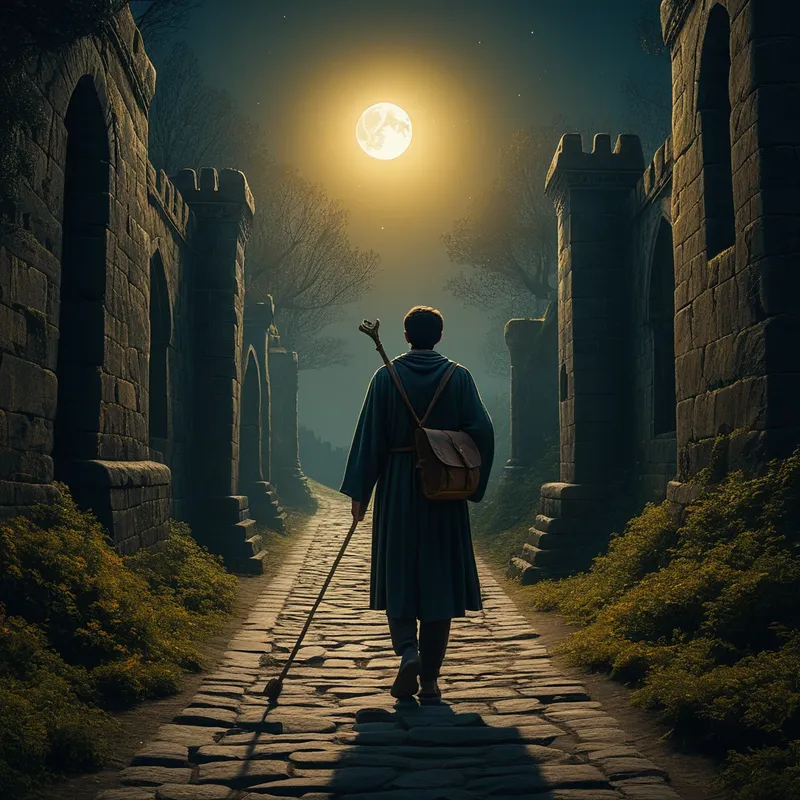
One morning, when the dew was still a cold silver on the cobblestones, they did not go to their loom or their ledger. They took a staff of unvarnished wood, a waterskin, and a pouch of hearth-ashes. Without farewells—for words would have been anchors—they passed through the great gate, its shadow a cold line across their back. The gatekeeper, an old man with milky eyes, simply nodded, as if he had been waiting to see who would finally answer the call.
The known road ended in a tangle of wild grasses. The Uncharted Steppe opened before them, a vast breathing entity under an endless sky. Here, there were no maps, only the teachings of the wind, the sun’s arc, and the secret language of animal tracks. They learned hunger that was a sharpening stone, thirst that was a prayer. They met the Ghost of the Salt Flats, who showed them mirages of lost cities and whispered that all destinations are illusions. They crossed the River of Echoes, where the water murmured with the voices of everyone they had ever been.
Seasons wheeled. Their city clothes frayed to nothing, replaced by garments of beast-hide and woven reeds. Their skin became the color of the earth, their eyes the color of the horizon. They forgot the songs of the city and began to hum the drone of the desert, the rhythm of their own footsteps. They were no longer from anywhere. They were simply going.
And then, one evening, as they crested a rise expecting yet another valley, they stopped. Before them lay not wilderness, but the familiar, warm glow of hearth-fires. The walls of their city stood in the distance. They had walked a great circle of the world. But as they approached, they saw with a shock that the gate, the streets, the faces—they were all utterly strange. It was a city, but it was not their city. Or perhaps it was, and they were the one who had become strange. The gatekeeper, a young man with curious eyes, did not recognize them.
The wanderer stood at the threshold, the warmth of home on one side, the vast, cool night on the other. They did not enter. They simply smiled, turned their staff toward a new, dark quarter of the sky, and took the first step of a new, unknown circle.
Cultural Origins & Context
The myth of The Nomad is not the property of any single culture, but a story etched into the collective bone-memory of humanity. It is found in the epic wanderings of Gilgamesh seeking immortality, in the forty-year Exodus of the Israelites in the desert, in the Aboriginal Dreamtime tracks that crisscross the continent, and in the Norse tales of Óðinn who travels in disguise. It was told around campfires on the Eurasian steppe, in the tents of Bedouin poets, and by the Inuit on the ice. Its tellers were the ones who lived by movement—the herders, the traders, the hunters—for whom home was not a point on a map, but a direction in the soul.
Its societal function was dual. For settled peoples, it was a cautionary tale about the dangers of abandoning one’s duties and the stability of the community. For nomadic peoples, it was a sacred charter, a mythic validation of their way of life, teaching that wisdom and identity are forged in motion, in relationship with the changing earth, not in the accumulation of things. It passed not as scripture, but as song, as anecdote, as the shared, weary, and wondrous glance between two travelers meeting on a lonely path.
Symbolic Architecture
The Nomad is the archetypal embodiment of the Self on its journey toward consciousness. The City represents the ego-complex—ordered, familiar, but ultimately confining. The call is the stirring of the unconscious, the intuition that there is more to one’s being than the socially constructed identity.
The true journey begins not with a step, but with a rupture in the map of the self.
The staff is the axis of will and intuition; the hearth-ashes are the symbolic link to the past, not as a burden, but as the elemental core of what one is. The Uncharted Steppe is the vast, unorganized territory of the unconscious—the personal and collective shadow, the realm of instincts, dreams, and latent potentials. The Ghost of the Salt Flats is the trickster archetype that dismantles illusion, teaching that the goal is not a place, but the transformation undergone in seeking it. The circular journey reveals the ultimate truth: one can never return to the old “home” of the ego, because the journey itself has annihilated that self. The new city, unrecognizable, symbolizes the new psychic structure that has been formed—a potential new conscious attitude, which the true Nomad must now also leave behind, in perpetual becoming.
The Dreamer’s Resonance
When this myth stirs in the modern dreamscape, it often manifests as dreams of endless travel: missing trains, wandering empty airports, driving on highways that loop back on themselves, or walking through ever-shifting, labyrinthine cities. The somatic feeling is one of rootless anxiety, a profound restlessness in the bones. This is not a call to literal travel, but a signal from the psyche that a phase of life—a relationship, a career, a deeply held self-concept—has become a “city” that now confines. The ego has outgrown its container.
The psychological process is one of uprooting. The dream-ego is being forced to relinquish its identification with a static identity. The anxiety is the death-throes of the old self, resisting its necessary dissolution. To dream of being a Nomad is to be in the liminal space between identities, where the old maps are useless and the new land has not yet coalesced. It is a deeply vulnerable, yet critically fertile, psychic state.

Alchemical Translation
The alchemical process mirrored in The Nomad’s journey is the Nigredo, extended into a way of being. It is the perpetual dissolution of fixed forms. In individuation, we are tempted to believe the goal is to arrive at a final, integrated, and static state of enlightenment or wholeness—a new, perfected “city” to live in forever. The Nomad myth corrects this.
Individuation is not a destination to be reached, but a fidelity to the journey itself. The goal is to become a fluent speaker of the language of departure.
The transmutation occurs in the walking. Each step is a confrontation with the unknown, a small death of expectation, a birth of immediate, unmediated experience. The “treasure” the Nomad seeks is not a grail or a throne, but the capacity to be transformed. The circular path is the key: it signifies that the work is never done. Each time we think we have “found ourselves,” we are merely at a new starting point, looking at a familiar world with utterly foreign eyes, and must have the courage to turn away from that new comfort.
The modern individual engaged in this work must learn to hold identity lightly, to see life not as a building project, but as a pilgrimage where the sacred sites are moments of profound disorientation and reorientation. The triumph is not in settling the wilderness, but in developing such a deep kinship with it that one is never truly lost, only eternally finding.
Associated Symbols
Explore related symbols from the CaleaDream lexicon: