The Nile Inundation Myth Meaning & Symbolism
The story of how the goddess Isis's grief for Osiris caused the Nile to flood, bringing both destruction and the fertile silt of renewal to Egypt.
The Tale of The Nile Inundation
Listen. Before [the world](/myths/the-world “Myth from Tarot culture.”/) knew the rhythm of seasons, there was only the burning gaze of Ra and the deep, silent flow of Hapi, the great river. The land was parched, a creature of dust panting under the sun. Then came the sorrow that would birth the cycle of [the world](/myths/the-world “Myth from Tarot culture.”/).
It began with a cry that split the silence of [the Duat](/myths/the-duat “Myth from Egyptian culture.”/), [the underworld](/myths/the-underworld “Myth from Greek culture.”/). Isis, the great magician, the devoted wife, had searched the length and breadth of the Two Lands for the scattered pieces of her beloved [Osiris](/myths/osiris “Myth from Global/Universal culture.”/), murdered and dismembered by the chaos of Set. With magic and unbearable love, she had reassembled him, had even conceived their son [Horus](/myths/horus “Myth from Egyptian culture.”/) from his posthumous essence. But [Osiris](/myths/osiris “Myth from Global/Universal culture.”/) was now Lord of the Beautiful West, ruler of the dead, and could not return to the land of the living.
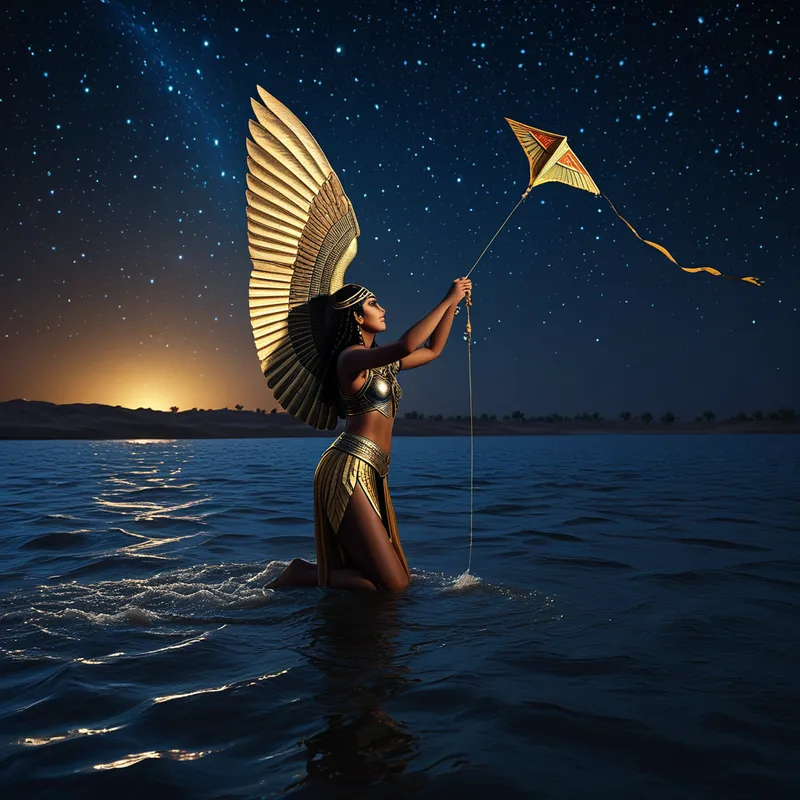
Her grief did not end with his resurrection in the afterlife. It deepened, became a vast, inland sea within her. She retreated to the banks of the great river, the artery of the world. There, she knelt on the black soil, her form sometimes that of a woman, sometimes that of a kite—a bird of piercing lament. She thought of his green skin, the color of new growth, now belonging to the realm of shadows. She thought of his gentle rule, replaced by the red sands of strife. The memory of his loss was a hook in her heart, pulling forth a tide of tears.
They were not small tears. They were the tears of a goddess whose love built kingdoms and whose magic revived gods. Each drop that fell from her cheek was a world of sorrow. They struck the placid surface of Hapi’s waters not with a plink, but with a profound, resonant thrum that traveled [the river](/myths/the-river “Myth from Buddhist culture.”/)’s entire length. The [water](/myths/water “Myth from Chinese culture.”/), sympathetic, began to weep with her. It swelled. It stirred from its bed. It remembered its own chaotic, primordial nature before the time of order, [Ma’at](/myths/maat “Myth from Egyptian culture.”/).
The river rose. It did not rage like the storms of Set; it mourned. It overflowed its banks with a heavy, deliberate sigh, a liquid embrace for the grieving land. The dark, life-giving water, now mingled with the divine salt of Isis’s sorrow, spread across the fields. It drowned the old, dry stalks of last year’s harvest. It covered the footprints of men and beasts. It silenced the world under a shallow, reflective sea.
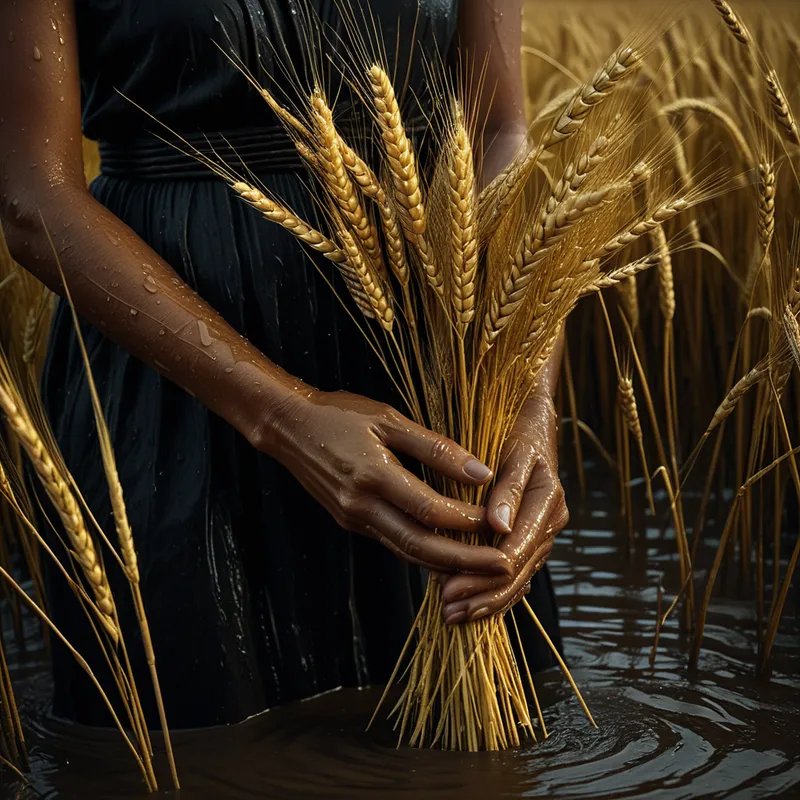
For days, the land was a mirror to a grey sky, a monument to loss. Then, as all things must turn, the waters began to recede. They left behind not just mud, but a gift: a layer of rich, black silt, Kemet, the very name of Egypt. This silt was the fertile essence of the faraway mountains, the dissolved substance of the south, now transformed and charged by the goddess’s tears. It was grief made fertile. From this dark, wet blanket, green shoots would soon erupt with a vigor unknown before—barley, emmer wheat, flax. Life returned, not in spite of [the flood](/myths/the-flood “Myth from Biblical culture.”/), but because of it. The inundation was no catastrophe; it was the land drinking the tears of Isis and transforming them into the body of Osiris, the green god of resurrection. The cycle was sealed: love, loss, grief, flood, retreat, and glorious, abundant rebirth.
Cultural Origins & Context
This myth was not a single story recited in temples but the fundamental, lived reality of ancient Egyptian civilization. The Inundation or Akhet was the pivotal event of the year, dividing the calendar into three seasons: Inundation, Emergence, and Harvest. The myth of Isis’s tears provided the sacred, narrative framework for this uncontrollable, essential natural phenomenon.
It was a story woven into the fabric of state and soul. [Pharaoh](/myths/pharaoh “Myth from Egyptian culture.”/), as the living Horus, was ritually responsible for ensuring the flood’s arrival and bountiful retreat, acting as the intermediary between the people and the divine grief that sustained them. The myth was enacted in temple rituals and hymns, particularly those dedicated to [Isis and Osiris](/myths/isis-and-osiris “Myth from Egyptian culture.”/). It explained the why of their world: life was not a given, but a gift born from a divine, cyclical sacrifice and profound emotional alchemy. The society’s function—agriculture, taxation, labor—was organized around this story of death and rebirth, making the myth the ultimate grounding principle of Ma’at.
Symbolic Architecture
At its core, the myth presents a radical, non-[linear](/symbols/linear “Symbol: Represents order, predictability, and a direct, step-by-step progression. It symbolizes a clear path from cause to effect.”/) understanding of creation. [Fertility](/symbols/fertility “Symbol: Symbolizes creation, growth, and abundance, often representing new beginnings, potential, and life force.”/) does not come from joyful union alone, but from the conscious, watery [dissolution](/symbols/dissolution “Symbol: The process of breaking down, dispersing, or losing form, often representing transformation, release, or the end of a state of being.”/) that follows profound [loss](/symbols/loss “Symbol: Loss often symbolizes change, grief, and transformation in dreams, representing the emotional or psychological detachment from something or someone significant.”/).
The most fertile ground is not that which is untouched, but that which has been thoroughly drowned by the waters of feeling.
[The Nile flood](/myths/the-nile-flood “Myth from Egyptian culture.”/) symbolizes the necessary, periodic overwhelm of the conscious ego. The ordered banks of the [river](/symbols/river “Symbol: A river often symbolizes the flow of emotions, the passage of time, and life’s journey, reflecting transitions and movement in one’s life.”/)—the defined fields, the villages, the predictable pathways—represent the established structures of [life](/symbols/life “Symbol: The symbol of ‘Life’ represents a journey of growth, interconnectedness, and existential meaning, encompassing both the joys and challenges that define human experience.”/) and [psyche](/myths/psyche “Myth from Greek culture.”/). The [inundation](/symbols/inundation “Symbol: A flood or overwhelming deluge, often representing emotional overwhelm, cleansing, or uncontrollable forces.”/) is the unconscious, emotional tide that must periodically rise to dissolve those rigid boundaries. Isis’s tears are not weakness; they are the active, magical substance of transformation. She does not suppress her [grief](/symbols/grief “Symbol: A profound emotional response to loss, often manifesting as deep sorrow, yearning, and a sense of emptiness.”/); she expresses it so completely that it alters the geography of the world. The black [silt](/symbols/silt “Symbol: Fine sediment deposited by water, representing accumulation, hidden foundations, and the fertile residue of time’s passage.”/), Kemet, is the symbolic [residue](/symbols/residue “Symbol: What remains after a process or event; traces left behind that persist beyond the original occurrence.”/) of this process: the new, fertile potential that can only emerge after the old has been decomposed in the waters of sorrow.
Osiris, the dismembered god who becomes [Lord](/symbols/lord “Symbol: The symbol of ‘Lord’ represents authority, mastery, and control, along with associated power dynamics in relationships.”/) of the Dead and [source](/symbols/source “Symbol: The origin point of something, often representing beginnings, nourishment, or the fundamental cause behind phenomena.”/) of vegetative life, represents the content that must be sacrificed and mourned—an old [identity](/symbols/identity “Symbol: Identity represents the sense of self, encompassing personal beliefs, cultural background, and social roles.”/), a [relationship](/symbols/relationship “Symbol: A representation of connections we have with others in our lives, often reflecting our emotional state.”/), a phase of life. His green [skin](/symbols/skin “Symbol: Skin symbolizes the boundary between the self and the world, representing identity, protection, and vulnerability.”/) is the promise that what is mourned is not lost but transmuted into a different, more foundational form of sustenance.

The Dreamer’s Resonance
When this myth stirs in the modern unconscious, it often manifests in dreams of flooding. These are not typically nightmares of tsunamis, but dreams of a slow, inevitable, melancholic rise of water within one’s own house—the psyche’s domicile. The furniture of daily identity floats; familiar rooms become unfamiliar, submerged lagoons. There is a somatic feeling of being emotionally “in over one’s head,” of a grief or depression that is quietly filling up the container of [the self](/myths/the-self “Myth from Jungian culture.”/).
This dream-flood signals that a psychic Inundation is underway. The conscious ego is being gently, irresistibly overwhelmed by material from the depths—unprocessed loss, old sorrows, or a deep yearning for meaning that cannot be articulated. The dreamer is in the phase of Akhet. The critical task is not to frantically bail out the water, but to understand, like Isis, that this flood is sacred. It is the psyche’s necessary irrigation. The process is one of saturation, of allowing the tears to fall and the waters to rise, trusting in the organic timeline of retreat.

Alchemical Translation
The alchemical journey modeled by this myth is the transmutation of [Nigredo](/myths/nigredo “Myth from Alchemical culture.”/) into Viriditas—the blackening into greening. In psychological terms, it is the individuation process of consciously engaging with profound sorrow, not as a pathology to be cured, but as [the prima materia](/myths/the-prima-materia “Myth from Alchemical culture.”/) for renewal.
The individual must become the riverbank and the flood, the mourner and the fertile field.
First, one must Gather the Fragments (Isis searching for Osiris): confronting the dismembered parts of one’s history, the traumas and losses that feel scattered and unreconciled. Then comes the Sacred Lament (Isis’s tears): the full, embodied expression of grief, allowing the emotional tide to rise and dissolve the rigid, arid structures of the [persona](/myths/persona “Myth from Greek culture.”/). This is the putrefaction, the dissolution in the aqua permanens of feeling.
The floodwaters eventually recede not by force of will, but by the natural completion of their cycle. What remains is the Black Silt of the Self (Kemet): a new, rich, and incredibly fertile inner ground. This is the humus of the soul, composted from what was mourned. From this ground, the Green Shoot (Horus, the new conscious attitude) can emerge—vital, resilient, and rooted in the transformed depth of what came before. The modern individual learns that personal growth is not a linear ascent, but a cyclical immersion. To live a fertile life, one must periodically allow the river of the unconscious to flood its banks, trusting that the retreating waters will leave behind not ruin, but the very substance of future growth.
Associated Symbols
Explore related symbols from the CaleaDream lexicon: