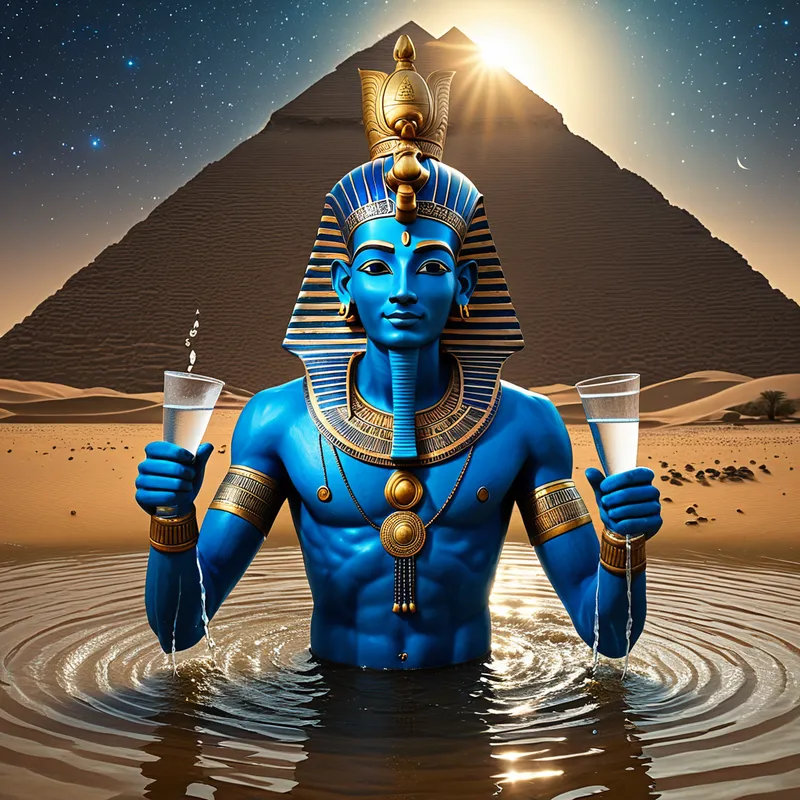
The Nile Flood Myth Meaning & Symbolism
The god Hapi's annual flood, born from the goddess Isis's tears, transforms barren land into fertile black soil, embodying the cycle of death and rebirth.
The Tale of The Nile Flood
In the time before time, when the sky was a vast, inverted bowl of beaten copper and the land was the bone-dry hide of a long-dead beast, the world held its breath. The sun, Ra, blazed his daily path, but his heat was a curse. The earth cracked into a million thirsty mouths. The people, shadows clinging to the river’s fading memory, watched the lifeblood of Kemet shrink to a thin, brown trickle. Despair, thick and heavy as a funeral shroud, settled over the Two Lands.
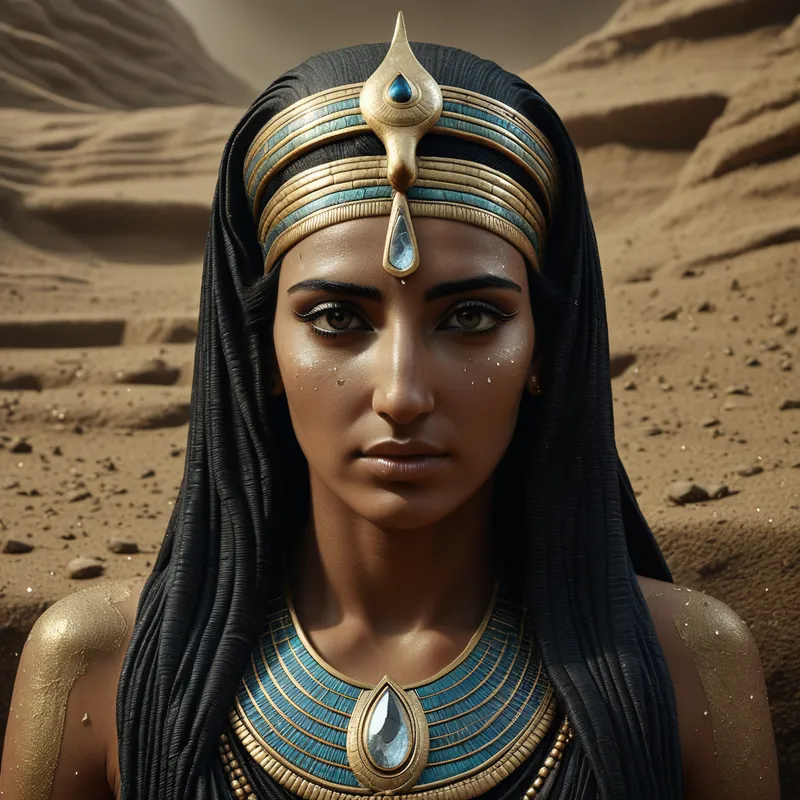
But in the silent, star-chilled vault of the night, a goddess wept. Isis, the Great of Magic, whose throne was sorrow, knelt on the barren bank. Her heart was a cavern echoing with a loss older than the pyramids—the loss of her beloved Osiris, slain and scattered. Her grief was not a quiet thing. It was a torrent held behind the dam of her divinity. And on this night, the dam broke.
A single tear, luminous as a pearl, fell from her cheek. It did not sink into the dust. It rang upon it like a silver bell. Then another fell, and another, until her weeping became a rain that was not rain, a storm contained within her sorrow. The tears did not evaporate under Ra’s gaze; they flowed. They gathered in the deep places, tracing the forgotten path of the river. They called to the abyssal waters under the earth, to the celestial ocean above the sky.
And he heard. From the murky depths at the world’s first cataract, where chaos met order, he stirred. Hapi. He was not a man, not a beast, but the potent, fecund spirit of the river itself. His skin was the blue-green of deep water, his body robust with the promise of abundance. Upon his head sat the twin crowns: the papyrus of the North and the lotus of the South. In his hands, he carried two overflowing vases.
With a sound like the sigh of the earth itself, Hapi poured forth. He did not merely flood the land; he embraced it. The water, born of divine grief, was dark, rich, and warm. It did not destroy, but sought. It slipped into every crack, every fissure, every desperate, open mouth of the soil. It covered the fields not as a conqueror, but as a lover, a nourisher. For days, the world was a primordial ocean once more, a return to the Nun.
Then, the miracle. As Ra’s barque rose again, the waters began to recede, slow and deliberate. What they left behind was not mud, but life. A layer of black, gleaming silt—the rich, fertile Kemet itself. From this dark, wet womb, green shoots erupted with a joyful violence. Barley and emmer wheat waved in the new breeze. Lotus blossoms unfurled on the receding pools. The people emerged from their homes, not to salvage, but to celebrate. They cast seeds into the black gold, knowing they would feast. The flood was not a disaster. It was the annual resurrection, the tear of grief transformed into the milk of sustenance. The cycle was sealed: from the tears of Isis came the gift of Hapi, and the desert once again dreamed of becoming a garden.
Cultural Origins & Context
This was not a singular myth confined to a papyrus scroll, but the living, breathing narrative of a civilization. The story of the Nile Flood was etched into the very rhythm of Egyptian life, an eternal, three-act play performed each year: the drought (Akhet), the flood, and the emergence (Peret). It was passed down not by bards in halls, but by farmers watching the river gauge at Elephantine, by priests in temples conducting the “Festival of Hapi,” and by mothers singing to their children of the life-giving black earth.
Its societal function was paramount: it explained the inexplicable bounty of their world. Surrounded by the “Red Land” of desert (Deshret), the Egyptians saw their survival as a fragile victory of order (Maat) over chaos (Isfet). The predictable, life-giving flood was the ultimate expression of Maat—a divine covenant. Pharaoh, as the living embodiment of Horus, was personally responsible for ensuring the flood’s arrival through ritual and right-rule. The myth thus legitimized the state, calmed existential anxiety, and rooted a profound gratitude in every loaf of bread.
Symbolic Architecture
At its core, the myth is a masterful allegory for the alchemy of the psyche, where the most painful human experience is transformed into the source of all creativity and growth.
The flood does not come from a place of plenty, but from a well of profound lack. The fertile black earth is born only after the land has been utterly parched and the goddess has fully wept.
The barren desert represents a state of psychic aridity—depression, stagnation, creative block, or emotional numbness. It is the ego’s landscape when cut off from the unconscious, the life-giving waters. Isis’s tears symbolize the necessary, often avoided, descent into genuine grief and feeling. This is not trivial sadness, but the deep, archetypal sorrow that comes with loss, disillusionment, or confronting one’s own shadow. Her tears are the release of this dammed-up emotional energy.
Hapi is the personification of the Self—the central, organizing principle of the psyche that orchestrates wholeness. He is the transformative function that takes the raw, salty water of personal sorrow and transmutes it into the nourishing, communal flood. The flood itself symbolizes the overwhelming but necessary inundation of the conscious mind by the contents of the unconscious. It is a temporary dissolution of ego-boundaries.
The resulting Kemet, the “black land,” is the supreme symbol. It is the prima materia of the soul—the rich, fertile, and fecund inner ground from which new life, new ideas, and a renewed personality can emerge. It is the embodied result of psychic work, the compost of experience that yields wisdom.
The Dreamer’s Resonance
When this myth stirs in the modern dreamer, it often heralds a period of profound emotional or psychological inundation. To dream of a great, dark, but strangely peaceful flood covering a familiar yet parched landscape is to experience the Hapi function initiating a cleansing.
Somatically, one might feel a sense of being emotionally “full to bursting,” or conversely, a deep, cellular thirst. Psychologically, the dreamer is in the Akhet phase. Old structures of the personality—defenses, outdated identities, repressed feelings—are being softened and dissolved by rising waters from the unconscious. This can feel chaotic and frightening, akin to the chaos of Nun. The dream is an assurance: this flood has a purpose. It is not random destruction, but a cyclical, renewing force. The key is to not build dams against it, but to learn, like the ancient Egyptians, to measure it, respect its power, and trust in the fertile silt it will leave behind.

Alchemical Translation
The individuation process modeled by the Nile Flood is the ultimate alchemical opus: Solve et Coagula—dissolve and coagulate. The ego’s arid, rigid structures (the desert) must first be dissolved by the aqua permanens, the perennial water of feeling and the unconscious (the tears, the flood).
The goal is not to avoid the flood, but to become the vessel that can hold it and the patient sower who trusts the black earth it reveals.
The first stage is the recognition of one’s own “barren land”—the areas of life that feel lifeless, repetitive, or devoid of meaning. This is followed by the courageous work of Isis: to grieve what is lost, to feel the depth of one’s longing, and to shed the tears that honor the pain. This emotional release is the catalyst.
Then comes the surrender to the flood, the Hapi phase. This is the act of allowing the unconscious to have its say, to temporarily overwhelm the conscious agenda. It might involve a period of introspection, creative frenzy, or emotional volatility. It is the Solve.
The final, crucial stage is Coagula: the recession of the waters and the work with the black earth. This is the conscious integration. The dreamer must now “plant seeds” in this new inner territory—take concrete actions, form new habits, create from the fresh insights. This is the emergence (Peret), where what was dissolved re-forms at a higher level of complexity and fertility. The individual learns that their deepest wounds, when fully felt and transformed, become the very source of their unique creativity and capacity to nurture both themselves and the world around them. They become, in essence, a living embodiment of Kemet, a fertile ground where death and rebirth are forever entwined in a sacred, life-giving dance.
Associated Symbols
Explore related symbols from the CaleaDream lexicon: