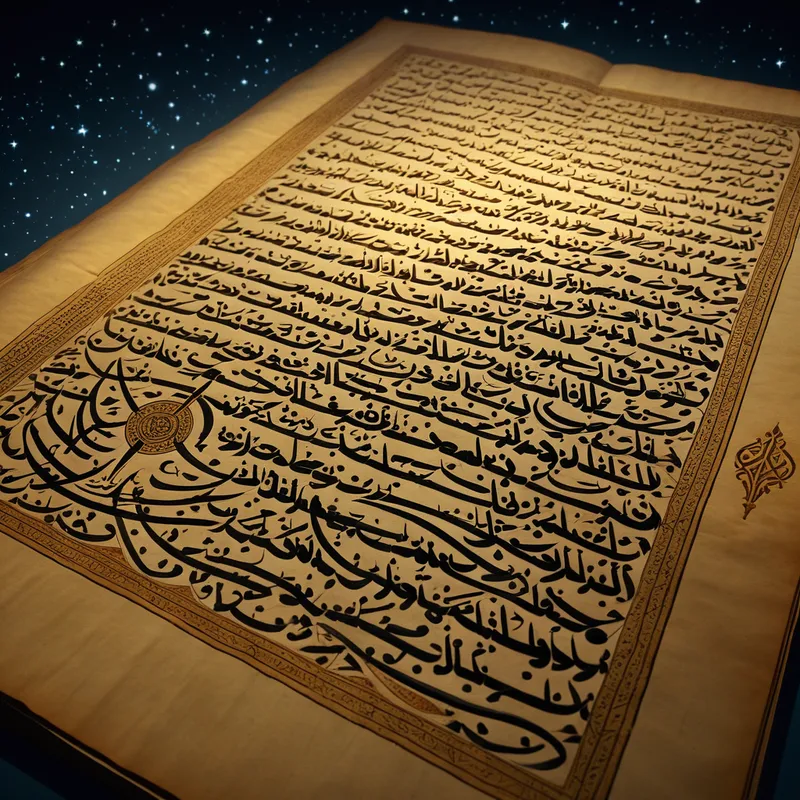
The Night of Power Sufi Myth Meaning & Symbolism
A sacred night when the veils between heaven and earth thin, and the divine word descends to awaken the sleeping heart to its eternal truth.
The Tale of The Night of Power Sufi
Listen, and let the silence between the words speak. There is a night woven into the fabric of time, not with threads of silver or gold, but with the substance of eternity itself. It is a night so profound that the angels hold their breath, and the cosmos stills its turning. They call it Laylat al-Qadr.
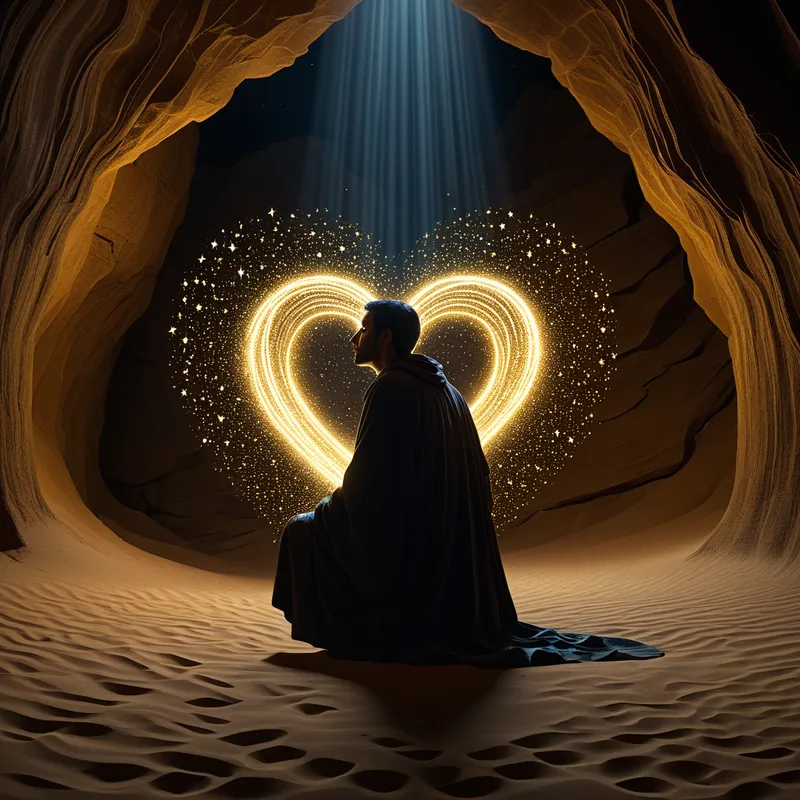
In the deep desert, where the sands remember only the wind, the air grows thick with a palpable presence. The stars do not merely twinkle; they listen. The darkness is not an absence, but a vessel, pregnant with a light that has not yet dawned. In a cave of solitude, a man named Muhammad rests, his heart a chamber emptied of all but a yearning for the Real. He is not a king on a throne, but a servant in the dust, and in that perfect humility, the vessel becomes fit to receive.
Then, without thunder or earthquake, the veil tears.
It begins not as a sound, but as a pressure in the soul, a weight of majesty that bends the very axis of being. Then comes the presence—a vast, compassionate intelligence that fills the cave, not with form, but with essence. It is Jibril. He appears not in warrior’s guise, but as a being of pure communication, his wings spanning the unseen. His command is a single, resonant word that contains multitudes: “Iqra!” — “Recite!”
But the man in the cave has no scroll, no prepared speech. “I am not a reciter,” he whispers, his human frailty laid bare before the divine command. The embrace of the presence tightens, a crucible of love and awe. Again, the imperative comes, a vibration that rearranges the atoms of his spirit. And in the third, final embrace, something within the man’s heart cracks open—not a wound, but a door.
From that opened door, from the depth where the human soul touches the divine, words begin to flow. They are not his words. They are a river of light, of law, of love, of absolute truth. They pour forth in the rhythm of his own breath, in the melody of his own tongue, yet they are ancient, older than time. “Recite in the name of your Lord who created…” The first verses of the Quran descend, syllable by luminous syllable, imprinting themselves upon the heart of the world. The night itself becomes a scribe, recording this moment where the Unspoken speaks to the core of the human condition. When the presence withdraws, the man trembles, not with fear, but with the aftershock of union. He returns to the world, bearing a light that will now forever seek its reflection in the hearts of seekers. The Night of Power has passed, but its echo is eternal.
Cultural Origins & Context
This is not a myth of antiquity, but the foundational historical-spiritual event of Islam, occurring in the year 610 CE. For Sufis, the mystical dimension of Islam, Laylat al-Qadr is the archetypal template for all spiritual experience. It is commemorated in the last ten nights of Ramadan, particularly on the odd-numbered nights, with intense prayer, vigil (ihya), and remembrance (dhikr). The story is preserved in the Quran itself (Surah Al-Qadr 97:1-5) and the Prophetic traditions (Hadith).
Its societal function is dual. Exoterically, it marks the inception of divine law and guidance for the community. Esoterically, for Sufis, it models the personal revelation every seeker must undergo—the descent of divine knowledge (‘ilm ladunni) directly into the purified heart (qalb), bypassing mere intellectual learning. It is told not just as history, but as an ever-present possibility, a night that recurs whenever a human soul becomes utterly receptive to the Truth.
Symbolic Architecture
The myth’s power lies in its stark, alchemical imagery. The cave is the [heart](/symbols/heart “Symbol: The heart symbolizes love, emotion, and the core of one’s existence, representing deep connections with others and self.”/) in retreat, the interiority necessary to hear the subtle. The command Iqra! is the divine imperative toward [consciousness](/symbols/consciousness “Symbol: Consciousness represents the state of awareness and perception, encompassing thoughts, feelings, and experiences.”/), urging us to “read” the signs (ayat) within our own being and the [universe](/symbols/universe “Symbol: The universe symbolizes vastness, interconnectedness, and the mysteries of existence beyond the individual self.”/).
The first revelation was not a treatise, but a command to engage: to recite, to give voice to the unspoken truth that already resides in the clay of creation.
The embrace of Jibril symbolizes the often overwhelming, constricting pressure of grace that feels, to the ego, like annihilation. It is the necessary [dissolution](/symbols/dissolution “Symbol: The process of breaking down, dispersing, or losing form, often representing transformation, release, or the end of a state of being.”/) of the personal will to make [space](/symbols/space “Symbol: Dreaming of ‘Space’ often symbolizes the vastness of potential, personal freedom, or feelings of isolation and exploration in one’s life.”/) for the Transpersonal. The descent of the words represents the incarnation of [spirit](/symbols/spirit “Symbol: Spirit symbolizes the essence of life, vitality, and the spiritual journey of the individual.”/) into the medium of [soul](/symbols/soul “Symbol: The soul represents the essence of a person, encompassing their spirit, identity, and connection to the universe.”/) and [language](/symbols/language “Symbol: Language symbolizes communication, understanding, and the complexities of expressing thoughts and emotions.”/)—the ultimate [marriage](/symbols/marriage “Symbol: Marriage symbolizes commitment, partnership, and the merging of two identities, often reflecting one’s feelings about relationships and social obligations.”/) of the transcendent and the immanent.
The Dreamer’s Resonance
When this myth stirs in modern dreams, it often manifests as dreams of being overwhelmed by a beautiful, terrifying light or sound, or of receiving a book with living text. One may dream of a voice of immense authority issuing a command they feel unequipped to obey, or of a constricting yet luminous embrace.
Psychologically, this signals the ego’s confrontation with a content or calling from the Self that is too vast to integrate easily. The somatic feeling is often one of awe mixed with dread, a trembling in the chest. It is the psyche’s announcement that a foundational insight—a core truth about one’s nature or destiny—is seeking to descend from the unconscious into conscious life. The dreamer is in the cave, and the divine imperative is at the door.
Alchemical Translation
For the modern individual, the Night of Power models the critical phase of individuation where received dogma (religious, parental, societal) is shattered by a direct, personal experience of meaning. The “cave” is the disciplined inner work—therapy, meditation, creative isolation—that creates a vacuum. The “command” is the often uncomfortable, life-altering call from the depths: to change, to create, to forgive, to speak a hard truth.
The alchemy occurs in the repeated embrace, the tension between “I cannot” and “you must.” It is in that crucible that the ego’s resistance is transmuted into the vessel for the soul’s unique expression.
The “descent of the Quran” is the birth of one’s own authentic “scripture”—the personal mythology, the creative work, the lived philosophy that carries the authority of direct revelation. One does not become a prophet, but one becomes oneself, fully and responsibly, having touched the source. The night of power is the moment the soul’s purpose, long hidden in the stars, finally takes root in the earth of a human life.
Associated Symbols
Explore related symbols from the CaleaDream lexicon:
- Night — The fertile darkness of the unknown and the unconscious, the necessary container for the sudden, illuminating descent of divine consciousness.
- Light — The revelatory truth that pierces the darkness of ignorance, symbolizing divine knowledge, guidance, and the awakened intellect or heart.
- Cave — The interior sanctuary of the heart, representing retreat, introspection, and the purified vessel required to receive a profound truth.
- Door — The threshold between the human and the divine, the moment of potential opening where revelation can pass from the unseen into conscious awareness.
- Heart — The central organ of spiritual perception in Sufism, the polished mirror that must be cleansed to perfectly reflect the descending light of truth.
- Moon — A symbol of reflected light and the receptive, feminine principle, often associated with the cyclical nature of spiritual insight and the holy month of Ramadan.
- Star — The guiding points in the darkness of the soul’s night, representing divine signs, hope, and the myriad facets of revealed wisdom.
- Dream — The state of inner receptivity and vision, analogous to the Prophet’s state in the cave, where the boundaries between the worlds become permeable.
- Destiny — Encapsulated in the meaning of “Al-Qadr” as decree, representing the pre-ordained moment of spiritual awakening and the soul’s fateful encounter with its source.
- Revelation — The core event of the myth, the direct communication from the divine realm that transforms the recipient and provides a new law for living.
- Book — The divine word made manifest, symbolizing law, wisdom, and the eternal scripture that is inscribed upon the tablet of the heart.
- Spirit — The animating breath and divine presence, embodied by Jibril, which carries the imperative to consciousness and awakens the soul from its slumber.