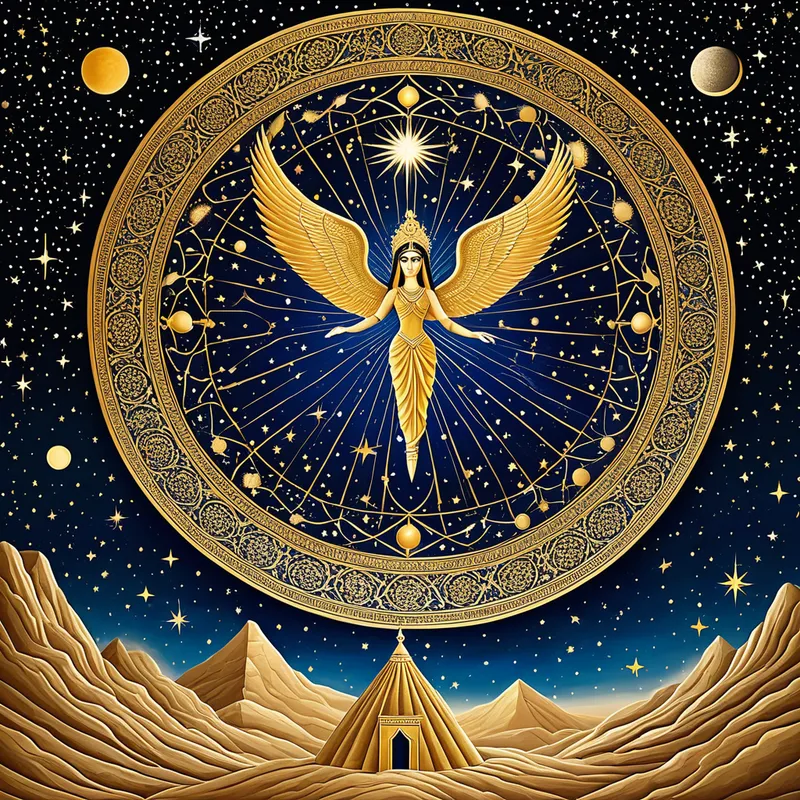
The Night of Power in Persian Lore Myth Meaning & Symbolism
A celestial battle for cosmic order, where the fate of the world hangs on a single, luminous night of divine judgment and revelation.
The Tale of The Night of Power in Persian Lore
Listen, and let the veil of stars part. There was a time when the axis of the world groaned, and the fabric of Asha grew thin. From the void of Druj, a shadow stretched—a great Lie that sought to unweave the tapestry of creation, to plunge the sun into silence and turn the seasons to dust. The heavens trembled, and the earth held its breath.
In the highest realm, the [Ahura Mazda](/myths/ahura-mazda “Myth from Persian culture.”/) convened the Amesha Spentas. Their light, usually a steady constellation of virtues, flickered with concern. The balance was tipping. The Lie whispered into the hearts of mortals and coiled around the roots of the Haoma. It was a corruption that could not be undone by force alone, for it was a corruption of choice, of spirit.
Thus, was decreed the Shab-e Qadr. Not a night of battle with clashing swords, but a night of profound, silent reckoning. On this one night, the gates between the worlds would dissolve. The celestial scribe, Sraosha, would descend, not with an army, but with a single, perfect scale. The Rashnu would stand as the judge.
As the last sliver of sun vanished, an unnatural stillness fell. No wind stirred the cypress trees. The stars seemed to pulse, becoming the watchful eyes of the Staota Yasna. In every humble dwelling, by every flickering hearth, souls felt a weight descend—not of fear, but of absolute presence. It was as if the very air had become a mirror.
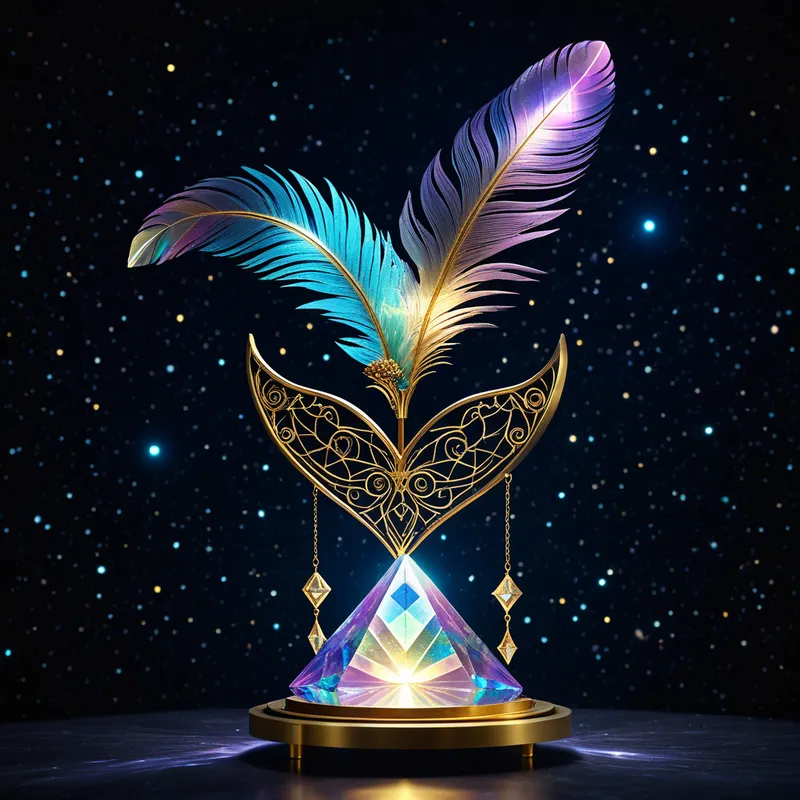
Then, the light came. Not from the moon, but from within. A soft, silver luminescence emanated from every stone, every leaf, every sleeping child. It was the light of essence, of truth laid bare. In this glow, Sraosha moved unseen. Upon his scale, he placed the feather of Asha Vahishta on one pan. On the other, he placed the accumulated weight of a soul’s thoughts, words, and deeds. There was no hiding. The vanity of kings and the kindness of shepherds were weighed with the same impartial gaze.
All through that endless night, the scales tipped and balanced. Where the heart was heavier than the feather, a sigh echoed through the foundations of the world—a note of Angra Mainyu’s discord. Where the feather was heavier, a chime, pure and clear, rang out, strengthening the song of creation. The fate of the coming year—its abundance or famine, its peace or strife—was written in that silent ledger of light.
As the first true hint of dawn tinged the east with fire, the ritual reached its climax. The collective balance of all souls was tallied. For a terrifying moment, the scales hung in perfect equilibrium, the fate of Getig trembling on a knife’s edge. Then, from the hearts of those who had chosen truth in the dark, a final, collective intention rose—a whispered prayer for the dawn. It was the last, weightless grain. The scale tipped, ever so slightly, toward the feather.
The sun rose, not as it had the day before, but victorious. The shadow of the Lie receded, wounded by the collective choice for light. The world was not merely saved; it was renewed. The Shab-e Qadr had passed. Order was preserved not by a deity’s flat, but through the somber, beautiful, and terrifying participation of every soul in the great cosmic trial.
Cultural Origins & Context
The myth of the Shab-e Qadr finds its deepest roots in the Zoroastrian tradition of ancient Persia, a worldview fundamentally structured by the cosmic struggle between Asha and Druj. It was not merely a story but a cosmological principle enacted through ritual. Priests (Mobeds) would recite the holy texts, the Gathas, during long night vigils, their words seen as active forces to uphold order.
The myth was passed down not just as narrative, but as a lived, annual experience. It framed the New Year festival of Nowruz as a consequence of this nocturnal victory. Its societal function was profound: it instilled an immense sense of personal responsibility. One’s individual moral choices were cosmically significant, directly influencing the health of the king, the fertility of the land, and the movement of the stars. It was a myth that democratized destiny, making every person a soldier in the spiritual war for creation.
Symbolic Architecture
At its core, the [Night](/symbols/night “Symbol: Night often symbolizes the unconscious, mystery, and the unknown, representing the realm of dreams and intuition.”/) of Power is a myth of the Individuation of the [cosmos](/symbols/cosmos “Symbol: The entire universe as an ordered, harmonious system, often representing the totality of existence, spiritual connection, and the unknown.”/) itself, mirrored in the [soul](/symbols/soul “Symbol: The soul represents the essence of a person, encompassing their spirit, identity, and connection to the universe.”/). The scale is the ultimate [symbol](/symbols/symbol “Symbol: A symbol can represent an idea, concept, or belief, serving as a powerful tool for communication and understanding.”/) of the objective psyche, the impersonal law of consequences that operates beyond personal desire or justification.
The feather is not lightness, but truth. The heart is not weight, but the condensed substance of a life’s intentions.
The night itself represents the unconscious—not a place of monsters, but of ultimate, non-negotiable [reality](/symbols/reality “Symbol: Reality signifies the state of existence and perception, often reflecting one’s understanding of truth and life experiences.”/). The [dissolution](/symbols/dissolution “Symbol: The process of breaking down, dispersing, or losing form, often representing transformation, release, or the end of a state of being.”/) of gates is the [suspension](/symbols/suspension “Symbol: A state of being held in limbo, neither progressing nor regressing, often representing unresolved tension or transitional phases in life.”/) of the ego’s defenses, allowing the Self to be seen and measured. Sraosha represents [consciousness](/symbols/consciousness “Symbol: Consciousness represents the state of awareness and perception, encompassing thoughts, feelings, and experiences.”/) itself, the faculty that observes and records. The collective tipping of the scale signifies that individuation is never a purely solitary act; the healing of one soul contributes to the healing of the world ([Anima](/symbols/anima “Symbol: The feminine archetype within the male unconscious, representing soul, creativity, and connection to the inner world.”/) Mundi).
The Dreamer’s Resonance
When this myth stirs in modern dreams, it often manifests not as a Persian celestial court, but through its core architecture. One may dream of being in a vast, silent hall awaiting an interview for a job they have already, mysteriously, performed. They may dream of their own shadow being weighed, or of trying to lighten their body to float. The somatic sensation is often one of profound exposure, of being utterly known.
Psychologically, this signals a confrontation with the Superego in its most profound, non-personal form—not as parental voice, but as the inner Rashnu. The dreamer is undergoing a process of self-auditing, where life choices, compromises, and authentic actions are being inwardly assessed. It is a call to integrity, often preceding a major life transition where the “weight” of one’s current path must be consciously evaluated.
Alchemical Translation
The alchemical process modeled here is the Nigredo followed by the Albedo. The long, silent night is the Nigredo: the descent into the dark night of the soul, where all illusions are stripped away and the raw material of the psyche is laid bare for examination. The weighing is the crucial separation (Separatio) of the essential from the dross—truth from self-deception.
The victory of dawn is not the eradication of shadow, but the conscious integration of its weight into the service of light.
The final, collective tipping of the scale is the Albedo: the illumination that comes from accepting this ruthless self-assessment. The “renewed world” that dawns is the nascent conscious personality, now aligned with a deeper law. For the modern individual, the myth teaches that transformation requires submitting one’s entire being—thoughts, words, and deeds—to an inner tribunal. The goal is not to be found “innocent,” but to achieve a balance where one’s actions are in harmony with one’s deepest truth, thus contributing one’s note to the harmony of the whole.
Associated Symbols
Explore related symbols from the CaleaDream lexicon:
- Scale — The central artifact of divine judgment, representing the immutable law of moral consequence and the balancing of one’s inner truth against one’s actions.
- Night — The liminal, sacred time of revelation and unconscious reckoning, when the veil between the personal and the cosmic is thinnest.
- Feather — The symbol of transcendent truth, lightness of being, and the essential, weightless standard against which the soul is measured.
- Heart — Not the physical organ, but the condensed record of a life’s intentions, emotions, and choices, carrying the tangible weight of lived experience.
- Star — Representing the divine watchers, the Staota Yasna, and the celestial order that is both upheld by and reflected in the night’s judgment.
- Light — The illuminating force of consciousness and divine presence that reveals essence without distortion, leading to renewal at dawn.
- Mirror — The function of the Night itself, which reflects the soul back to itself without the ego’s filters, forcing a confrontation with true nature.
- Order — The cosmic principle of Asha, the harmonious state the ritual seeks to preserve and strengthen through individual and collective integrity.
- Judgment — The impersonal, inevitable process of evaluation conducted by the inner Rashnu, essential for psychological growth and alignment.
- Book — The celestial ledger in which deeds are recorded, symbolizing memory, karma, and the inescapable narrative of one’s choices.
- Dawn — The rebirth and renewal that follows the successful integration of shadow and truth, representing hope, victory, and a new cycle of consciousness.
- Silence — The necessary condition for the hearing of the inner verdict, the space where the noise of the world falls away and the soul’s weight can be truly felt.