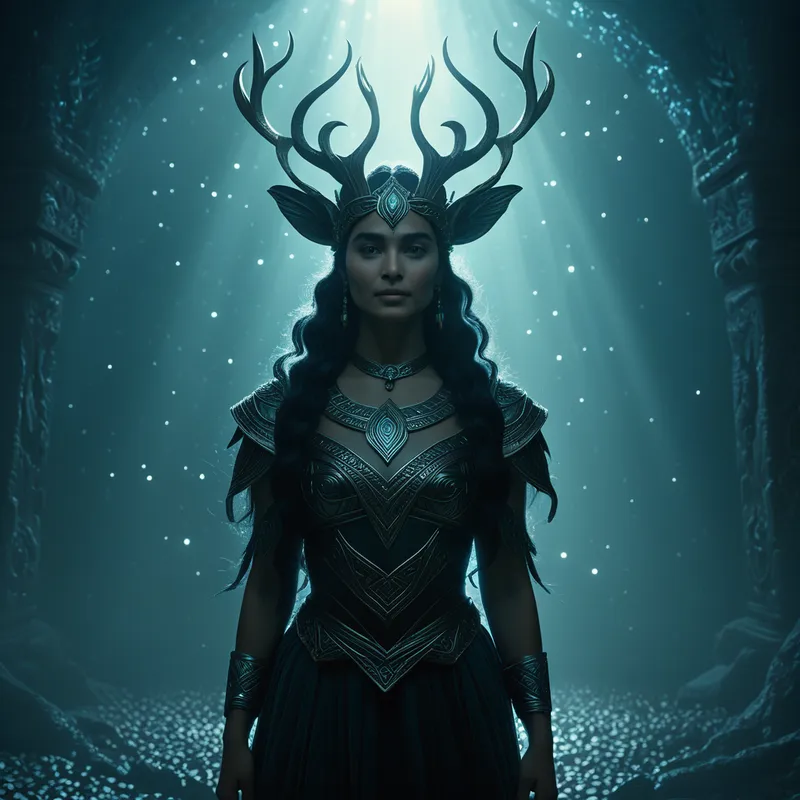
The Night Journey Isra and Miraj
The miraculous night journey where Prophet Muhammad traveled from Mecca to Jerusalem and ascended through the heavens, marking a pivotal spiritual event in Islam.
The Tale of The Night Journey Isra and Miraj
In the deep stillness of a Meccan night, within the sacred precincts of the [Kaaba](/myths/kaaba “Myth from Abrahamic culture.”/), a profound rupture in the fabric of reality occurred. The Prophet Muhammad, peace be upon him, lay sleeping in the home of his cousin, Umm Hani. It was a night heavy with the weight of his mission, a time of profound personal loss and tribulation. Then, the archangel Jibril came to him. With a touch that cleansed the very chambers of his heart, Jibril prepared him for a journey beyond the comprehension of time and space.
Mounted upon the celestial steed Buraq—a creature of dazzling white, larger than a donkey yet smaller than a mule, with wings that shimmered with latent power—the Prophet was transported from the Masjid al-Haram to the Masjid al-Aqsa in the blink of an eye. This was the Isra, the Night Journey. In [Jerusalem](/myths/jerusalem “Myth from Biblical culture.”/), he dismounted and tethered Buraq to the ring used by [the prophets](/myths/the-prophets “Myth from Biblical culture.”/) of old. There, in that hallowed ground, he led a congregation of all the previous prophets—Ibrahim, Musa, Isa—in prayer, a silent testament to the unbroken chain of divine message and his station as the Seal of the Prophets.
Then began the [Miraj](/myths/miraj “Myth from Sufi culture.”/), the Ascension. From the Noble Sanctuary, a ladder of radiant light descended. Alongside Jibril, the Prophet ascended through the seven heavens, each a realm of increasing sublimity. At [the threshold](/myths/the-threshold “Myth from Folklore culture.”/) of each heaven, a guardian would challenge them, and Jibril would declare, “Muhammad.” The gate would then open in recognition, and they would be welcomed by a prophet residing therein. He met Adam in the first heaven, Yahya and Isa in the second, Yusuf in the third, Idris in the fourth, Harun in the fifth, Musa in the sixth, and Ibrahim in the seventh. Each encounter was a dialogue of souls across epochs.
Beyond the seventh heaven, they reached [the Lote Tree of the Utmost Boundary](/myths/the-lote-tree-of-the-utmost-boundary “Myth from Islamic culture.”/), Sidrat al-Muntaha. Its leaves were like the ears of elephants, its fruits like celestial jars. Here, the light of divine presence became so intense that even Jibril could proceed no further, stating this was his limit. Alone, the Prophet traversed the veils of transcendence, entering into the direct presence of the Divine. In this intimate communion, beyond all form and description, the commandment for fifty daily prayers was gifted to him and his community.
On his return, he encountered Musa, who, with the practical wisdom of a shepherd of souls, urged him to return and seek a reduction for the sake of humanity’s strength. The Prophet, in an act of profound intercession, returned to the Divine presence again and again, until the obligation was reduced to five prayers, whose reward would remain as fifty. He then descended back through the heavens, returned to Buraq, and was carried back to Mecca, arriving before his bed had grown cold, though his soul had traversed the cosmos.
Cultural Origins & Context
The event of Isra and Miraj is firmly rooted in the Qur’an and the Prophetic traditions (Hadith). The opening verse of Surah Al-Isra (17:1) serves as its anchor: “Exalted is He who took His Servant by night from [al-Masjid al-Haram](/myths/al-masjid-al-haram “Myth from Islamic culture.”/) to al-Masjid al-Aqsa, whose surroundings We have blessed, to show him of Our signs.” The detailed narrative is preserved in multiple, rigorously authenticated hadith collections, most notably in Sahih al-Bukhari and Sahih Muslim.
Historically, this event is believed to have occurred around 621 CE, during the “Year of Sorrow,” following the deaths of Muhammad’s beloved wife Khadijah and his protective uncle Abu Talib. This context is crucial. The journey was not merely a celestial spectacle but a divine response to profound earthly grief and isolation. It served as a spiritual fortification for the Prophet, preparing him for the imminent and perilous migration (Hijrah) to Medina. For the early Muslim community, besieged in Mecca, the story was a radical affirmation. It validated the Prophet’s mission, connected Islam’s spiritual axis to Jerusalem—linking it to the Abrahamic lineage—and established the five daily prayers (Salah) as the practical, rhythmic anchor of Muslim life, a direct link from the humblest believer to that ultimate divine encounter.
Symbolic Architecture
The Isra and Miraj is not a [linear](/symbols/linear “Symbol: Represents order, predictability, and a direct, step-by-step progression. It symbolizes a clear path from cause to effect.”/) travelogue but a [multi](/symbols/multi “Symbol: Multi signifies multiplicity and diversity, often representing various aspects of life or identity in dreams.”/)-layered map of the [soul](/symbols/soul “Symbol: The soul represents the essence of a person, encompassing their spirit, identity, and connection to the universe.”/)’s potential. Each stage is a symbolic [station](/symbols/station “Symbol: Signifies a temporary stop, transition point, or a place of waiting in life’s journey.”/) on the [path](/symbols/path “Symbol: The ‘path’ symbolizes a journey, choices, and the direction one’s life is taking, often representing individual growth and exploration.”/) of awakening.
The journey from the Kaaba to Al-Aqsa represents the movement from the center of one’s individual faith to the broader sanctuary of collective prophecy and spiritual heritage. It is the soul recognizing it walks a path trodden by countless seekers before.
The seven heavens are not physical places but ascending stages of [consciousness](/symbols/consciousness “Symbol: Consciousness represents the state of awareness and perception, encompassing thoughts, feelings, and experiences.”/). Each [prophet](/symbols/prophet “Symbol: A messenger or seer who receives divine revelations, often warning of future events or guiding moral direction.”/) encountered embodies a specific spiritual [virtue](/symbols/virtue “Symbol: A moral excellence or quality considered good, often representing inner character, ethical principles, or spiritual ideals in dreams.”/): Adam (repentance), Isa (purity and [spirit](/symbols/spirit “Symbol: Spirit symbolizes the essence of life, vitality, and the spiritual journey of the individual.”/)), Yusuf ([beauty](/symbols/beauty “Symbol: This symbol embodies aesthetics, harmony, and the appreciation of life’s finer qualities.”/) and [resilience](/symbols/resilience “Symbol: The capacity to recover quickly from difficulties, adapt to change, and maintain strength through adversity.”/)), Musa (divine law and [dialogue](/symbols/dialogue “Symbol: Conversation or exchange between characters, representing communication, relationships, and narrative flow in games and leisure activities.”/)). The [ascension](/symbols/ascension “Symbol: A profound sense of rising upward, often representing spiritual enlightenment, personal growth, or transcendence beyond physical limitations.”/) is the soul’s purification, shedding layers of limitation as it approaches the [Source](/symbols/source “Symbol: The origin point of something, often representing beginnings, nourishment, or the fundamental cause behind phenomena.”/).
Buraq, the mystical mount, symbolizes the purified body and instinct—the nafs—now sublimated and made radiant, capable of carrying the spirit on its transcendent voyage. It is the vehicle where animal vitality is harnessed to divine purpose.
The [climax](/symbols/climax “Symbol: The peak moment in a narrative or musical composition, representing resolution, transformation, or ultimate expression.”/) at the Lote [Tree](/symbols/tree “Symbol: In dreams, the tree often symbolizes growth, stability, and the interconnectedness of life.”/) marks the [boundary](/symbols/boundary “Symbol: A conceptual or physical limit defining separation, protection, or identity between entities, spaces, or states of being.”/) of created [knowledge](/symbols/knowledge “Symbol: Knowledge symbolizes learning, understanding, and wisdom, embodying the acquisition of information and enlightenment.”/). Beyond it lies the Unseen (al-Ghayb). The negotiation for the prayers is deeply psychological; it reveals a divine [compassion](/symbols/compassion “Symbol: A deep feeling of empathy and concern for others’ suffering, often involving a desire to help or alleviate their pain.”/) that understands [human](/symbols/human “Symbol: The symbol of a human represents individuality, complexity of emotions, and social relationships.”/) limitation, transforming an impossible [obligation](/symbols/obligation “Symbol: A perceived duty or responsibility imposed by social norms, relationships, or internalized expectations, often involving a sense of being bound to act.”/) into a sustainable practice of grace. The [prayer](/symbols/prayer “Symbol: Prayer represents communication with the divine or a higher power, often reflecting inner desires and spiritual needs.”/) becomes the believer’s own nightly ascension, a daily Miraj of the [heart](/symbols/heart “Symbol: The heart symbolizes love, emotion, and the core of one’s existence, representing deep connections with others and self.”/).
The Dreamer’s Resonance
For the modern dreamer or psychological seeker, the Night Journey is a master narrative of the individuation process. It begins in a state of “Night”—of grief, confusion, or existential crisis (the Year of Sorrow). The call comes not when we are strong, but when we are most open in our vulnerability.
The cleansing of the heart by Jibril mirrors the necessary, often painful, initial work of psychotherapy or spiritual practice: confronting one’s shadow, clearing blockages. The journey itself is the archetypal Hero’s journey into the unknown depths and heights of the [psyche](/myths/psyche “Myth from Greek culture.”/). The prophets met in the heavens can be seen as internal archetypes—the Guide, the Lawgiver, the Beloved—aspects of [the Self](/myths/the-self “Myth from Jungian culture.”/) that must be integrated.
The ultimate encounter is with the numinous, the overwhelming totality of the Self, which both shatters and reconstitutes [the ego](/myths/the-ego “Myth from Jungian culture.”/). The return, with the gift of the “five prayers,” symbolizes the crucial step of bringing that transcendent experience back into the mundane world. It is not enough to have the vision; one must find the daily ritual, the concrete practice (the Ritual), that grounds the ecstasy into a sustainable structure for life. The dreamer who has a profound visionary experience must find their own “five daily prayers”—a journaling practice, meditation, art—to keep the connection alive.
Alchemical Translation
In the alchemical vessel of this myth, the base metal of human suffering and limitation is transmuted into the gold of direct gnosis and enduring [covenant](/myths/covenant “Myth from Christian culture.”/).
The Isra is the Nigredo, the blackening. It is the journey through the night, the dissolution of the ego’s familiar landmarks (Mecca) as the soul is forced to travel to a distant, unknown sanctuary (Jerusalem). This is the necessary darkness before the dawn.
The Miraj is the [Albedo](/myths/albedo “Myth from Alchemical culture.”/) and Citrinitas—the whitening and yellowing. It is the ascension through purification (the heavens), a distillation of spirit from matter. Each prophet represents a purifying agent, washing the soul in their particular virtue until it gleams.
The encounter at the Lote Tree and beyond is the Rubedo, the reddening. It is the union with the Divine, the culmination where the seeker and the Sought meet. The soul is irradiated with a light that does not burn but transforms.
The return with the gift of prayer is the final stage, the [Projection](/myths/projection “Myth from Alchemical culture.”/). The philosopher’s stone has been created within, and now its tincture must be applied to [the world](/myths/the-world “Myth from Tarot culture.”/). The five prayers are the formula, the repeated Alchemical operation that continually performs this transmutation on the human soul, turning the lead of daily forgetfulness into the gold of remembrance.
Associated Symbols
Explore related symbols from the CaleaDream lexicon:
- Journey — The fundamental movement from a state of limitation to one of expansion, encompassing both physical travel and profound spiritual or psychological passage.
- Night — The realm of the unconscious, the unknown, and divine revelation; a time when [the veil between worlds](/myths/the-veil-between-worlds “Myth from Celtic culture.”/) grows thin and the soul can undertake its deepest voyages.
- Hero — The archetypal figure who answers a call to adventure, traverses a threshold into the unknown, and returns transformed with a boon for their community.
- Prophet — A vessel for divine communication, serving as a bridge between the transcendent will and the human community, often through the medium of inspired speech or vision.
- Divine — The ultimate, ineffable source of reality and meaning, which calls the soul toward union and comprehension beyond rational understanding.
- Ritual — A structured, symbolic action that connects the mundane to the sacred, creating a container for spiritual experience and communal identity.
- Ascension — The symbolic movement upward through layers of consciousness or spiritual realms, representing purification, enlightenment, and approach to the source.
- Temple — A consecrated space, whether physical or internal, that serves as a meeting point between the human and the divine, a sanctuary for prayer and revelation.
- Vision — A perception that transcends ordinary sight, granting insight into spiritual truths, future possibilities, or the hidden architecture of reality.
- Bridge — A structure or concept that connects two separate realms, states of being, or aspects of the self, enabling passage and communication where there was division.
- Light — The primordial symbol of consciousness, revelation, divine presence, and guidance that dispels the darkness of ignorance and illusion.
- Key — An instrument or insight that unlocks a barrier, granting access to hidden knowledge, a new level of understanding, or a previously inaccessible realm.