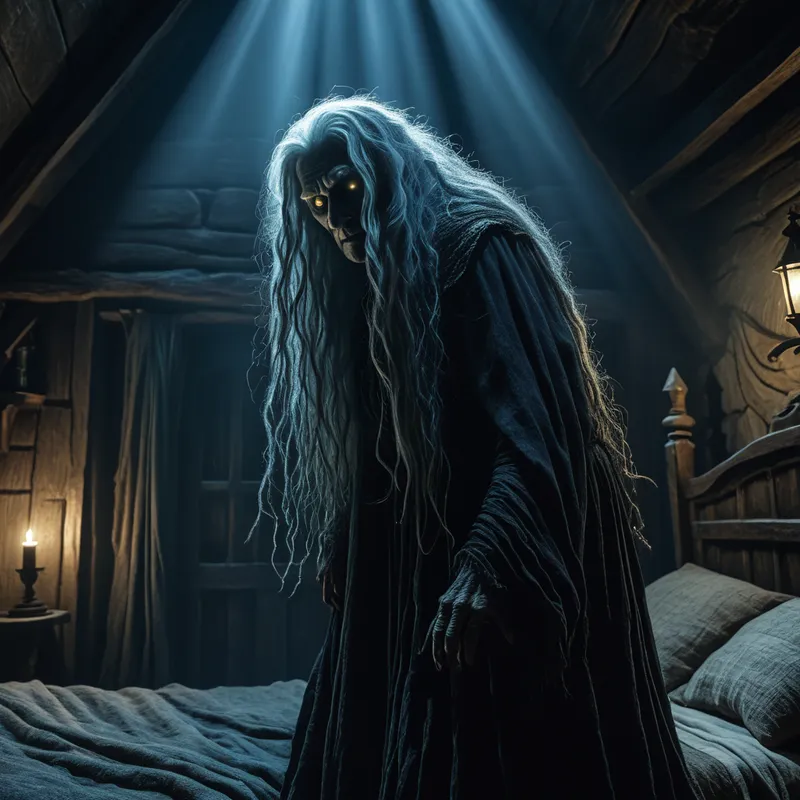
The Night Hag Myth Meaning & Symbolism
A universal folklore entity of nocturnal terror, whose visitation reveals the psyche's deepest fears and the path to reclaiming one's sovereign self.
The Tale of The Night Hag
Listen, and know the terror that walks the borderlands of sleep. It comes not with a crash of thunder, but with the deep, suffocating silence that settles after the last ember dies in the hearth. The world is held in the fist of the moon, and in that silvered stillness, the anima grows restless, loosening its tether to the flesh.
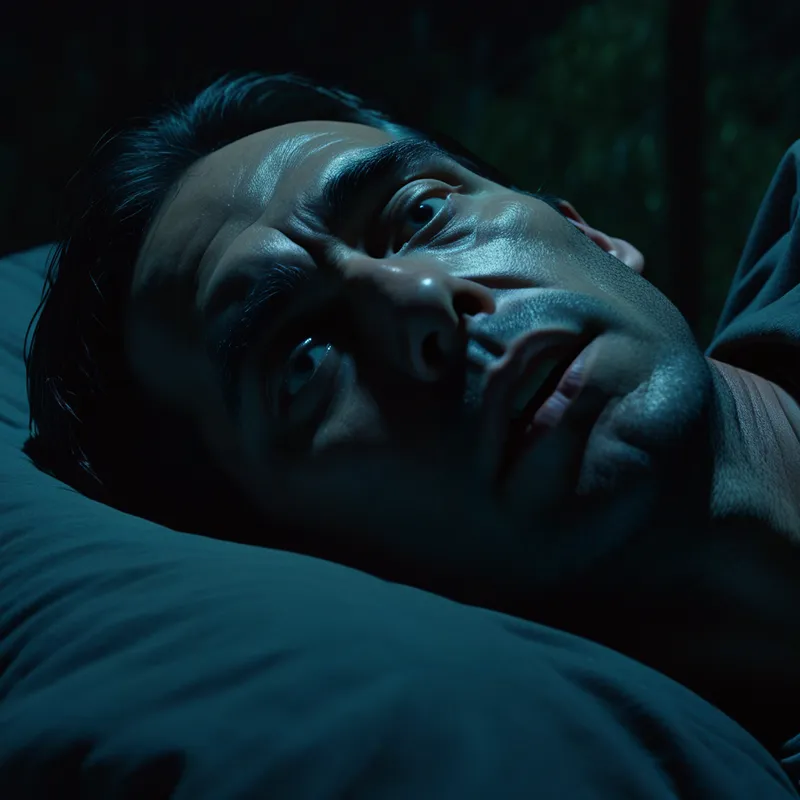
You are in your bed, the familiar contours of your home now strange in the dark. A weight begins to press upon you, gentle at first, like a heavy blanket. Then it grows. It becomes a stone, a millstone, an entire mountain settling on your chest. The air thickens to syrup, and you cannot draw breath. You strain to cry out, but your voice is buried deep within your paralyzed throat. Your eyes fly open, scanning the known room now made alien.
And She is there.
She is in the corner where the shadows are too deep. She is the sudden chill that has nothing to do with the wind. She is the Old Woman of the Night, the Mara, the Crushing One. Her form is of smoke and malice—a hunched silhouette, a glimpse of stringy hair, eyes that are pits or pinpricks of cold light. She does not always show her face, for her presence is her essence: a pure, oppressive intent. She has come to steal your breath, to drink the warmth from your limbs, to whisper despair into your ear as you lie helpless. This is her domain: the vulnerable threshold where you are neither awake nor asleep, where you are a guest in your own body.
The struggle is monumental and utterly silent. Every fiber of your being screams to move a finger, to twitch a toe, to break the spell. It is a war fought on the battlefield of a single breath. The terror is absolute, a black tide that threatens to dissolve you. And just as you feel your very self will be extinguished under her weight, as the darkness begins to swallow your sight… a sound breaks through. A distant cockcrow. The first grey hint of dawn at the window. A log shifting in the grate.
The pressure lifts. The cold recedes. You gasp a shuddering breath, your body your own once more. The room is just a room. She is gone. But the memory of her weight, the echo of her presence, lingers like a bruise on the soul. She has visited, and you have survived. For now.
Cultural Origins & Context
The Night Hag is not a myth of a single culture, but a haunting chorus across the globe. She is the Mara of the Germanic peoples, the Incubus and Succubus of medieval Europe, the Pesanta of Catalan folklore (a heavy, furry beast), the Kanashibari of Japan (the feeling of being bound), the Popobawa of Zanzibar, and the Old Hag of Newfoundland. This is a primordial story, emerging independently from the shared physiology of sleep paralysis and the universal human experience of nocturnal vulnerability.
The tale was passed down in whispers by the hearth, a story to explain the inexplicable terror that could befall anyone. It served as a folk diagnosis for a terrifying somatic event, giving a name and a shape to the formless dread. Societally, it often functioned as a cautionary tale about sleeping in certain positions, leaving windows open, or moral failings that might invite such a visitation. It was a narrative container for the raw, biological fear of suffocation and helplessness, transforming a personal physiological crisis into a shared mythological encounter with a known, though dreaded, entity.
Symbolic Architecture
The Night Hag is the embodied Shadow of the night-self. She represents the part of the psyche that feels utterly opposed to the conscious, daytime identity—the accumulated weight of repressed fear, guilt, shame, and unresolved trauma.
The Hag does not come from outside; she coalesces from the un-lived life within, the psychic material deemed too heavy to carry in the light of day.
Her pressing weight symbolizes burdens we refuse to acknowledge—responsibilities we haven’t shouldered, grief we haven’t expressed, passions we have suppressed. The paralysis is the ego’s helplessness when confronted with the autonomous power of the unconscious. The inability to scream is the silencing of our own authentic voice, our true desires and fears, by internalized censors and old prohibitions. She is the ultimate experience of dispossession—the feeling that one’s own body, one’s own life, is being occupied by a foreign, hostile force.
The Dreamer’s Resonance
When this mythic pattern erupts in modern dreams or episodes of sleep paralysis, it is a direct summons from the depths. It is not a random neurological glitch, but a profound somatic metaphor. The psyche is staging a crisis to get our attention.
The dreamer is undergoing a process of psychic compression. An aspect of their life—a relationship, a career path, a self-image—has become a crushing weight, but they have been unable or unwilling to move it. The paralysis mirrors a waking-life feeling of being stuck, trapped, or voiceless in a situation. The terrifying presence is often the concretized form of a specific anxiety or a looming confrontation the ego is desperately trying to avoid. The experience, while terrifying, is a brutal form of communication: the unconscious is forcing a confrontation with the material that is literally suffocating the individual’s potential. To awaken from it is to receive a stark message: you must find your breath, your voice, and your movement again, or be consumed by what you refuse to face.
Alchemical Translation
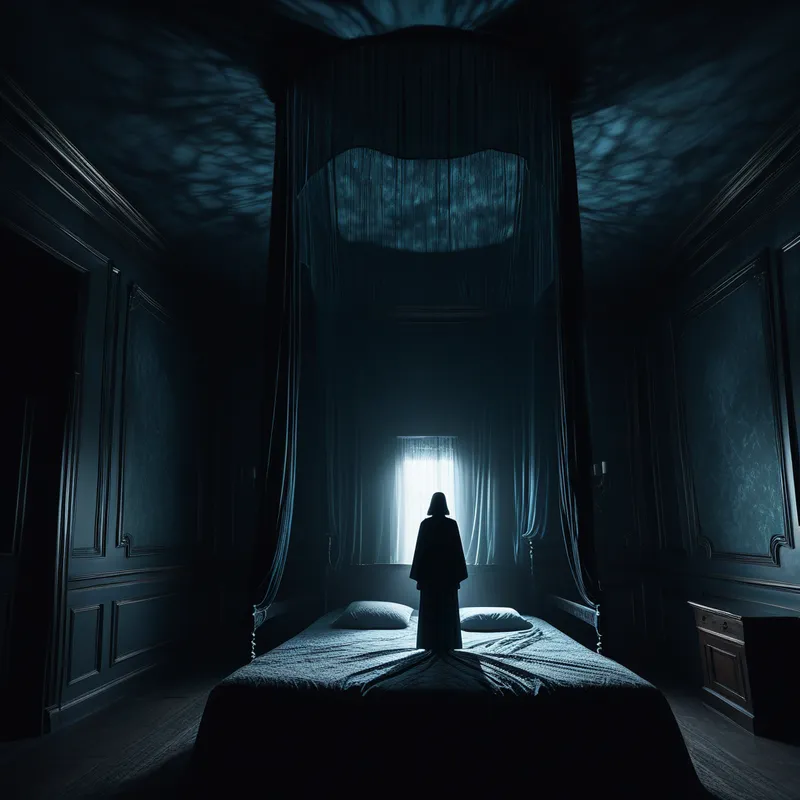
The triumph in the Hag myth is not a glorious slaying, but a simple, profound endurance. The hero’s journey here is one of passive resistance and awakening. The alchemical process modeled is separatio followed by solutio—the separation of the conscious self from the identification with the crushing shadow, and the dissolution of that shadow’s power through the light of awareness.
The dawn that banishes the Hag is not the sun, but the first flicker of conscious observation turned inward upon the terror itself.
The modern individuation process requires a “Night Hag” moment. We must allow ourselves to be pressed, to feel the full weight of our unlived life, our repressed anger, our dormant power. In that paralyzed state, the only faculty left is witnessing. We must learn to be the one who, even in terror, observes the Hag. This observation is the beginning of differentiation. It is the recognition: “This pressure is in me, but it is not me.”
The alchemical translation is the reclaiming of sovereignty from the autonomous complex. By surviving the visitation, by drawing that first free breath at dawn, we integrate the knowledge of the shadow’s reality and its limits. We learn that we can bear the pressure and not be annihilated. The Hag, integrated, transforms. Her crushing weight becomes the grounding pressure of self-containment. Her stolen breath becomes the focused prana of conscious living. The entity that seemed an external predator is revealed as a disowned part of the self, now acknowledged, whose energy can be reclaimed. We do not defeat her in battle; we outlast her in the dark, and in doing so, we reclaim the territory of our own souls.
Associated Symbols
Explore related symbols from the CaleaDream lexicon: