The Net of Ran Myth Meaning & Symbolism
The story of the sea goddess Ran and her golden net, which gathers all things lost to the deep, embodying fate, the unconscious, and the soul's journey.
The Tale of The Net of Ran
Listen, and hear the whisper of the salt-wind. It does not speak of sunlit fields or the clamor of the hall, but of the grey, heaving silence that lies beyond the last sight of land. It speaks of Aegir, who brews his ale in a cauldron deep as [the world](/myths/the-world “Myth from Tarot culture.”/)’s root, and of his wife.
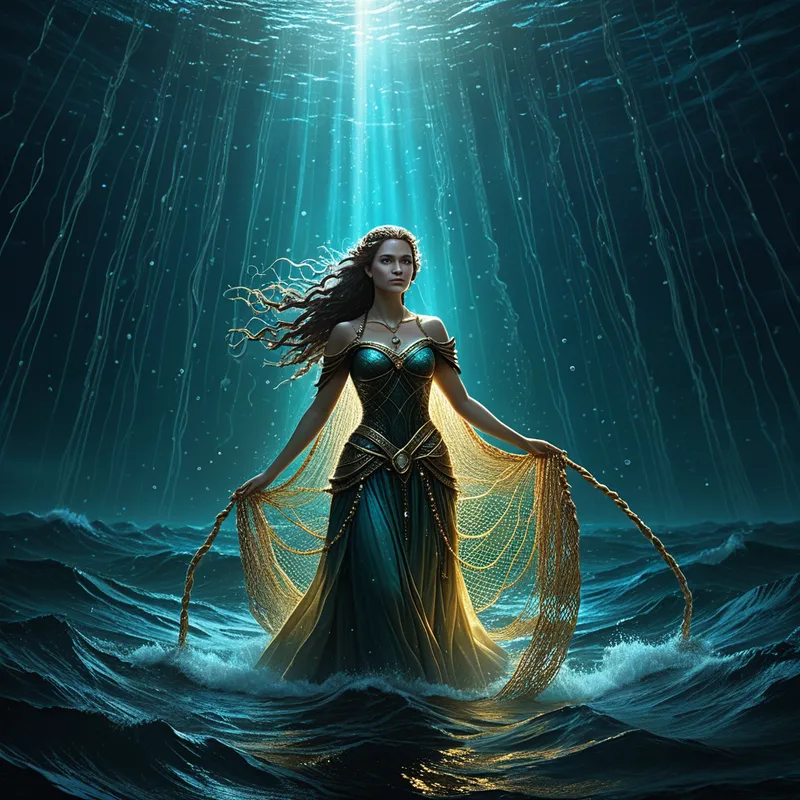
Her name is Ran. She does not rule the playful waves that lap the shore. Her domain is the cold, green darkness where the light gives up its ghost. She waits in her hall, Aegirheim, a palace built from the ribs of leviathans and lit by the pallid glow of drowned gold. And she has a net.
It is not a net of hemp or flax, but a [thing](/myths/thing “Myth from Norse culture.”/) woven from the very essence of the deep. Some say it is spun from the last breaths of drowning men, from the sighs of sinking timbers, from the captured glimmer of moonlight on a wave-crest just before it breaks. It is a net of pure, cold gold, and it is vast enough to embrace [the horizon](/myths/the-horizon “Myth from Various culture.”/).
When the storm-gods whip [the sea](/myths/the-sea “Myth from Greek culture.”/) into a frothing madness, when the [Midgard Serpent](/myths/midgard-serpent “Myth from Norse culture.”/) stirs in its coils, Ran walks not upon the waves, but beneath them. She rises through the black [water](/myths/water “Myth from Chinese culture.”/), her hair a cloud of darkest weed, her eyes holding the patience of [the abyss](/myths/the-abyss “Myth from Kabbalistic culture.”/). In her hands, the net lies folded, a dormant promise of finality.
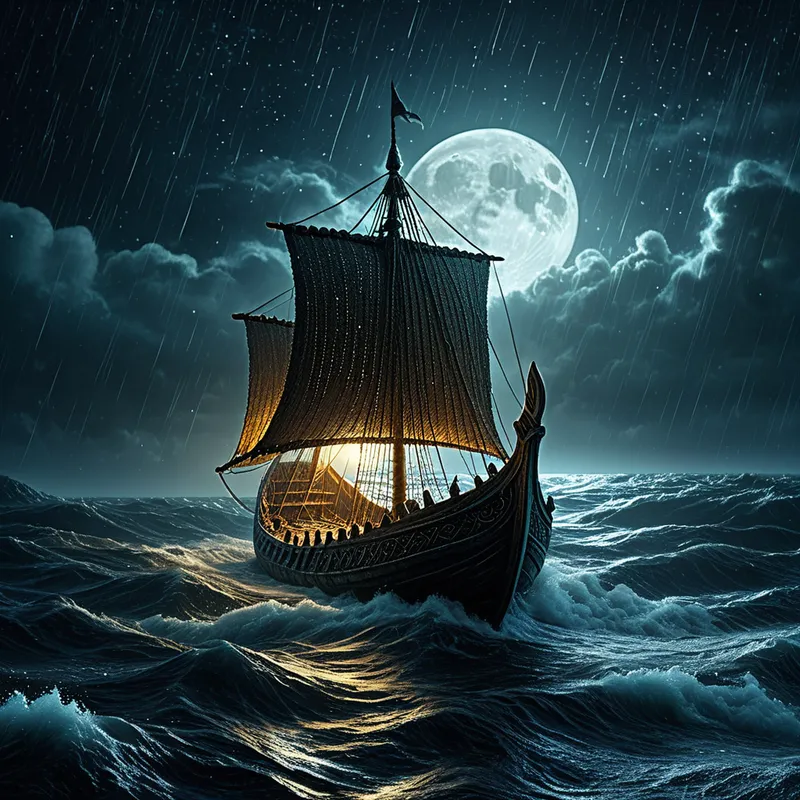
See the ship—the proud dragon-prow biting at the spray, the oak planks groaning. The men shout prayers to Thor for strength, to Odin for cunning. But their voices are stolen by [the wind](/myths/the-wind “Myth from Various culture.”/). Ran watches. She does not hate. She does not desire. She simply is, the inevitable conclusion to a journey begun on land. With a gesture as timeless as the tide, she casts her net.
It unfurls not like a fisherman’s throw, but like fate itself unfolding. It is a shimmering, golden web that rises from the deep, a cage of light in the dark water. It does not snag the hull; it accepts it. The ship, the cargo, the shouting men, the treasure clasped in fearful hands—all are gathered. The net closes with a softness more terrible than any crash. It draws its catch down, not to destruction, but to reception.
In the quiet halls of Aegirheim, Ran returns. The net is emptied. Gold coins clatter on tables of coral. Fine silks, now forever damp, drape over chairs of whalebone. And the sailors? They sit at the long table, their earthly fears washed away, guests at a feast that has no end. They are received. They are hers. This is the tale the sea tells in its deepest voice: not of murder, but of a terrible, final hospitality.
Cultural Origins & Context
The figure of Ran and her net are threads woven into the broader tapestry of Norse seafaring reality. These stories were not formalized scriptures but lived breath in the skáld’s poetry and the sagas, told in smoky longhouses by those who knew the sea as both road and reaper. The primary sources are sparse but evocative, found in the Poetic Edda and later sagas, where kennings for death at sea often [reference](/myths/reference “Myth from Global/Universal culture.”/) “falling into Ran’s hands” or “being chosen for her net.”
This myth served a profound societal function for a culture whose lifeblood was the ocean. It gave a face and a logic to the sea’s capricious violence. A storm was not mere weather; it was Ran exercising her prerogative. This personification transformed a random, terrifying accident into a narrative with an actor and a destination. To drown was to be “gathered by Ran,” to become a guest in her hall. This offered a sliver of meaning in the face of meaningless oblivion, a way to speak of the unspeakable loss that every fishing village and trading port knew intimately. It was a myth born from the salt on the lips and the empty horizon, a story to make the abyss feel, if not friendly, then at least purposeful.
Symbolic Architecture
The Net of Ran is one of the most potent symbols in the Norse imagination, representing the inescapable [matrix](/symbols/matrix “Symbol: A dream symbol representing the fundamental structure of reality, consciousness, or the self. It often signifies feelings of being trapped, controlled, or questioning the nature of existence.”/) of [fate](/symbols/fate “Symbol: Fate represents the belief in predetermined outcomes, suggesting that some aspects of life are beyond human control.”/) and the unconscious.
The net does not chase; it awaits. It is the patterned conclusion woven into the very fabric of a journey, the destiny that was present at the departure.
Ran herself is the archetypal personification of the unconscious—not [the personal unconscious](/myths/the-personal-unconscious “Myth from Jungian Psychology culture.”/) of repressed memories, but the collective, impersonal, and oceanic unconscious. She is the [depth](/symbols/depth “Symbol: Represents profound layers of consciousness, hidden truths, or the unknown aspects of existence, often symbolizing introspection and existential exploration.”/) that exists below the surface of conscious [life](/symbols/life “Symbol: The symbol of ‘Life’ represents a journey of growth, interconnectedness, and existential meaning, encompassing both the joys and challenges that define human experience.”/) ([Midgard](/myths/midgard “Myth from Norse culture.”/)). Her hall, Aegirheim, is not a hell but a repository. It holds all that has been lost, all that has sunk below [the threshold](/myths/the-threshold “Myth from Folklore culture.”/) of [awareness](/symbols/awareness “Symbol: Conscious perception of self, surroundings, or internal states. Often signifies awakening, insight, or heightened sensitivity.”/): forgotten memories, abandoned potentials, and the un-lived lives of those who drown psychologically long before they die physically.
The golden net symbolizes the attractive, ensnaring quality of this depth. What we value most—our “gold” in the form of ambition, love, or [identity](/symbols/identity “Symbol: Identity represents the sense of self, encompassing personal beliefs, cultural background, and social roles.”/)—can become the very [weight](/symbols/weight “Symbol: Weight symbolizes burdens, responsibilities, and emotional loads one carries in life.”/) that draws us down into confrontation with the unconscious. The myth suggests that what is “caught” is not destroyed but translocated from the [realm](/symbols/realm “Symbol: The symbol of ‘Realm’ often signifies the boundaries of one’s consciousness, experiences, or emotional states, suggesting aspects of reality that are either explored or ignored.”/) of conscious striving to the realm of psychic potential. The sailors at Ran’s feast are in a state of [suspended animation](/symbols/suspended-animation “Symbol: A state where biological processes are halted or slowed dramatically, often used in science fiction for space travel or medical preservation.”/), their earthly struggles resolved, awaiting some unknown next [chapter](/symbols/chapter “Symbol: Chapters symbolize phases or segments of life, often representing transitions or new beginnings.”/).
The Dreamer’s Resonance
When the Net of Ran appears in modern dreams, it rarely manifests as a literal fishing net. Its presence is felt through pattern and sensation. A dreamer may experience:
- A recurring, inescapable situation that “traps” them.
- The sensation of being slowly pulled downward into water, sleep, or quicksand, often with a paradoxical sense of calm.
- Visions of intricate, beautiful, but confining webs, lattices, or networks.
- Finding a treasured object (the “gold”) only to have it dissolve or be pulled away into a depth.
Somnatically, this signals a process of enfolding. The conscious ego is being drawn into a confrontation with material it has kept at bay. It is not an attack, but a rebalancing. The [psyche](/myths/psyche “Myth from Greek culture.”/) is casting its own net, gathering scattered or sunken aspects of [the self](/myths/the-self “Myth from Jungian culture.”/) that are necessary for wholeness. The anxiety in the dream comes from [the ego](/myths/the-ego “Myth from Jungian culture.”/)’s resistance to this necessary descent. The dreamer is undergoing a rite of passage where control must be relinquished to the larger, fateful currents of their own soul.

Alchemical Translation
The alchemical journey, or the path of individuation, is mirrored perfectly in Ran’s myth. The first great operation in alchemy is the [nigredo](/myths/nigredo “Myth from Alchemical culture.”/)—the blackening, the descent into the prime materia, the confrontation with [the shadow](/myths/the-shadow “Myth from Jungian culture.”/) and the unconscious.
The shipwreck is not the failure of the journey; it is its necessary beginning. One must be dissolved in the sea of the unconscious before one can be reconstituted.
The conscious personality (the ship) must be broken apart by the storm of circumstance or inner conflict. The ego’s plans and identities are “drowned.” This is a terrifying, often depressive phase where all seems lost. Ran’s Net represents the mechanism of this dissolution—it is the pattern within the chaos that ensures the ego is gathered, not merely annihilated.
The feast in Aegirheim is the albedo, the whitening, that follows [the nigredo](/myths/the-nigredo “Myth from Alchemical culture.”/). It is a state of passive reflection, of being a “guest” at one’s own inner table. Here, in the quiet of the deep, [the drowned](/myths/the-drowned “Myth from Norse culture.”/) elements—the lost talents, the ignored wounds, the hidden strengths—sit alongside one another. They are not yet integrated, but they are in proximity, no longer fighting the storm.
The final transmutation requires a return. The myth, as we have it, ends in the hall. But the alchemical process implies that from this gathered host, a new, more resilient consciousness can eventually be forged, one that has made peace with the depth and carries a piece of its gold back to the surface world. To integrate the Net of Ran is to acknowledge that we are all, always, both the sailor and the catch, the seeker and the sought, forever journeying across a sea that holds our deepest self in its patient, golden weave.
Associated Symbols
Explore related symbols from the CaleaDream lexicon: