The Net of Hephaestus Myth Meaning & Symbolism
The lame god Hephaestus forges an unbreakable golden net to ensnare his unfaithful wife Aphrodite and her lover Ares, exposing divine hypocrisy.
The Tale of The Net of Hephaestus
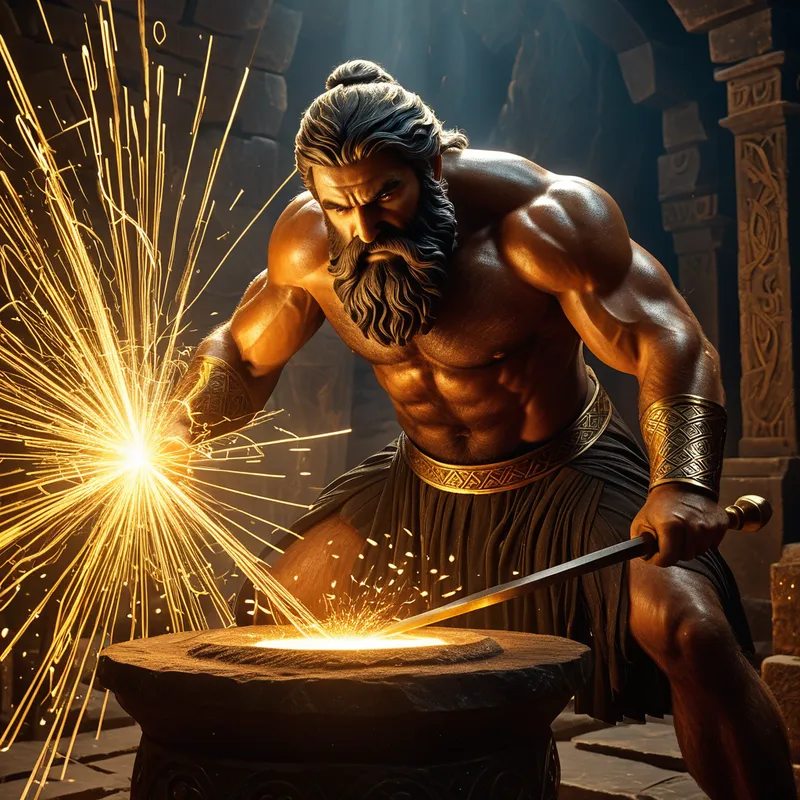
Hear now the tale of the fire in the dark, the cunning of the broken god, and the laughter that turned to stone in divine throats. It begins not on sun-drenched Olympus, but in its smoldering underbelly, within the cavernous heart of a volcano on the isle of Lemnos. Here, Hephaestus labors. The air is thick with the scent of ozone and hot metal, ringing with the relentless clang-clang-clang of a hammer that is both tool and heartbeat. He is the master artificer, his massive shoulders hunched over the anvil, his powerful arms—streaked with soot and scars—moving with a grace that belies his lame and twisted leg. His brow is perpetually furrowed, not in anger, but in the deep concentration of one who speaks to metals and understands the whispers of the flame.
His heart, however, is a colder forge. For he is wed to Aphrodite, born of sea-foam and sunlight, a creature of fleeting touch and capricious delight. Their union was a jest of the gods, a mismatch that echoed through the marble halls. And the whispers came to him, carried by the soot-grimed spirits of his forge: his wife did not linger in his smoky halls. She found her solace in the brutal, gleaming arms of Ares, whose domain was not creation but carnage.
A fury colder than any quenching bath settled in Hephaestus’s bones. But his was not the hot, blind rage of Ares. It was the slow, calculating heat of the crucible. He would not confront; he would demonstrate. He would craft a truth so undeniable it would shame the shameless. For days and nights, the hammering ceased. In its place was a delicate, almost silent scraping, a pulling of thread finer than a spider’s silk, but forged from star-metal and divine intent. He wove not a chain, but a net. A net of gold wires so fine they were nearly invisible, yet so cunningly linked that no power, divine or mortal, could break its weave. It was his masterpiece—not a weapon of war, but a prison of proof.
With the net coiled like a dormant serpent in his hand, he ascended to Olympus. He spoke to no one. He went to the bedchamber he seldom shared and set his trap with the precision of a master craftsman. The net was hung above the great bed, its threads catching the faint light like a dew-laden web at dawn. Then, he announced to all that he was departing for his beloved Lemnos, his forge calling him back. The words hung in the air, a bait as obvious as it was irresistible.
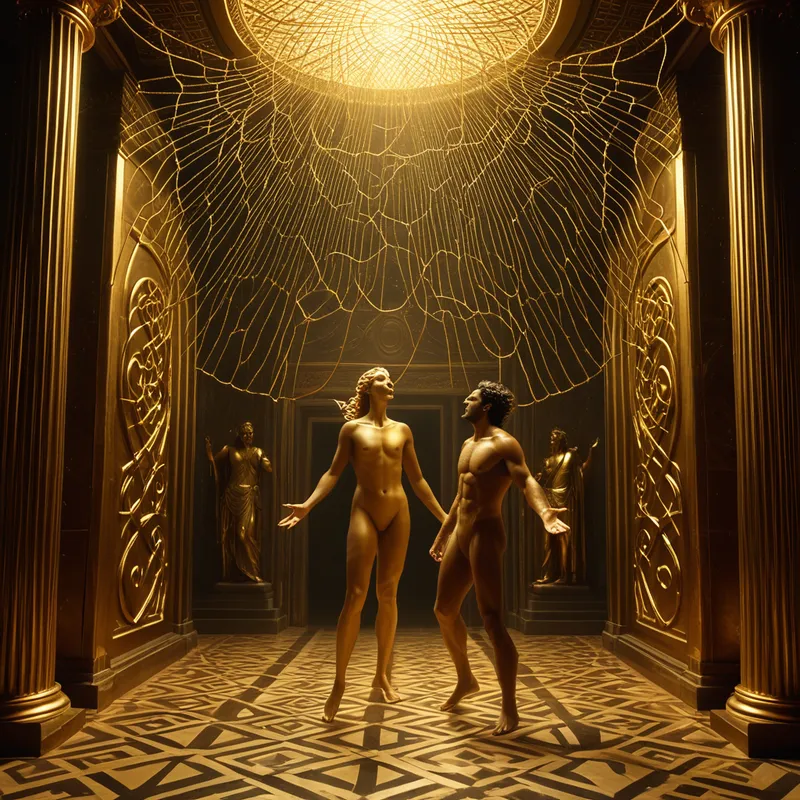
He did not go far. From a hidden vantage, the lame god watched. And as he knew they would, the lovers came. Ares, all arrogant muscle, and Aphrodite, a vision of yielding softness, entered the chamber of the cuckold, laughing at the simplicity of the brute they thought him. The moment they lay upon the bed, Hephaestus, from his place of hiding, invoked the net’s secret nature. It fell, a shimmering cascade of golden light, wrapping them in a perfect, unbreakable embrace. They struggled, but the more they moved, the more exquisitely the net conformed, pinning limb to limb, holding them in the very act of their betrayal.
Then, Hephaestus did the unthinkable. He threw open the doors of the chamber and called all Olympians to witness. They came—Zeus, Hera, Poseidon, Hermes—a crowd of immortals gathering around the entangled pair. A roar of laughter erupted, but it was not the laughter of justice. It was the cruel, bawdy laughter of peers caught in another’s embarrassment. Dionysus leered. Hermes quipped that he would gladly trade places with Ares, even trapped so. The proof was absolute, the humiliation complete, yet the divine court found not condemnation, but comedy in the pain of the craftsman. In the end, under Poseidon’s persuasion and promises of recompense, Hephaestus, his victory ashen in his mouth, withdrew the net. The lovers fled, and the gods returned to their halls, the story already becoming a favorite anecdote. Hephaestus was left alone, the brilliant, empty net in his hands, the echo of immortal laughter the only reward for his perfect craft.
Cultural Origins & Context
This myth is preserved primarily in the eighth-century BCE epic, the Odyssey, sung by the blind poet Homer. In Book Eight, the bard Demodocus sings this very tale in the court of the Phaeacians to entertain Odysseus. This framing is crucial: it is a story told about the gods, for the amusement and moral contemplation of mortals. It functions as a piece of divine gossip, pulling back the curtain on Olympus to reveal that the gods are subject to the same passions, jealousies, and social embarrassments as humans, albeit on a grander, more consequential scale.
Societally, the myth served multiple purposes. It explained the natural enmity between the principles of war (Ares) and craftsmanship (Hephaestus). It reinforced social norms around marriage and fidelity, even as it cynically displayed the gods flouting them. Most importantly, it celebrated metis—cunning intelligence and masterful skill. Hephaestus, though physically imperfect and socially wronged, triumphs through his intellect and artistry. He uses the very qualities that set him apart (his lameness, his connection to the underground forge) to craft a solution that temporarily brings the beautiful, powerful, and deceitful to heel. For an ancient Greek audience, this was a deeply satisfying narrative: brain over brawn, craft over passion, the underdog using his unique gifts to expose hypocrisy.
Symbolic Architecture
The Net is the central symbol, and it is a profound paradox. It is a trap, but not one of brute force. It is a revelation device.
The Net does not punish the crime; it illuminates it. It is the material manifestation of hidden truth, made so exquisite and inescapable that it cannot be denied.
Hephaestus represents the Creator archetype, but one whose creative power is born from a wound—his lameness, his rejection by Hera, his marital betrayal. His forge is the psychic crucible where raw pain (the base ore of betrayal) is transmuted into a conscious, deliberate artifact (the net). The net itself is his perfected thought, his “complex” made manifest. Ares and Aphrodite trapped within it symbolize the raw, unconscious entanglement of two primal drives: violent aggression and binding desire. They are caught in flagrante delicto, representing a psychological state where shadow contents (hidden desires, betrayals) are suddenly, glaringly conscious.
The reaction of the other gods is equally symbolic. Their laughter is not justice, but the psyche’s defensive tendency to trivialize profound, uncomfortable revelations. It represents the ego’s attempt to defuse a shocking truth by turning it into entertainment, thereby avoiding its own moral reckoning. Hephaestus’s ultimate, hollow victory speaks to the moment when one’s perfect proof fails to elicit the desired change in others, leaving only the stark reality of the exposed truth itself.
The Dreamer’s Resonance
To dream of a net, especially one of golden or luminous threads, often signals a process of conscious realization about an entangling situation. The dreamer may be the forger, the trapped, or the witness.
If one dreams of forging the net, it indicates a somatic process of containment. The body-mind is actively working to give form to a diffuse sense of betrayal or injustice. There is a crafting of boundaries, a deliberate, almost obsessive focusing of intellect to solve an emotional problem. The somatic sensation might be one of intense, focused tension in the hands and brow—the feeling of precise, furious creation.
Dreaming of being caught in the net reflects a moment of profound psychological exposure. The dreamer has become conscious of how they are trapped by their own desires, addictions, or a complicit relationship. The net is not painful, but it is utterly immobilizing, forcing a confrontation with a truth they have participated in hiding. The somatic feeling is often one of paradoxical comfort within the trap—the shame is real, but so is the relief of no longer maintaining the pretense.
To dream of watching others caught, like the Olympian gods, points to the dreamer’s own ambivalence. They are witnessing a truth revealed in their own psyche or life, but are responding with detached amusement, judgment, or cynicism rather than integration. This is a defense dream, highlighting a resistance to the emotional gravity of the revealed content.

Alchemical Translation
The myth models the alchemical process of coagulatio—the moving from a fluid, volatile state (the secret affair, the diffuse pain of betrayal) to a fixed, solid state (the crafted net, the exposed truth). Hephaestus is the alchemist within the psyche, performing this operation.
Individuation often requires forging our own Net of Hephaestus: a conscious structure fine enough to capture the elusive, golden shadows of our personal betrayals—both those we have suffered and those we have enacted.
The first stage is the nigredo: the blackening, the despair and fury Hephaestus feels in his forge. This is the necessary descent into the painful affect. The second is the albedo: the whitening, the purification of intent. Here, raw emotion is distilled into a precise plan—the design of the net. The forging is the citrinitas, the yellowing, where the plan is given brilliant, tangible form. Finally, the trapping and exposure is the failed rubedo—the reddening, or culmination. In the myth, it fails because it seeks external validation. The true alchemical rubedo for the modern individual occurs internally.
The triumph is not in shaming the other, but in the act of creation itself. By crafting the “net”—which could be a piece of art, a deeply honest journal entry, a therapeutic breakthrough, or a conscious boundary—we perform the sacred labor of giving form to our wound. We move from being passive victims of circumstance (the cuckolded husband) to active agents who can manifest our reality (the divine smith). The trapped lovers then symbolize aspects of our own psyche—our inner Ares (brutish instinct) and inner Aphrodite (addictive desire)—that we have finally caught in the act and must consciously relate to, not as enemies to be destroyed, but as entangled energies to be understood and ultimately, with compassion, released. The net is not an end, but the exquisite, necessary tool that makes the next stage of integration possible.
Associated Symbols
Explore related symbols from the CaleaDream lexicon: