
The Native American myth of th Myth Meaning & Symbolism
A colossal spirit-bird whose wings create thunder and eyes flash lightning, embodying the terrifying and cleansing power of the sacred.
The Tale of The Native American myth of th
Listen. Before the world was as it is, when the earth was still soft and the sky was close enough to touch, there was a silence. It was not a peaceful silence, but a waiting one, heavy with potential. Then, from the place where the four winds are born, came the sound of a great heartbeat. Thump-thump. Thump-thump. It was the pulse of the world itself.
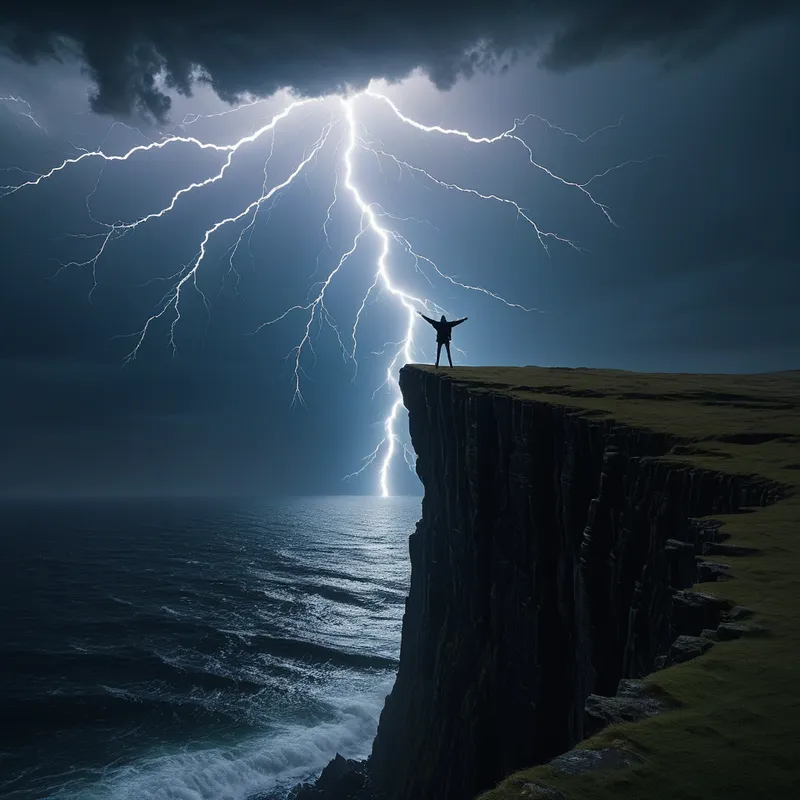
And with that pulse came the being known as Wakinyan, the Thunderbird. It did not hatch from an egg, but coalesced from the very breath of the storm. Its body was the mountain range given wings, feathers the color of bruised sky and sun-bleached bone. When it stretched its wings—wings so vast they brushed the ceilings of the heavens—the air tore with a sound that shook the roots of the trees and the bones of the animals. This was the first thunder.
Its eyes were not eyes of flesh, but pools of captured lightning. A single glance could split a stone, or ignite the dry grass of the plains. It lived high in the sacred peaks, in a nest woven from the branches of ancient pines and the bones of chaos. It was a being of terrifying power, a sovereign of the upper air, and the people below both revered and feared its passage.
For the Thunderbird was not a gentle guardian. It was a purifier. When the world grew stagnant, when lies festered in the hearts of men, or when the balance between the creatures was broken, the Thunderbird would descend. It would hunt the great, twisting serpents of the deep waters and the underworld—the Unktehi or the Horned Serpents—whose coils choked the rivers and whose breath poisoned the springs. Their battles would darken the sky. The serpent’s hiss was the whirlwind, the Thunderbird’s shriek the thunderclap. Lightning would strike the earth, sometimes setting forests ablaze.
The people would huddle in their lodges, feeling the world tremble. They would hear the terrible sounds of this cosmic struggle—the clash of primal forces. But when the storm passed, when the Thunderbird returned to its mountain aerie, wounded perhaps, but victorious, a new silence would fall. This silence was different. It was clean, washed, and charged. The air smelled of ozone and wet earth. The rivers ran clear again. The world had been scoured. The dangerous, chaotic energies had been driven back into their holes, and the sacred balance was restored, purchased at the price of terrifying, awe-full violence. The Thunderbird ruled not through gentle decree, but through the undeniable, transformative force of the storm.
Cultural Origins & Context
The figure of the Thunderbird is not a single, monolithic myth from one tribe, but a profound and widespread archetype found across many Indigenous nations of North America, from the Lakota and Ojibwe of the Plains and Woodlands to the Kwakwaka’wakw and Haida of the Pacific Northwest. This places it in a “Global/Universal” context within the tapestry of Native American thought—a shared spiritual concept adapted to local landscapes and cosmologies.
It was passed down not in books, but in the oral traditions told by elders around winter fires, in the intricate patterns of totem poles reaching for the sky, and in the designs of ceremonial regalia worn in dance. Its story was not mere entertainment; it was a cosmological map and a social contract. It explained the terrifying yet necessary phenomenon of thunderstorms, framing them as a divine, cleansing conflict. It reinforced the principle of balance—that sky and earth, order and chaos, must be in a dynamic, sometimes violent, equilibrium. The Thunderbird’s authority was a reminder of a power greater than any human chief, a sovereign force that demanded respect and humility from all beings under its vast domain.
Symbolic Architecture
Psychologically, the Thunderbird represents the awesome, non-negotiable power of the Self—what Carl Jung termed the archetype of the Self in its aspect as supreme ruler and integrator. It is not the personal ego, but the transpersonal authority that orchestrates the psyche’s development, often through disruptive, “stormy” interventions.
The lightning does not ask permission to illuminate; it simply reveals what is, in a flash of terrifying clarity.
The Thunderbird’s eternal battle with the serpentine water spirits is the internal drama between the soaring spirit of consciousness, order, and transformation (sky) and the chthonic, instinctual, often chaotic forces of the unconscious (water/earth). We are not meant to “slay” our depths, but to engage them, to bring them into a dynamic relationship with our higher nature. The storm is the psychic crisis necessary for growth; the cleansing rain that follows is the integration and new life that emerges from that struggle. The Thunderbird’s power is ultimately one of sovereign renewal, enforcing a balance that the smaller, personal self might be too afraid or too attached to establish.

The Dreamer’s Resonance
When the Thunderbird storms into modern dreams, it signals a profound somatic and psychological upheaval. The dreamer may be undergoing a period where foundational aspects of their life or identity are being challenged by an overwhelming, external-seeming force. This is the psyche’s sovereign power acting to break a stagnation.
Somatically, one might dream of being buffeted by impossible winds, feeling the deep, subsonic vibration of thunder in their chest, or witnessing blinding flashes that reveal hidden truths in their dream landscape. Psychologically, it is a process of forced perspective. The Thunderbird’s view is from the mountain peak—it sees the whole pattern. Its descent into the dreamer’s world is the arrival of that holistic, authoritative perspective, which can feel terrifying as it dismantles old, outgrown structures (relationships, careers, self-concepts) that are out of alignment with the soul’s greater balance. The dreamer is in the lodge, hearing the battle overhead; they are witnessing their own inner sovereignty at work.

Alchemical Translation
The alchemical journey modeled by the Thunderbird myth is that of Imperium—the stage of gaining true inner sovereignty. The modern individual often lives in a negotiated peace with their inner serpents: their repressed instincts, unresolved traumas, or inflated fantasies. We let these forces choke our inner rivers, poisoning our vitality. The Thunderbird’s process is not one of gentle negotiation.
The throne of the Self is not cushioned; it is carved from lightning-struck stone.
The alchemical translation begins with the lightning flash—a sudden insight, a devastating loss, a crisis that shatters our complacency (the nigredo or blackening). This is the Thunderbird’s gaze. The subsequent storm is the chaotic, painful period of confrontation where we must, consciously or not, engage our deepest shadows and chaotic patterns (the battle with the serpent). The ego feels victimized by this storm. But the goal is the cleansing rain—the albedo or whitening—the release, clarity, and emotional catharsis that follows integration. We emerge not “healed” in a bland sense, but re-balanced under a new, more authoritative inner order. We learn to respect the storm within as a necessary, sacred force. To individuate is to stop cowering from the thunder and to begin to understand, and ultimately embody, the majestic, terrifying responsibility of that ruling power over the totality of one’s own being.
Associated Symbols
Explore related symbols from the CaleaDream lexicon: