The Narrow Gate Myth Meaning & Symbolism
A teaching of Jesus describing a difficult, constricting path that leads to life, contrasted with a wide, easy road to destruction.
The Tale of The Narrow Gate
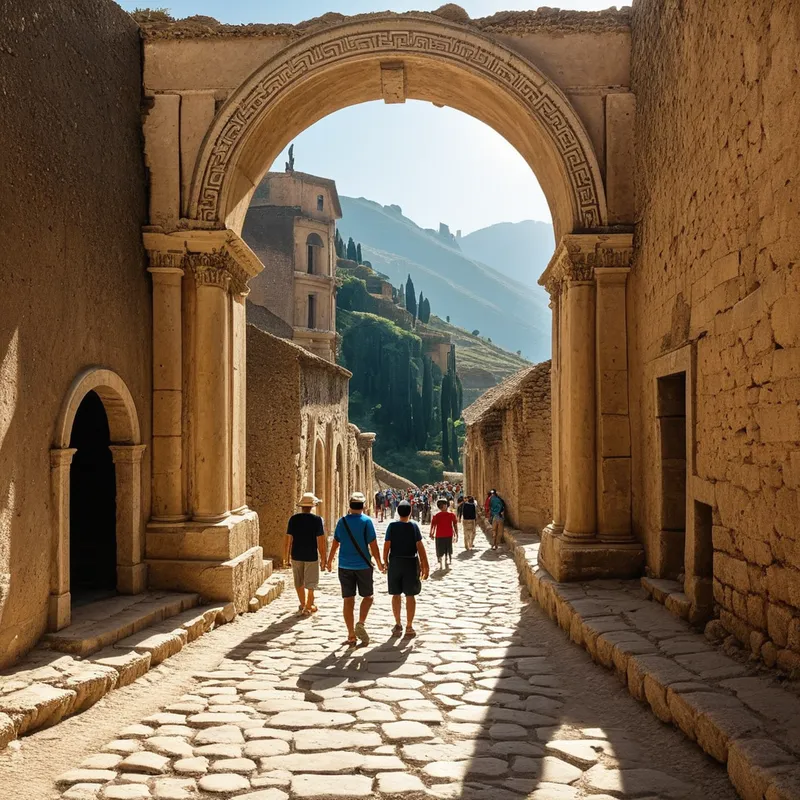
Listen. The road is wide. You know this road. Its stones are worn smooth by a million sandaled feet, its ruts deep from the wheels of a thousand carts. It runs through the valley, easy and flat, bordered by fig trees and taverns. The sun is warm, the dust is thick, and the air hums with the sound of barter and laughter, of arguments and gossip. Travelers move in great herds, their eyes fixed on the horizon where a great, gilded gate stands perpetually open, adorned with garlands. The way is clear. The choice is effortless. You simply join the flow.
But lift your eyes. Look to the hills. There, where the rock breaks its teeth against the sky, you will see it. Not a road, but a path. A goat track. It begins where the wide road seems most inviting, a mere fissure in the earth, an afterthought. It climbs immediately, away from the noise, into the silence of stone and thorn. Few tread here. The path is not worn; it must be found with each step. The air grows thin. Your breath becomes a prayer.
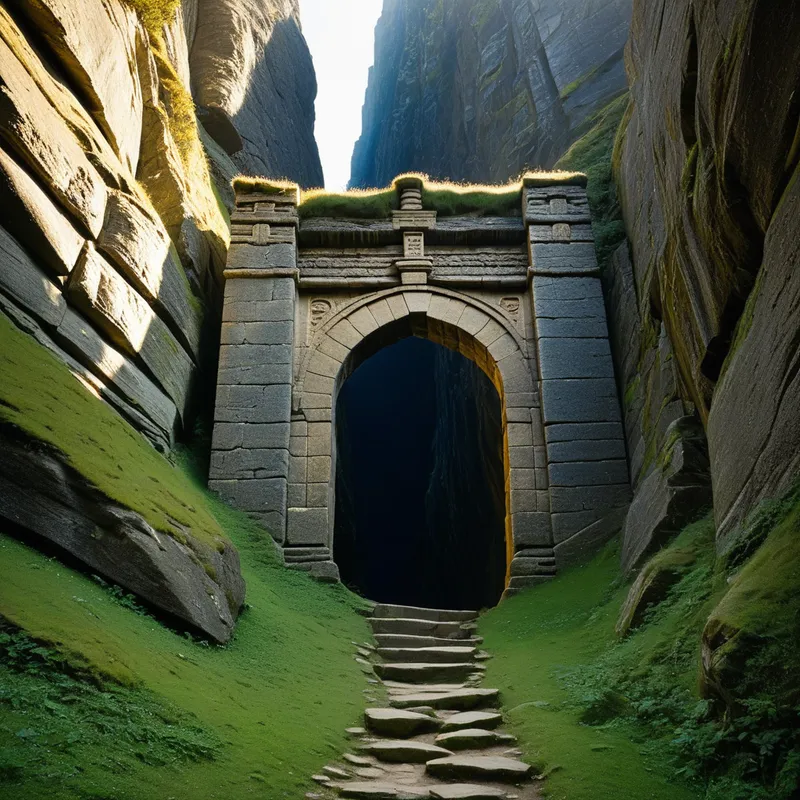
And at the summit, where the wind screams and the eagles circle, there is the gate. It is not gilded. It is hewn from the living rock of the mountain itself—two sheer faces with a sliver of light between them. It is so narrow you must turn sideways. You must shed your pack, your cloak, the trophies you collected on the wide road. You must exhale to make yourself small enough. To pass through is to be squeezed by the mountain, to have the world stripped from you. On the other side… there is only a blinding, silent radiance, and a new kind of air. The Teacher stood on a slope, the crowds pressing in, and his voice cut through the chatter like a cold wind. “Enter through the narrow gate,” he said, his gaze holding the terrible, beautiful path on the horizon. “For wide is the gate and broad is the road that leads to destruction, and many enter through it. But small is the gate and narrow the road that leads to life, and only a few find it.” In that moment, every heart felt the fork in the road within itself.
Cultural Origins & Context
This teaching is recorded in the Gospel of Matthew, delivered during the Sermon on the Mount. It was not a formal myth of gods and heroes for a settled people, but a radical, existential map for a community under pressure. The early followers of Jesus were a minority sect within Judaism, facing social ostracism and the looming threat of Roman persecution. The “wide road” was the dominant culture’s path of assimilation, conventional success, and compromised values—the way of the Empire and of worldly security.
Passed down orally before being codified, this saying functioned as a stark boundary marker and a source of identity. It fortified the community, explaining why their path was difficult and lonely. It was a call to vigilance and deliberate choice in a world that offered many easier, more popular alternatives. The mythos framed the entire spiritual life not as a passive inheritance, but as an active, arduous pilgrimage requiring constant discernment and the courage to walk alone.
Symbolic Architecture
The myth presents a supreme archetypal crossroads. The Wide Gate symbolizes the unconscious life, the path of least resistance where the individual is dissolved into the collective. It is the realm of consensus reality, unexamined assumptions, and the persona. Its destination is “destruction”—not necessarily a fiery hell, but the psychic death of authenticity, the erosion of the unique self into the mass.
The Narrow Gate is not a test of worthiness, but a geometry of essence. It is the shape the soul must assume to become itself.
Conversely, the Narrow Gate is the birth canal of consciousness. Its narrowness represents the necessity of discrimination (from the Latin discriminare, “to divide”). To pass through, one must consciously choose what to bring and what to leave behind—cherished identities, comfortable narratives, and even virtuous traits that have become crutches. The squeezing is the pressure of individuation, where the complex, contradictory totality of the psyche is forced into a coherent, singular expression. The “life” on the other side is the integrated Self, a state of being that is whole, authentic, and connected to the transcendent.
The Dreamer’s Resonance
When this myth stirs in the modern unconscious, it manifests in dreams of constriction and critical choice. You may dream of trying to crawl through a narrowing tunnel, of being stuck in a hallway that gets smaller, or of facing two doors with paralyzing urgency. These are not nightmares of random anxiety, but somatic maps of a psychological process.
The somatic feeling is one of pressure, of breath held, of the chest tightening. Psychologically, the dreamer is at a nexus where a previously broad and acceptable way of being—a career path, a relationship dynamic, a self-image—has become untenable. The psyche is signaling that continuation on the “wide road” is now a form of self-betrayal. The dream presents the crisis: the comfortable, known way versus the difficult, unknown, but ultimately authentic one. The anxiety is the birth pang of a new consciousness, the ego’s resistance to being stripped down and remade.

Alchemical Translation
The alchemical journey is precisely this passage from the massa confusa—the wide, chaotic, mixed matter of the unconscious—to the lapis philosophorum—the perfected, singular stone of the Self. The myth of the Narrow Gate models this opus.
The “wide road” is the initial stage of gathering all aspects of the personality, both noble and base. But this collection is merely the raw material. The crucial, terrifying stage is the separatio and the mortificatio—the separation and the symbolic death. The Narrow Gate is the alembic, the vessel of transformation. The traveler must willingly submit to its crushing confines, allowing the inflated ego, the superfluous attachments, and the borrowed identities to be pressed out. What remains is the distilled essence.
To find the gate is to realize the path is not outside, but a narrowing of attention until only the core truth remains.
For the modern individual, this translates to the moments of ruthless honesty and necessary sacrifice that precede any genuine transformation. It is quitting the secure job to follow a calling. It is ending the pleasing facade to speak a hard truth. It is surrendering the addiction to being right, liked, or safe in order to become real. The triumph is not in reaching a heavenly destination, but in achieving the integrity of form that allows one to finally pass through one’s own center. The light on the other side is the illumination that comes only when everything that is not you has been left behind.
Associated Symbols
Explore related symbols from the CaleaDream lexicon: