The mythological crossroads Myth Meaning & Symbolism
A universal tale of a solitary traveler at a liminal place of power, facing a choice that will define their fate and identity.
The Tale of The Mythological Crossroads
Listen. There is a place that is not a place, a time that is not a time. It is the hour between the dog and the wolf, the breath between question and answer. It is where the worn path you have always known splits, and the earth itself holds its breath.
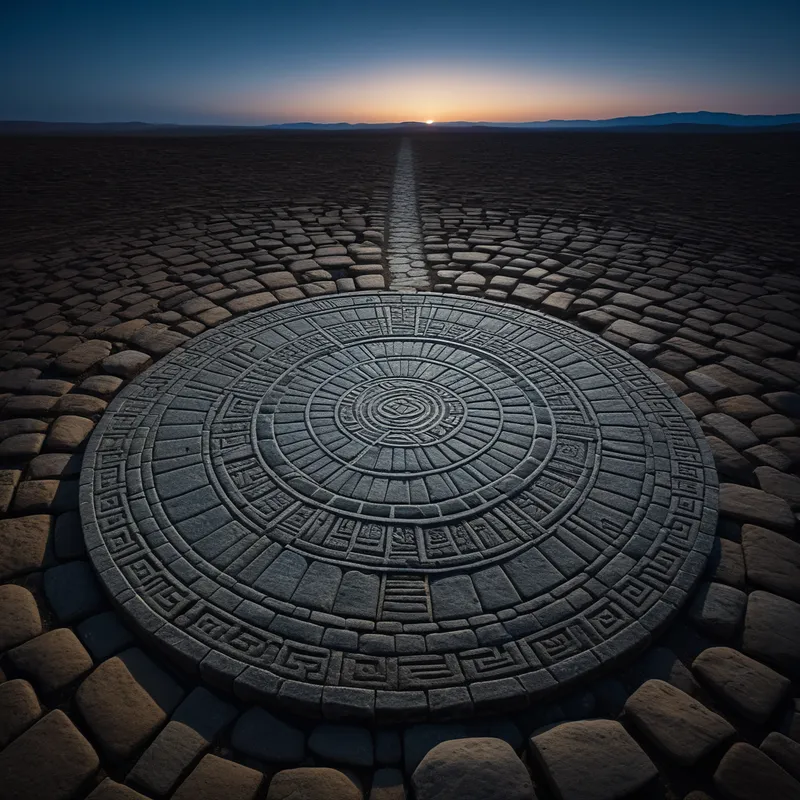
Here, at the convergence of the four ways, the air shimmers with potential. The road from the north is hard-packed earth, cold and certain. The road from the south is sun-baked stone, warm with memory. The road from the east is a path of new-cut cobbles, sharp and promising. The road from the west is nothing but dust and wind, whispering of oblivion. And at the very center, where all directions cancel into a perfect, silent point, stands a marker—a stone so old it remembers the first footfall. Its surface is carved with signs no living tongue can speak, yet every heart can feel: a spiral, a blade, a cup, a mask.
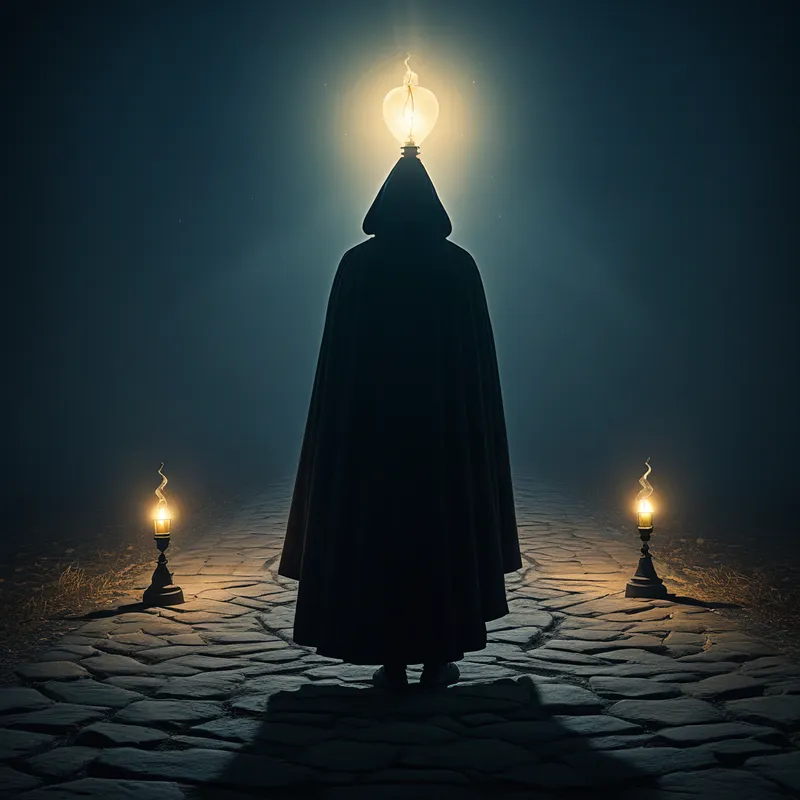
Into this charged silence walks the Traveler. They are weary, their cloak stained with the miles of a linear life. They carry a satchel of regrets and a lantern whose guttering flame is their dwindling certainty. They have come because they must; the old road has ended in a thicket of thorns.
As the last light bleeds from the sky, the crossroads awakens. From the northern path steps a figure clad in grey wool and iron. Their face is stern, etched with the lines of law and consequence. They hold a set of scales that do not balance. “Choose my road,” their voice echoes like a judge’s gavel. “I offer order, structure, and the safety of the known wall. Your life will be measured, predictable, and secure.”
From the southern path comes a being of vibrant silks and warm spices. Their laugh is rich, their eyes full of passion’s fire. In their hands, a ripe pomegranate bursts with seeds. “Follow me,” they croon, “and know pleasure, connection, the fertile chaos of the heart. Your days will be a feast of sensation and belonging.”
Then, from the eastern path, a shimmering form materializes, like light refracted through a prism. They speak not with a voice, but with a chorus of ideas. “The future lies with me,” they intone. “I offer innovation, the spark of genius, a destiny forged by your own will. Walk here, and become the architect of a new world.”
The Traveler looks to the western path. No figure emerges. Only a deep, inviting silence, and the scent of rain on dry earth. It promises nothing but an end to choosing.
The wind rises, snuffing the Traveler’s lantern. In the sudden dark, they are alone with the weight of the four winds and the silent judgment of the stone. This is the crux. This is the moment where a soul is unmade and remade. Do they take the north road of the Father, the south road of the Mother, the east road of the Spirit? Or do they step into the west’s embrace, the road of the Shadow?
The Traveler does not choose a road.
Instead, they sink to their knees at the base of the central stone. They empty their satchel of regrets—the heavy stones of “what if” and “if only.” They place their cold hands upon the ancient glyphs. And they wait. They do not choose a direction from the outside; they listen for the direction from within.
As dawn’s first light touches the marker, the spiral glyph begins to glow. The four figures bow their heads and dissolve back into the paths from whence they came. The Traveler rises. They do not take the north, south, or east. They do not vanish into the west. They begin to walk around the central stone, tracing a slow, deliberate circle that touches the beginning of all four roads. They are at the center and on the perimeter. They have chosen not a path, but the crossroads itself. And with that, they walk on, leaving the sacred junction behind, a new road forming softly beneath their feet with every step, a fifth way that did not exist until they willed it into being.
Cultural Origins & Context
The crossroads is not a myth owned by any one culture, but a primordial symbol etched into the human psyche. It appears with startling consistency across the globe: as the Hecate’s domain in Greece, where offerings were left for the goddess of ghosts; as the potent crossroads (crossroads) in African and African Diasporic traditions, where one might bury a petition to the spirits or meet a trickster deity like Eshu-Elegba; in the Celtic tales where fairy paths intersect; and in the countless folk stories where the hero meets a mysterious stranger or must make a fateful choice.
This universality stems from its fundamental reality. Before maps, the intersection of paths was a critical, tangible locus of human experience—a place of meeting, trade, danger, and decision. Ritually, it was a liminal zone, neither here nor there, and thus a conduit to the Otherworld. It was where society’s rules were suspended, where one could commune with chthonic powers, cast away curses, or seek forbidden knowledge. The myth was passed down not in a single sacred text, but in proverbs, folktales, rituals, and warnings told at hearthsides and on journeys, serving as a cognitive map for navigating life’s inevitable crises of direction.
Symbolic Architecture
The crossroads is the ultimate symbol of the critical juncture. It is the embodied “either/or,” the physical manifestation of dilemma. Its four arms represent the totality of possibilities—often framed as the four cardinal directions, the four elements, or the four functions of consciousness (thinking, feeling, sensation, intuition).
The crossroads does not ask what you will do, but who you will become in the deciding.
The central stone or marker is the axis mundi in miniature, the connection between the personal and the cosmic. The figures who appear are not external deities but archetypal potentials within the Traveler: the Ruler (north), the Lover (south), the Magician (east), and the silent call of the Shadow (west). The myth’s profound twist is that the true choice is not between these externalized options, but to integrate their essence from a position of centered awareness.
The Dreamer’s Resonance
When the crossroads appears in a modern dream, the psyche is signaling a profound state of existential navigation. The somatic feeling is often one of paralysis, anxiety, or dizzying vertigo—the body experiencing the weight of a life decision. The dreamer may find themselves at a literal intersection, before multiple doors, or facing divergent paths in a landscape.
This is not merely about choosing a job or a partner. It is the psyche working through a structural dilemma of identity. Each path represents a potential self, a life script, or an unlived life. The terror of the dream comes from the unconscious knowledge that to choose one is to forsake others—a miniature experience of mortality. The dream invites the dreamer to stop seeking the “correct” external signpost and to instead locate their own internal “central stone”—their core values and authentic self—from which to view the options. The dream may recur until the dreamer moves from a state of frantic choice to a state of conscious selection.
Alchemical Translation
The alchemical journey is one of separation, confrontation, and integration—the solve et coagula. The myth of the crossroads is a perfect model for this psychic transmutation.
First, Separation (Solve): The Traveler is separated from their old, linear path. They are plunged into the nigredo, the blackening, the crisis of meaning where all former certainties fail. The extinguished lantern symbolizes this necessary dark night.
Second, Confrontation: The appearance of the archetypal figures is the albedo, the whitening, where the contents of the unconscious are made visible. The ego is presented with its own dissociated potentials in dazzling, personified form. The temptation is to identify with one and become possessed by it (the rigid ruler, the hedonistic lover, the ungrounded magician).
The alchemy occurs not in the selection of a path, but in the circumambulation of the center. The true gold is the realization that the Self is the crossroads.
Finally, Integration (Coagula): The Traveler’s refusal to choose a given path and their turn inward to the center stone is the pivotal moment. This is the citrinitas, the yellowing, the dawn of a new consciousness. By touching the ancient glyphs—the inherited, instinctual wisdom of the Self—they activate a new pattern. Walking the circle that encompasses all paths is the rubedo, the reddening, the creation of the philosopher’s stone. The new, fifth road that appears is the integrated life, the unique path of individuation that could not be seen or walked until the ego surrendered its frantic need to pick and instead learned to synthesize from the center. The myth teaches that our deepest choices are not about going in a direction given by the world, but about forging a direction from the marriage of our inner totality and outer circumstance.
Associated Symbols
Explore related symbols from the CaleaDream lexicon: