The myth of King Solomon Myth Meaning & Symbolism
A king blessed with divine wisdom builds a glorious kingdom, yet his heart is divided by earthly desires, leading to a profound legacy of light and shadow.
The Tale of The myth of King Solomon
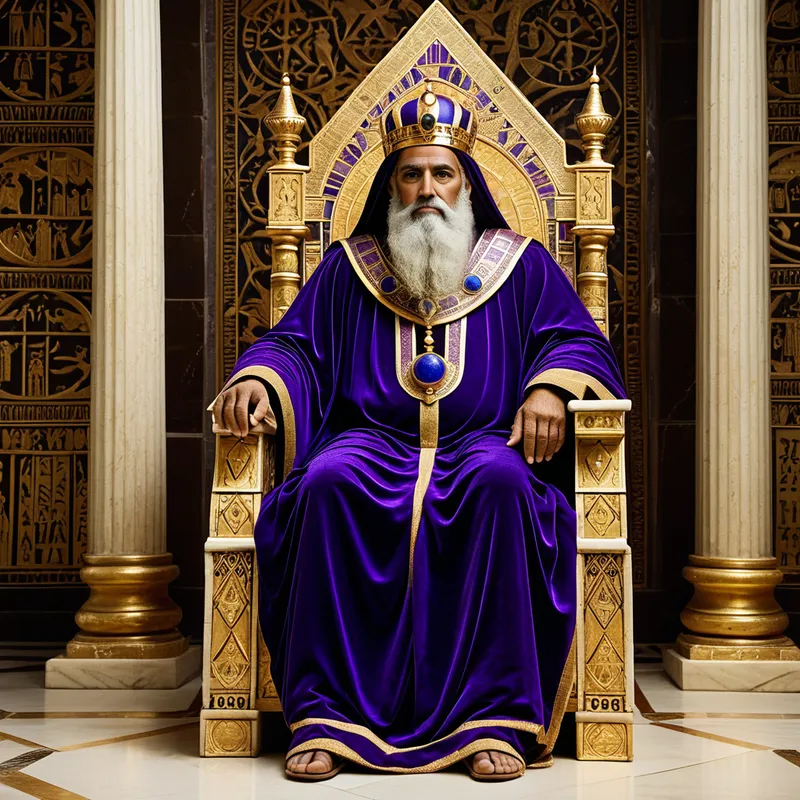
Hear now the tale of the man who held the world in the cup of his mind. In the high hills of Judah, when the dawn of empires was still young, there reigned a king named Solomon, son of the warrior David. But this was no ordinary prince. In the deep velvet of a Gibeonite night, the Lord appeared to him in a dream and spoke: “Ask. What shall I give you?”
The young king, feeling the weight of the crown like a mountain upon his brow, did not ask for the lives of his enemies, nor for boundless wealth, nor for a long life. He drew a breath that seemed to draw in the silence of the cosmos itself and said, “Give your servant an understanding heart to judge your people, that I may discern between good and evil.” This plea, a selfless yearning for the scales of justice, pleased the Divine. And so, wisdom beyond measure was poured into his soul—a wisdom that was not merely knowledge, but a hearing of the music of creation, an understanding of the language of birds, the reasoning of ants, and the hidden properties of all growing things.
With this wisdom, his reign became a golden age. Kings and queens, like the famed Queen of Sheba, journeyed from the ends of the earth, drawn by the rumor of his brilliance. They came to test him with riddles and left staggering, their own treasures seeming dull before the light of his mind. He built the Temple, a house for the Divine so magnificent that the very stones seemed to sing. He composed songs of love and despair that etched themselves upon the heart of time. He judged with a clarity that cut through deception like a diamond cleaves stone, famously revealing the true mother of a child by threatening to divide it, hearing the authentic cry of love in the woman who would rather lose than see harm done.
He commanded spirits with a ring inscribed with the sacred name, building his city not just with human hands, but with the labor of the unseen. His court shimmered with gold from Ophir, ivory from distant lands, and spices that perfumed the air with forgotten dreams. Yet, within this blinding splendor, a shadow grew. The wisdom that could govern nations and converse with the cosmos could not govern his own heart. To secure alliances, he took seven hundred wives and three hundred concubines, princesses from foreign nations who worshipped other gods. To please them, he built high places for Ashtoreth and Chemosh. The man who built a house for the One God raised altars to a thousand others.
The divine voice, once so clear in the dream, now spoke in the stern tones of prophecy. Because he had let his heart turn away, his kingdom would be torn in two after his death. The golden age would end not with a bang, but with a fracture. And so, the wisest of all men, the master of the visible and invisible worlds, died with his great work unfinished, his legacy a divided kingdom, his final writings in the book of Ecclesiastes a haunting refrain: “Vanity of vanities, all is vanity.” The light of his wisdom cast the longest, most intricate shadow.

Cultural Origins & Context
The myth of Solomon is rooted in the historical and theological soil of ancient Israel, primarily recorded in the biblical books of 1 Kings, 2 Chronicles, and in the wisdom literature attributed to him: Song of Songs, Proverbs, and Ecclesiastes. It was passed down by priests, scribes, and storytellers as a foundational national myth, explaining both the zenith of Israel’s united monarchy and the tragic reason for its subsequent schism.
Its function was multifaceted. For the community, it was a didactic tale of covenant and consequence, a warning that divine favor is contingent upon fidelity. For the individual, it was a model of the ideal ruler—the philosopher-king whose justice stems from divine insight. Beyond its canonical roots, the figure of Solomon exploded into global folklore, especially within Islamic tradition (where he is the prophet Sulayman), Jewish mysticism, and later European grimoires and Masonic symbolism. In these traditions, he becomes the archetypal magus, the master of djinn, and the keeper of secrets of the natural world. This transition from biblical king to universal sage-magician marks the myth’s journey from a specific national history to a global archetype of wisdom grappling with power.
Symbolic Architecture
At its core, the myth of Solomon is the story of the human intellect at its most sublime and its most tragically flawed. Solomon represents the pinnacle of conscious achievement—reason, order, justice, and cultural magnificence. His wisdom is the Logos principle incarnate, capable of discerning, naming, and organizing the chaos of the world.
The gift of Solomon is the terrifying burden of seeing everything clearly, except the darkness within one’s own heart.
His building of the Temple symbolizes the sacred task of constructing a coherent, integrated psyche—a Self where the divine can dwell. His judgment represents the ultimate application of discernment. Yet, his fatal flaw is the division of the heart. His many foreign wives symbolize the allure of the outer world, of political expediency, and of undifferentiated eros—the very forces his brilliant consciousness was meant to govern. By building altars to their gods, he unconsciously allows the unified temple of his Self to be partitioned. The ring that commands spirits is the symbol of the ego’s belief it can control the vast, autonomous powers of the unconscious (the djinn, the sheydim). It is a powerful tool, but not a substitute for wholeness.
The Dreamer’s Resonance
When the Solomon pattern stirs in the modern dreamer, it often manifests as a confrontation with one’s own brilliant success and its hidden cost. One might dream of being in a position of great authority or respect, solving impossible puzzles, or building something monumental. The initial feeling is of potent capability.
The shadow appears subtly: a beloved space in the dream becoming cluttered with foreign, beautiful but meaningless objects; a sense of being watched or judged by silent figures (the neglected inner figures, the “foreign wives”); or the dream’s magnificent structure developing a fatal, hairline crack. Somaticly, this can feel like a deep fatigue behind the eyes, a heart “turned away” feeling heavy or numb amidst intellectual triumph, or a sense of being a fraud in one’s own palace. The dream is signaling that the conscious mind’s magnificent achievements are being undermined by unintegrated complexes, addictive patterns (the “foreign altars”), or a neglect of the inner life for outer validation. The psyche is presenting the bill for a wisdom that is all light and no depth.
Alchemical Translation
The alchemical journey modeled by Solomon is not of a hero slaying a beast, but of a sage integrating his shadow. The prima materia is the raw gift of brilliant consciousness. The first stage (nigredo) is not failure, but the dizzying success that reveals the inner void—the haunting “vanity” of Ecclesiastes. The building of the Temple is the albedo, the labor of purification and conscious ordering.
The critical alchemical operation is the coniunctio oppositorum—the sacred marriage. Solomon’s failure is the failed coniunctio. He collects anima figures (the wives) but does not marry them to his spirit; he keeps them separate, allowing them to pull his heart into fragmentation. The true alchemical goal is to take the Queen of Sheba—the equal, questioning, sovereign feminine consciousness from a far land (the unconscious)—not as a concubine, but as a co-ruler, integrating her wisdom with his own.
The ring of Solomon is not for commanding demons, but for sealing the union of above and below, so that the spirit of wisdom inhabits the matter of the heart.
The individuation process here is the agonizing realization that supreme intellect alone is not wholeness. The triumphant ego must humble itself before the parts of the soul it has colonized or ignored. The fractured kingdom left to his heirs is the psychic inheritance we all face: the divided self. The alchemical gold is not the gold of Ophir, but the hard-won integration where one’s divine gift (wisdom) is finally wedded to a humble, undivided heart. The completed work is not a perfect kingdom, but a whole person who can hold the tension of their own glorious light and profound shadow, ruling the inner world with a justice born of that hard marriage.
Associated Symbols
Explore related symbols from the CaleaDream lexicon: