The myth of Antaeus Myth Meaning & Symbolism
A Libyan giant, son of Gaia, invincible while touching his mother the Earth, is defeated by Heracles who lifts him into the air to sever his connection.
The Tale of The myth of Antaeus
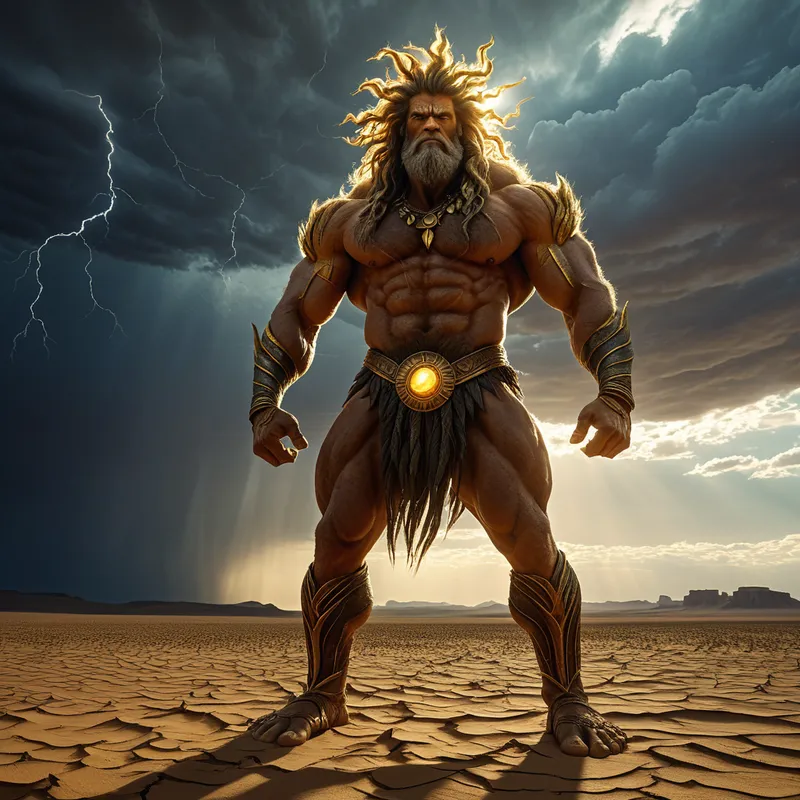
Hear now the tale of the unyielding earth, of a strength not born of muscle alone, but of the deep, silent pulse of the world itself. In the sun-scorched lands of Libya, where the desert meets the sky in a shimmering line of heat, there lived a being who was the land, and the land was him. His name was Antaeus.
He was a giant, not of mountain-crumbling rage, but of a terrible, patient power. His skin was the color of baked clay, his hair a wild thicket like gnarled roots. He did not build a home, for the entire plain was his hall. His sport was not hunting, but challenging. Any traveler who crossed his domain was forced to a contest of wrestling—a sacred, brutal dance upon the dust. And he never lost. For Antaeus was a son of Gaia, the Earth Mother, and from her he drew a secret, endless vitality.
The conflict was not a clash of armies, but of principles. It arrived in the form of a hero stained with labors: Heracles, journeying to the garden of the Hesperides. Antaeus, seeing this mighty stranger, grinned a grin of cracked earth. The challenge was given, and accepted. They grappled in the arena of the world.
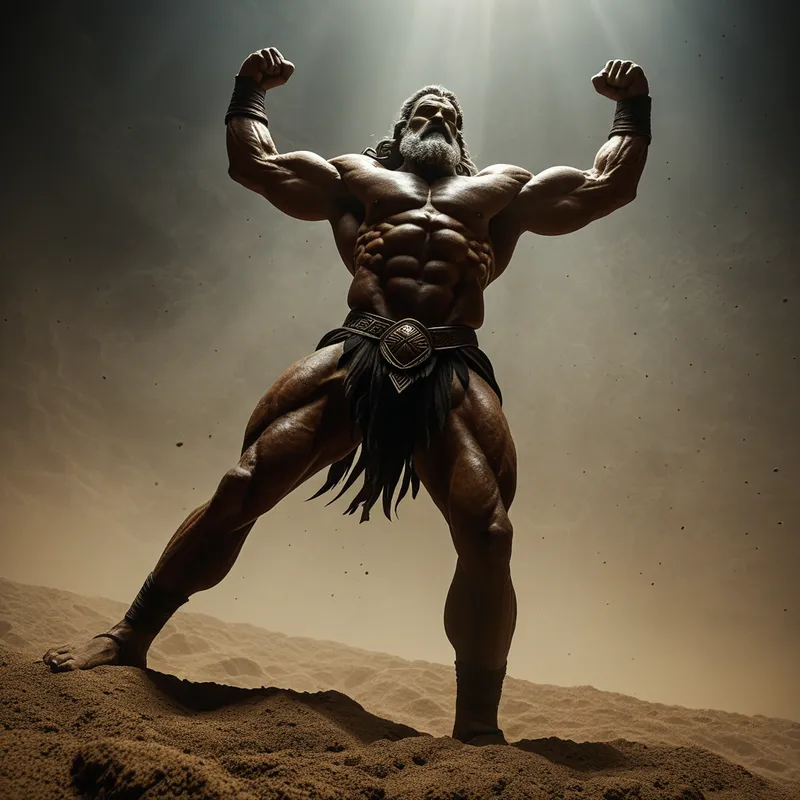
Feel the impact of their meeting—the thunderous crash of bodies, the geyser of dust kicked into the parched air. Heracles, mightiest of men, threw the giant. But as Antaeus’s broad back struck the ground, a shudder passed not through him, but into the earth. A low hum rose from the soil. The giant rose, not weakened, but renewed, larger, stronger, as if the very impact had been a mother’s embrace, transferring her boundless strength into his limbs. Again and again Heracles hurled him down. Again and again Antaeus rose, refreshed, his laughter a dry wind.
Heracles, his breath coming in ragged gasps, felt the terrible truth in his aching arms. This was no ordinary foe. His strength was a well that deepened with every draw. The hero’s mind, weary but cunning, watched. He saw the moment of contact, the subtle flow of energy from soil to skin. A realization, cold and clear, cut through the heat of battle. The giant’s power was not his own; it was a loan, a continuous circuit. To break the giant, one must break the circuit.
On the next mighty clash, Heracles did not strive to throw Antaeus down. Instead, with a final, titanic surge of effort born of desperation and insight, he locked his arms around the giant’s torso. He strained, every cord in his body standing out, his feet digging graves into the earth. And he lifted. He lifted Antaeus clear of the ground.
A silence fell, deeper than the desert’s quiet. The giant’s triumphant roar died in his throat. His feet, those anchors of his being, kicked at empty air. The connection was severed. The hum from the earth faded. Heracles felt the change immediately—the struggling form in his arms grew lighter, not in weight, but in essence. The terrible, renewing vitality drained away like water into sand. The life, the very being of Antaeus, depended on that touch. Held aloft, suspended between heaven and earth, he was no longer a son of Gaia; he was merely a man-shaped thing, vulnerable and finite. And there, in that terrible embrace, Heracles squeezed the breath and the borrowed life from him, until the strength of the earth was gone, and only a shell remained.
Cultural Origins & Context
The myth of Antaeus comes to us from the rich tapestry of Greek mythology, primarily recorded in the accounts of poets like Hesiod and later mythographers such as Pseudo-Apollodorus. It was not a central cult myth but a heroic episode, a sidebar in the epic journey of Heracles. Its function was multifaceted. On one level, it was an etiological tale, a “just-so” story explaining the strange, giant-like bones (fossils) found in the North African desert. On another, it served as a demonstration of Heracles’s metis—his practical intelligence and cunning—which was as crucial to his heroism as his brute strength.
Societally, it reinforced a fundamental Greek cosmological principle: the hierarchy and distinct domains of the gods. Antaeus, as offspring of Earth (Gaia) and Sea (Poseidon), represented a chthonic, primal, and localized power. Heracles, son of Zeus (the sky god), represents a newer, Olympian order. The victory is not just of strength over strength, but of celestial intelligence over telluric instinct, of mobile heroic culture over rooted, territorial monstrosity. The myth was told to illustrate that raw, elemental force, no matter how great, could be defeated by understanding the nature of that force itself.
Symbolic Architecture
At its core, the myth of Antaeus is a profound parable of connection and source. Antaeus is not a symbol of inherent, internal power, but of derived power. His strength is relational, contingent upon his unbroken contact with his source—the Earth, the Mother, the Ground of Being.
To be lifted from your source is to be rendered a ghost of your own potential.
Psychologically, Antaeus represents a state of unconscious identification with one’s foundational matrix. This could be the family system, the cultural womb, the native land, or even the physical body itself. In this state, the individual feels powerful, but only so long as they remain within that unexamined, symbiotic field. The “wrestling” is the engagement with life’s challenges, and the “renewal upon touching the ground” is the regression to the comfort of the familiar to regain energy, never developing an internal, self-sustaining reservoir of strength.
Heracles, in this reading, embodies the conscious ego or the differentiating principle of the psyche. His initial strategy—meeting force with force—fails spectacularly, mirroring our futile attempts to solve deep, systemic issues with sheer willpower. His triumph comes through observation and reframing. He sees the pattern, the dependency, and changes the rules of engagement. Lifting Antaeus symbolizes the necessary, terrifying act of psychological “lifting”—of creating conscious distance from the unconscious source, of examining one’s dependencies from a new perspective. It is the moment of insight that precedes integration.

The Dreamer’s Resonance
When this myth stirs in the modern unconscious, it often manifests in dreams of grounding and ungrounding. A dreamer may find themselves in a wrestling match where they feel inexplicably weak, or conversely, they may dream of being impossibly strong while standing on a particular patch of earth. More directly, one might dream of floating, of being unable to touch the ground, accompanied by intense anxiety and a feeling of life-force draining away.
Somatically, this resonates with feelings of dissociation, spaciness, or a lack of “embodiment.” The psychological process at work is one of re-evaluating one’s source of strength. The dream is asking: From where do you truly draw your vitality? Is it from an external, conditional source (a job, a relationship, a homeland, an identity) that can be taken away? The terror of being “lifted” in the dream is the psyche’s confrontation with the fragility of an outwardly-derived sense of self. It is a call to begin the alchemical work of internalizing that connection, of finding the “earth” within—the core, somatic, and psychic ground that cannot be severed by circumstance.
Alchemical Translation
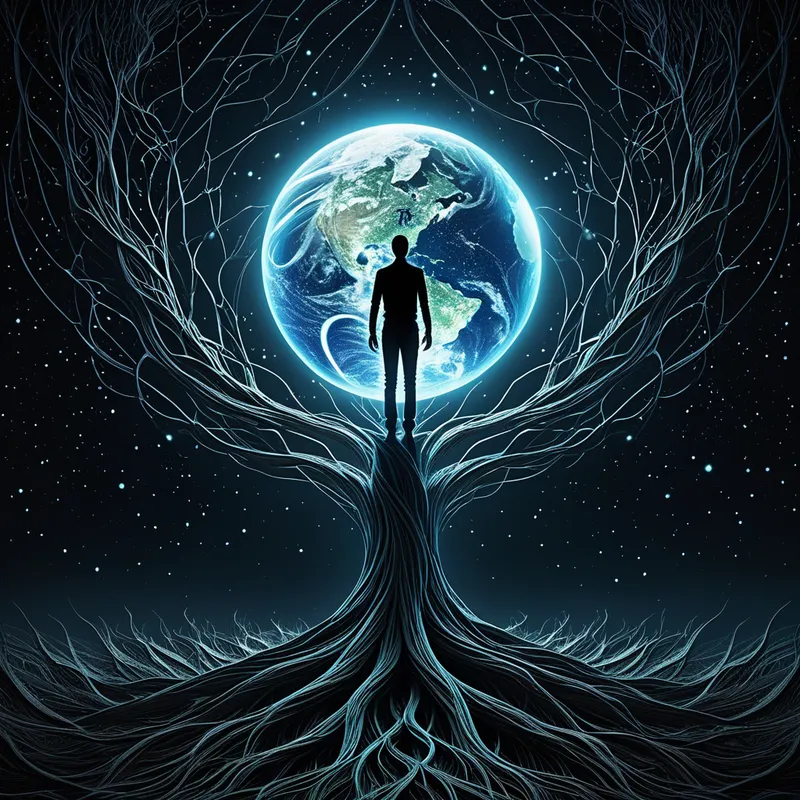
The alchemical journey modeled by the Antaeus myth is the transmutation of derived power into inherent virtue. The prima materia, the raw stuff of the psyche, is the Antaean state: strong, but dependent, rooted in the unconscious.
The first stage, calcinatio, is seen in Heracles’s repeated, frustrating attempts to defeat the giant by conventional means. This is the burning away of naive solutions, the failure of the ego’s first strategies, which leaves the psyche “burned out” and ready for insight. The separatio, the crucial separation, is the act of lifting. This is the most perilous phase of individuation—the conscious differentiation from the mother complex, the cultural norms, or the comfortable identity. It feels like a death, because it is. The dependent self must die.
The killing embrace is also a birthing hold; to be severed from the old ground is the precondition for discovering the ground of the soul.
What follows is solutio and coagulatio. The dissolved, lifeless form of the old dependency (Antaeus) must be reintegrated, not as a master, but as a resource. Heracles does not become the earth; he learns its secret. The alchemical goal is not to live forever suspended in air, disconnected and spiritualized, but to return to the earth with a new consciousness. One learns to “touch the ground” intentionally—to draw strength from nature, community, and the body—but now from a place of conscious choice and inner centering, not unconscious enmeshment. The giant is defeated, but the connection is not destroyed; it is transformed. The individual no longer is the ground, but has a relationship with it, forging a resilience that is both rooted and free. This is the creation of the lapis philosophorum, the true, unshakeable Self.
Associated Symbols
Explore related symbols from the CaleaDream lexicon: