The Myrmidons Myth Meaning & Symbolism
A king's prayer for an army is answered when Zeus transforms a colony of ants into the fiercely loyal and disciplined Myrmidon warriors.
The Tale of The Myrmidons
Hear now a tale from when the world was younger, and the breath of the gods still stirred the dust of Aegina. The sun was a merciless bronze disk, and a silence more terrible than any storm had fallen upon the land. A plague, sent by the wrathful Hera, had swept through the island like a scythe. The laughter of children was gone, the songs of the harvest were stilled. Only the wind remained, whispering through empty doorways and across the pyres of the dead.
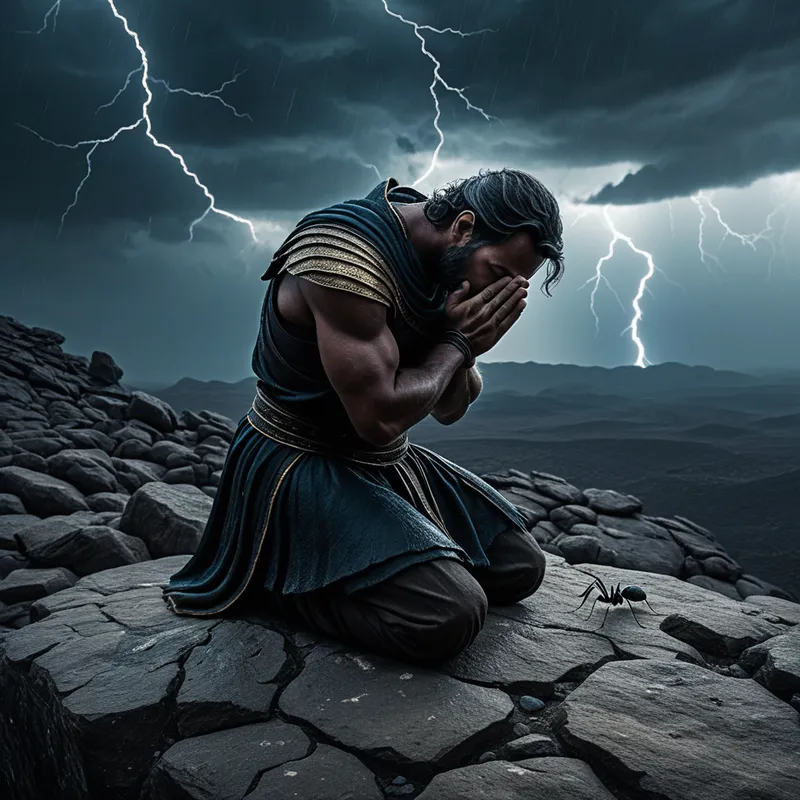
In the midst of this desolation stood Aeacus, a king without a people. His heart was a stone in his chest. He climbed to the highest sacred grove, a place of ancient oak and the scent of crushed thyme. He fell to his knees, not on soft grass, but on hard, dry earth. Lifting his hands to the pitiless sky, he did not beg for his own life, but cried out to his father, the cloud-gatherer Zeus.
“Father! Witness your son’s kingdom! The halls are tombs, the fields are graveyards. I rule over ghosts and echoes. If I have found favor in your sight, restore my people. Or let the stones themselves rise up and call me king!”
His voice cracked with a grief so profound it pierced the veil between earth and Olympus. The air grew heavy, charged with the scent of ozone and distant rain. As Aeacus wept, his tears fell upon the root of a great oak. There, at his knee, he saw a line of black ants, tireless and innumerable, flowing over the bark in a disciplined, unbroken column. They carried their burdens, repaired their fortress, an entire civilization thriving in the shadow of human ruin.
Zeus heard. And Zeus, in his inscrutable wisdom, answered.
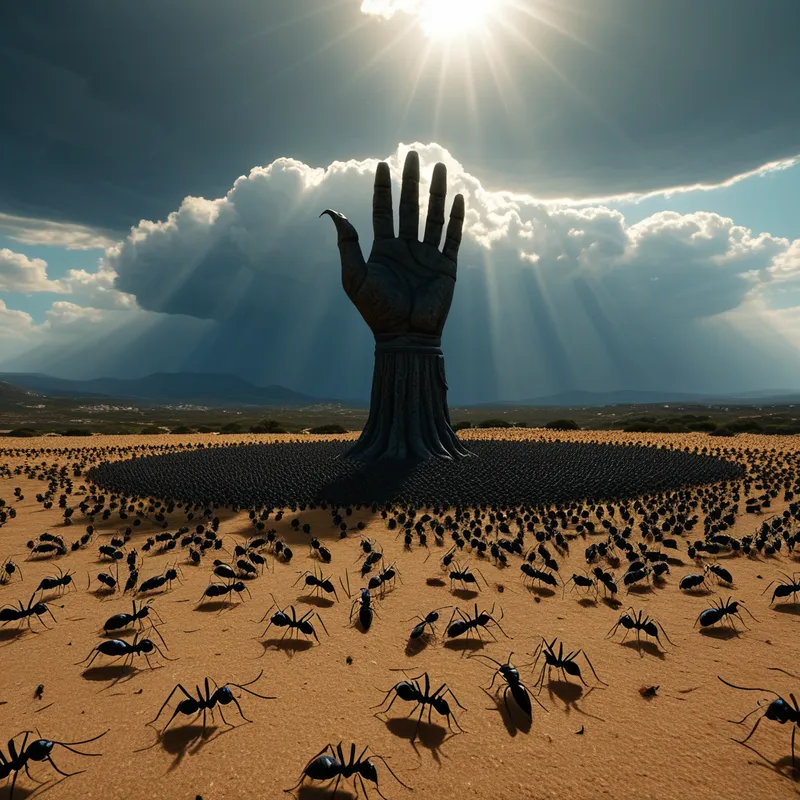
A dream fell upon Aeacus, a vision not of sleep but of waking wonder. The very ground at his feet seemed to stir and swell. The line of ants did not scatter. They paused, as if listening to a divine command. Then, they began to change. Their tiny, glossy bodies shimmered, elongating, rising. Six legs became two arms and two legs. Antennae withdrew; heads lifted. Where there was chitin, now there was sun-bronzed skin. Where there were mandibles, now were set jaws and eyes sharp with a new, fierce intelligence. They stood—a man, then ten, then a hundred, then a thousand—tall, muscular warriors emerging from the soil itself. The rustle of a million tiny feet became the clatter of spear on shield, a sound that filled the silent island with the promise of war and life.
Aeacus rose, his despair washed away by awe. He named them Myrmidons, the ant-people. They were his, utterly. Their loyalty was not born of fealty but of essence, as instinctual and unbreakable as the colony from which they sprang. They built a new city, stronger than the last. And when the hero Achilles came to lead them, their disciplined fury became the dread of Troy, a living testament to a king’s prayer and the soil’s strange redemption.
Cultural Origins & Context
The myth of the Myrmidons is primarily preserved in the works of the Latin poet Ovid in his Metamorphoses, a tapestry of tales about transformation. It reflects a deep, archaic layer of Greek thought that sought to explain the origins of specific tribes or city-states through divine intervention and autochthony—being born from the earth itself. The Myrmidons were not just a legendary contingent in the Trojan War cycle; they were the foundational myth of Aegina, providing its people with a heroic ancestry that was both humble and exalted.
This story functioned as a charter myth, justifying the unique character of the Myrmidon people: renowned for their discipline, cohesion, and unwavering loyalty to their leader. In a culture that valued both heroic individualism and civic duty, the Myrmidons represented the ultimate expression of the latter. They were the perfect hoplites in the cultural imagination, their unity literal and born of the earth. The tale was likely told to foster civic pride, instill values of collective strength, and connect the community to its landscape in a sacred, literal way—their ancestors were not invaders, but the very soil of Aegina given human form.
Symbolic Architecture
At its core, the myth of the Myrmidons is an alchemical parable of creation from the lowest, most despised material. The ant, in the ancient world, was often a symbol of industriousness but also of mindless toil and insignificance. Zeus’s act does not destroy the ant’s nature; he elevates and transfigures it.
The greatest armies of the soul are not recruited from the palaces of conscious virtue, but conscripted from the dark, fertile soil of the ignored and the instinctual.
The ant-colony becomes the model for the ideal human society: perfectly organized, self-sacrificing for the whole, and fiercely defensive of its home. Psychologically, the Myrmidons represent the raw, untapped potential of the instinctual psyche—the disciplined, autonomous complexes that operate beneath the ego’s awareness. King Aeacus’s profound despair is the necessary precondition. His ego (the king) is rendered powerless, creating the vacuum that allows the unconscious (the earth, the ants) to offer up its own formidable resources. The transformation is not a gentle evolution but a sudden, miraculous revelation of strength that was always there, waiting for the divine word—the call of necessity.
The Dreamer’s Resonance
When this myth stirs in the modern dreamer, it often manifests as dreams of overwhelming, coordinated tasks, or of discovering vast, intricate structures (cities, networks, armies) within seemingly small or mundane spaces. One might dream of lifting a stone to find a thriving metropolis beneath, or of seeing one’s own shadow multiply into a regiment of identical followers.
Somatically, this can feel like a sudden mobilization of energy after a period of depletion or illness (Aeacus’s plague). The psychological process is one of resource discovery. The dreamer is not being shown something foreign, but is being made aware of an innate, instinctual capacity for discipline, resilience, and collective action within their own psyche. The “ants” are the autonomous psychic units—habits, skills, loyalties, even traumas—that operate with a mind of their own. The dream signals that these fragments are ready to be organized, called into conscious service, and transformed from a scattered, instinctual buzz into a coherent force with a directed purpose.

Alchemical Translation
The alchemical journey modeled here is the transmutation of the base into the noble, or in psychological terms, the integration of the shadow and the instincts into the service of the conscious personality (the kingdom). The “plague” represents a necessary nigredo—a blackening, a dissolution of the old, familiar identity and social structures. The ego-king is humbled, forced to acknowledge its utter dependence on forces beyond its control.
The prayer is the act of sincere surrender and appeal to the Self (symbolized by Zeus). The answer does not come as a gift from on high, but as a transformation of what is already underfoot. The ants are the prima materia—the ignored, “base” contents of the unconscious: our repetitive thoughts, our ingrained behaviors, our swarm of petty worries and relentless drives.
Individuation does not mean becoming a solitary hero, but becoming the king who can command the loyal, formidable army that already inhabits his own soil.
The miracle is the realization that these very instincts, when organized by a central, purposeful authority (the newly strengthened ego in alignment with the Self), become our greatest strength. The Myrmidon within is the capacity for fierce loyalty to one’s true path, disciplined action, and the understanding that our power does not come from being unlike others, but from the profound, cohesive integration of all the myriad, instinctual parts of ourselves. We are not called to eradicate the ant, but to grant it a spear and a place in the phalanx of the soul.
Associated Symbols
Explore related symbols from the CaleaDream lexicon: