The Muses at Hippocrene Myth Meaning & Symbolism
The myth of Pegasus striking Mount Helicon, creating the Hippocrene spring where the Muses gather, symbolizing the violent birth of sacred inspiration.
The Tale of The Muses at Hippocrene
Hear now the story not of a hero’s might, but of inspiration’s violent, sacred birth. It begins not with a man, but with a mountain—Mount Helicon, a silent, brooding giant wreathed in mist and ancient trees. Its slopes were a sanctuary, a place where the air itself hummed with potential verse, where the rustle of leaves whispered half-formed melodies. Yet, for all its beauty, it was thirsty. The mountain yearned for a voice.
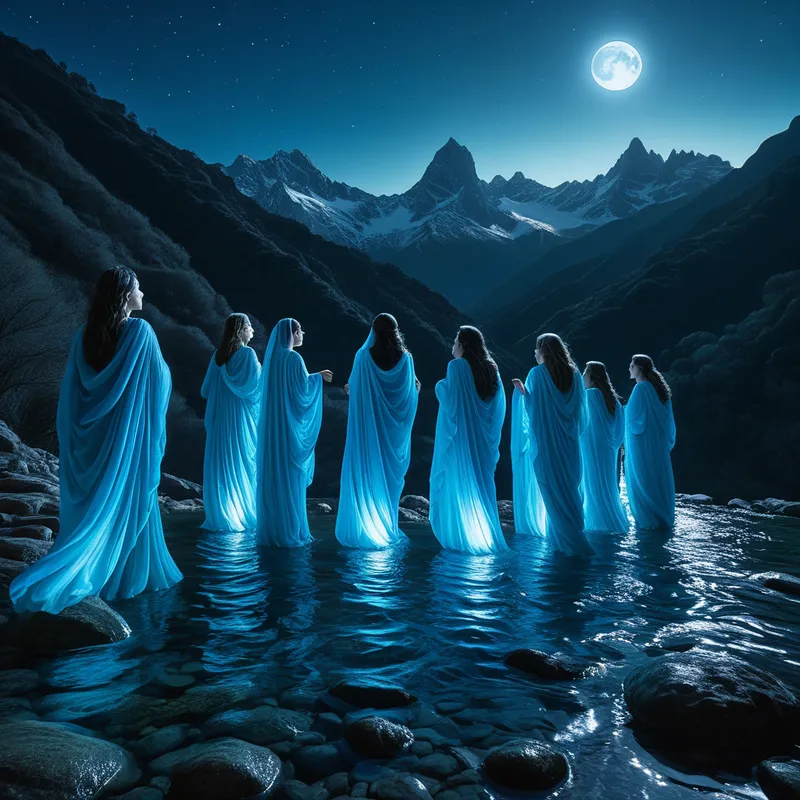
Enter the Muses, daughters of Zeus and [Mnemosyne](/myths/mnemosyne “Myth from Global/Universal culture.”/), Memory herself. They were not visitors, but the mountain’s very soul given form: Calliope with her tablet of wax, Erato with her tender lyre, [Urania](/myths/urania “Myth from Greek culture.”/) whose eyes held the turning stars. They danced upon the slopes, but their song, though beautiful, was rootless. It lacked a source, a wellspring from which the pure, undiluted waters of creation could flow.
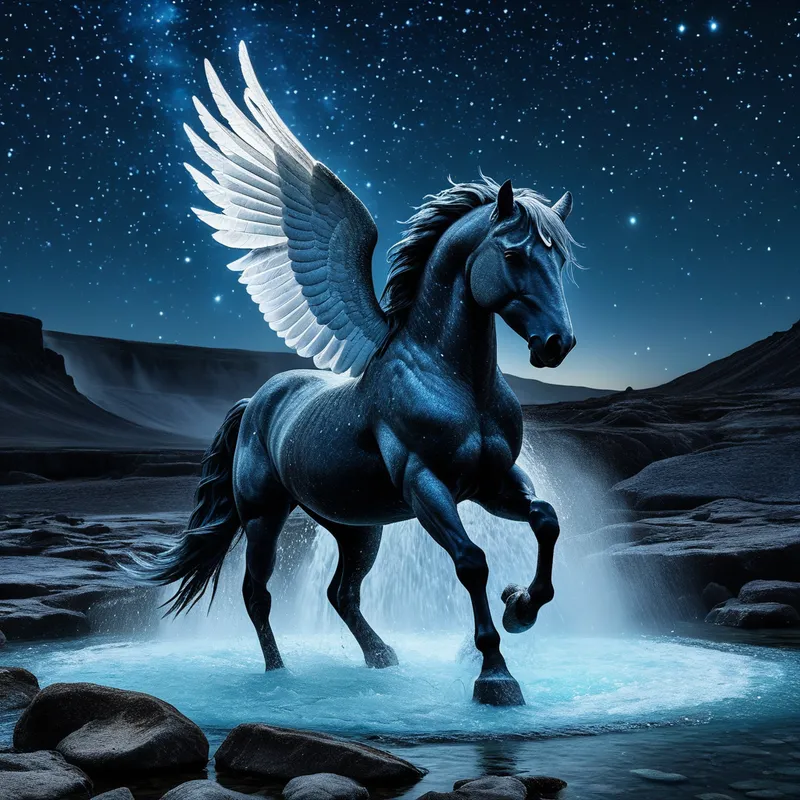
The catalyst arrived from a tale of blood and grief. From the severed neck of the Gorgon [Medusa](/myths/medusa “Myth from Greek culture.”/), sprung [Pegasus](/myths/pegasus “Myth from Global/Universal culture.”/), pure and wild, a creature born of death and ascent. The winged horse, embodying the untamed spirit of poetic flight, soared across the heavens, a living bolt of inspiration seeking its ground. Drawn by the silent call of [the Muses](/myths/the-muses “Myth from Greek culture.”/), by the mountain’s deep need, [Pegasus](/myths/pegasus “Myth from Global/Universal culture.”/) descended upon Helicon’s stony crown.
What happened next was not a gentle touch, but a strike. With a sound that split the silence of the ages, the divine hoof of Pegasus struck the bare rock. It was an impact of immense force, a cosmic percussion. The mountain shuddered. From the point of contact, where immortal energy met unyielding earth, a miracle erupted. Not a trickle, but a roaring, crystalline fountain burst forth, scattering starlight in its spray. The waters were not mere [water](/myths/water “Myth from Chinese culture.”/); they were hippos krene, the “horse’s spring”—[Hippocrene](/myths/hippocrene “Myth from Greek culture.”/).
The Muses, their dance halted, gathered at the spring’s newborn edge. They did not speak. First, they drank. The water was cool and electric on the tongue, tasting of forgotten memories and unwritten futures. Then, they began to sing. And this song was different. It was no longer just their own grace, but the song of the spring, through them. The mountain’ thirst was quenched, not with water, but with meaning. The Hippocrene became their sacred font, the physical heart of their intangible gift. From that day forth, any mortal who dared the climb and drank from those waters—if the Muses willed it—would feel the same shock of clarity, the same upwelling of divine, intoxicating creation.
Cultural Origins & Context
This myth is primarily preserved in the works of the poet Hesiod, who opens his Theogony by invoking the Muses of Helicon who bathed in the Hippocrene. It is a Boeotian myth, rooted in the local landscape and cult practices around Mount Helicon. For the ancient Greeks, this was not mere fantasy; it was a foundational etiological story explaining the source of artistic and intellectual inspiration (enthousiasmos—literally, “having a god within”).
The myth functioned on multiple levels. Societally, it sacralized the creative process, placing it under the patronage of specific, revered deities. It explained why inspiration felt so external, so sudden, and so powerful—it was a divine infusion. For poets like Hesiod or Pindar, claiming the Muses’ favor via the Hippocrene was a claim to authority and truth. Ritually, the spring (or springs identified as such) likely served as a site for libations and invocations before poetic or musical competitions. The myth thus bridged geography, religion, and the psychology of creativity, offering a cultural container for an intensely personal and often inexplicable experience.
Symbolic Architecture
At its core, the myth maps the archetypal [journey](/symbols/journey “Symbol: A journey in dreams typically signifies adventure, growth, or a significant life transition.”/) from latent potential to manifest creation. The symbols form a profound psychological [blueprint](/symbols/blueprint “Symbol: A blueprint represents the foundational plan or design for something, often symbolizing potential, structure, and the mapping of one’s inner self or future.”/).
- Mount Helicon represents the [human](/symbols/human “Symbol: The symbol of a human represents individuality, complexity of emotions, and social relationships.”/) [psyche](/myths/psyche “Myth from Greek culture.”/) in its totality—the lofty [heights](/symbols/heights “Symbol: Represents ambition, fear, or spiritual elevation. Often symbolizes life challenges or a desire for perspective.”/) of [consciousness](/symbols/consciousness “Symbol: Consciousness represents the state of awareness and perception, encompassing thoughts, feelings, and experiences.”/) and the deep, stony strata of the unconscious. It is fertile but dormant, waiting for a catalyzing [event](/symbols/event “Symbol: An event within dreams often signifies significant life changes, transitions, or emotional milestones.”/).
- The Muses symbolize the ordered, channeled forms of creative [expression](/symbols/expression “Symbol: Expression represents the act of conveying thoughts, emotions, and individuality, emphasizing personal communication and creativity.”/). They are the personification of cultural [memory](/symbols/memory “Symbol: Memory symbolizes the past, lessons learned, and the narratives we construct about our identities.”/) (Mnemosyne) and the specific domains of human [knowledge](/symbols/knowledge “Symbol: Knowledge symbolizes learning, understanding, and wisdom, embodying the acquisition of information and enlightenment.”/) and art. They are potential awaiting a [source](/symbols/source “Symbol: The origin point of something, often representing beginnings, nourishment, or the fundamental cause behind phenomena.”/).
- [Pegasus](/symbols/pegasus “Symbol: A winged divine horse from Greek mythology, symbolizing inspiration, poetic genius, and spiritual ascension beyond earthly limitations.”/) is the dynamic, disruptive force of pure inspiration. Born from a beheading (the severing of the old, petrifying gaze of Medusa), he represents the liberated, soaring [spirit](/symbols/spirit “Symbol: Spirit symbolizes the essence of life, vitality, and the spiritual journey of the individual.”/). He is [intuition](/symbols/intuition “Symbol: The immediate, non-rational understanding of truth or insight, often described as a ‘gut feeling’ or inner knowing that bypasses conscious reasoning.”/), the sudden “bolt from the blue,” the unconscious [impulse](/symbols/impulse “Symbol: A sudden, powerful urge or drive that arises without conscious deliberation, often linked to primal instincts or emotional surges.”/) breaking into conscious [awareness](/symbols/awareness “Symbol: Conscious perception of self, surroundings, or internal states. Often signifies awakening, insight, or heightened sensitivity.”/).
- The Hoof-Strike is the critical [moment](/symbols/moment “Symbol: The symbol of a ‘moment’ embodies the significance of transient experiences that encapsulate emotional depth or pivotal transformations in life.”/) of [trauma](/symbols/trauma “Symbol: A deeply distressing or disturbing experience that overwhelms the psyche, often manifesting in dreams as unresolved emotional wounds or psychological injury.”/) and [breakthrough](/symbols/breakthrough “Symbol: A sudden, significant advance or discovery that overcomes a barrier, often marking a transformative shift in understanding, ability, or situation.”/). Creation is not always gentle; it is often precipitated by a shock, a conflict, a forceful impact between the wild spirit (Pegasus) and the resistant structures of [the self](/myths/the-self “Myth from Jungian culture.”/) or [reality](/symbols/reality “Symbol: Reality signifies the state of existence and perception, often reflecting one’s understanding of truth and life experiences.”/) (the rock).
The spring is not found; it is struck. Inspiration is not a passive discovery, but the active, often violent, offspring of conflict between the soaring spirit and the unyielding earth of our limitations.
- The Hippocrene Spring is the resulting [synthesis](/symbols/synthesis “Symbol: The process of combining separate elements into a unified whole, representing integration, resolution, and the completion of a personal journey.”/): the embodied, accessible source of inspiration. It is the symbolic “well” of the unconscious now made available to consciousness. The [water](/symbols/water “Symbol: Water symbolizes the subconscious mind, emotions, and the flow of life, representing both cleansing and creation.”/) represents the fluid, [life](/symbols/life “Symbol: The symbol of ‘Life’ represents a journey of growth, interconnectedness, and existential meaning, encompassing both the joys and challenges that define human experience.”/)-giving, and intoxicating [nature](/symbols/nature “Symbol: Nature symbolizes growth, connectivity, and the primal forces of existence.”/) of creative [insight](/symbols/insight “Symbol: A sudden, deep understanding of a complex situation or truth, often arriving unexpectedly and illuminating hidden connections.”/)—it can nourish genius or drown the unprepared in madness.
The Dreamer’s Resonance
When this myth pattern stirs in the modern dreamer, it signals a profound somatic and psychological process: the pressure of unlived creativity seeking manifestation. One might dream of:
- A winged horse crashing through the ceiling of a mundane room.
- A forgotten, overgrown fountain in a backyard suddenly erupting with clear water.
- Tapping a wall in frustration and having poetry or music spill from the crack.
- Being desperately thirsty and finding only a single, elusive spring on a arduous hike.
Somatically, this can feel like a restless energy, a tightness in the chest or a buzzing in the hands—the “Pegasus” strain against its confines. Psychologically, it is the conflict between the inner Muse (the call to create, to know, to express) and the “rock” of internal resistance: fear, procrastination, perfectionism, or the sheer weight of daily life. The dream is the psyche’s dramatization of the need for a catalytic strike—a decisive action, an acceptance of risk, a surrender to the irrational impulse—to release the pent-up waters.

Alchemical Translation
The alchemy of this myth models the process of psychic transmutation, or individuation, with stunning clarity. The [prima materia](/myths/prima-materia “Myth from Alchemical culture.”/) is the dormant psyche (Helicon). [The first stage](/myths/the-first-stage “Myth from Alchemical culture.”/) is [nigredo](/myths/nigredo “Myth from Alchemical culture.”/)—the darkening, represented by the mountain’s thirst and the Muses’ unfulfilled potential. It is a state of creative depression or stagnation.
The arrival of Pegasus is the albedo, the whitening, the influx of a liberating, illuminating spirit from the unconscious (the Medusa complex transformed). The hoof-strike is the crucial [rubedo](/myths/rubedo “Myth from Alchemical culture.”/)—the reddening, the fiery, painful operation where spirit meets matter. This is [the ego](/myths/the-ego “Myth from Jungian culture.”/)’s confrontation with the Self, the necessary “wounding” or breaking open of old structures.
The creation of the Hippocrene is the coniunctio oppositorum—the sacred marriage of the soaring, airy principle (Pegasus) and the solid, earthly principle (the Rock). From their union flows the aqua permanens, the permanent water of the philosophers: the enduring, self-renewing source of inner wisdom and creativity.
For the modern individual, the “alchemical translation” is this: our deepest inspirations and callings often feel trapped, gestating in the dark. They require not just gentle nurturing, but a courageous, disruptive act—the “hoof-strike” of committing to the work, of speaking the truth, of starting the project despite fear. This act feels violent to the status quo of our lives. But from that point of impact, the sealed well of the soul is opened. What flows forth is no longer just a personal whim, but something sourced from the depths, something that can truly nourish and transform both the creator and, potentially, [the world](/myths/the-world “Myth from Tarot culture.”/) that drinks from their offering. The myth assures us that the spring is there, waiting within our own psychic landscape, but it demands the strike of the winged horse to be revealed.
Associated Symbols
Explore related symbols from the CaleaDream lexicon: