The Moss Temple Myth Meaning & Symbolism
A grieving monk's sorrow transforms a barren temple into a living sanctuary of moss, revealing the sacred alchemy of patient, silent grief.
The Tale of The Moss Temple
Listen, and let the mists of Jōmon times part. There was a temple, once, not of grandeur but of profound silence, perched where the mountain’s breath met the valley’s sigh. Its name is lost to the wind, but its truth remains. It was tended by a single monk, a man named Sō, whose life was the rhythm of the bell, the chant, the sweeping of empty halls.
Then, the great sorrow came. A fire, swift and hungry, born from a winter lightning strike. It consumed the temple’s storehouse, and within it, Sō’s only companion—a young novice, bright as a morning sparrow, who had rushed in to save the sacred texts. The novice perished. The temple’s heartwood beams blackened; its garden turned to ash and cracked clay. The bell’s tone grew hollow.
Sō did not leave. He did not wail to the heavens. His grief was too vast for sound. It settled into his bones, a silent, heavy frost. Each day, he performed his duties in the scorched shell. He swept ash that the wind simply returned. He knelt in the barren courtyard, where not a single blade of grass dared grow, and he prayed. But his prayers were no longer words; they were the weight of his presence, a slow, patient pouring of his unspoken loss onto the wounded earth.
Seasons turned. The rains came, gentle and persistent. One morning, after a soft night shower, Sō knelt and saw a miracle so small it could be missed by any eye not schooled in despair. In the deepest crack of the courtyard stone, where his tears and the rain had mingled, a stain of green appeared. Not the vibrant green of new leaves, but a humble, velvety green—moss.
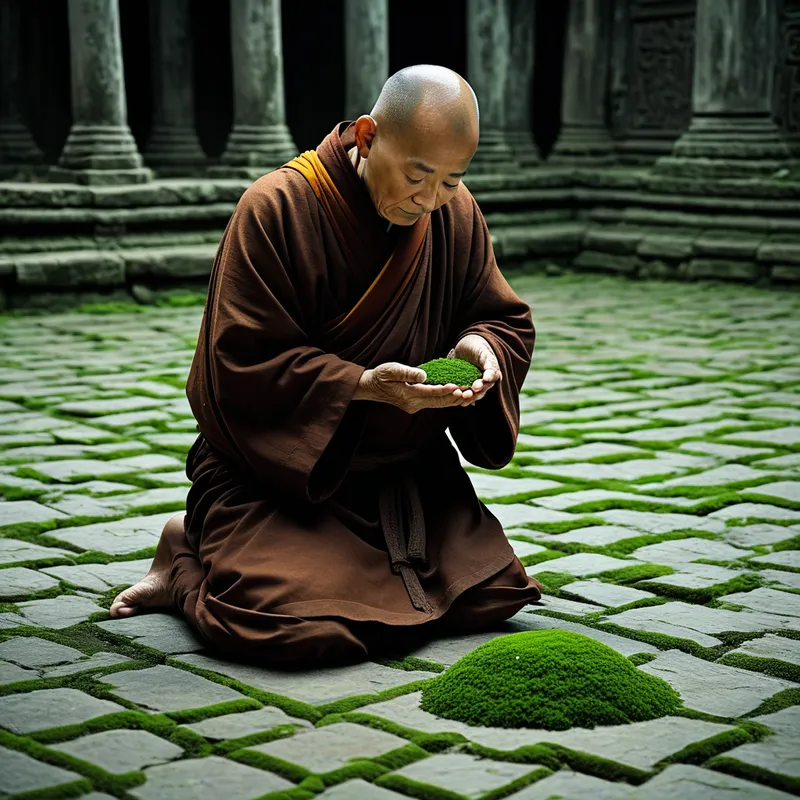
He did not cheer. He simply bent closer. With a tenderness reserved for a sleeping child, he cupped his hands around this fragile life. Each day, he would bring a single dipper of water from the well, not dousing the earth, but letting drops fall from his fingertips onto that tiny patch. The moss grew, slowly, from one stone to the next. It was a patient conversation. Sō’s silent grief was the question; the moss’s gradual spread was the answer.
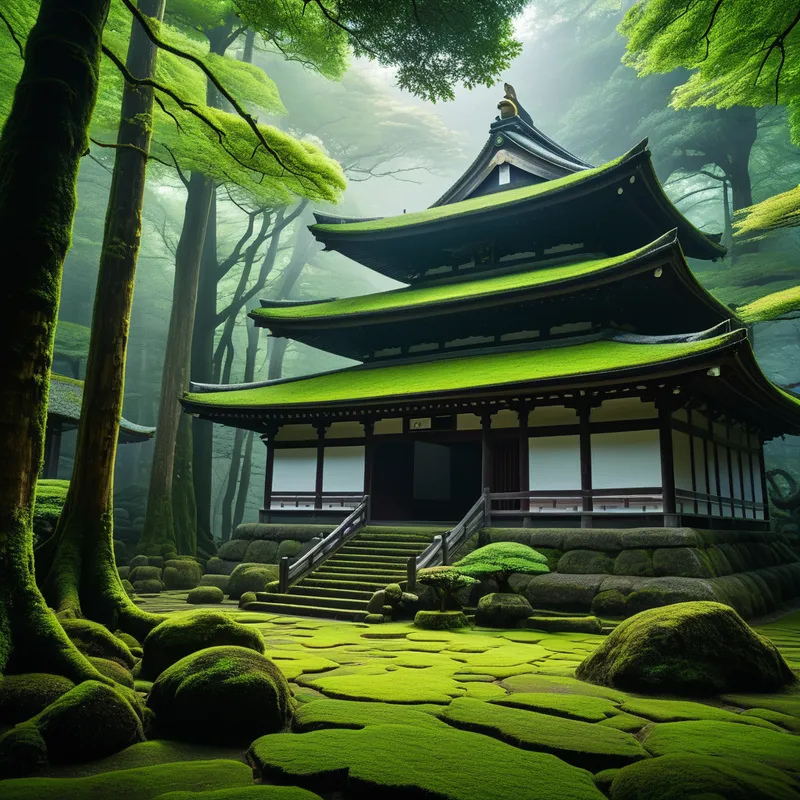
Years flowed like the mountain stream. Sō’s hair turned the color of mist, and his grief, while never gone, softened, transformed. Where he walked, he carried water. Where he knelt, he cleared debris. He was not cultivating a garden; he was in communion with a slow, green breath. The moss accepted his offering. It crept over the blackened beams, clothing the scars in emerald velvet. It carpeted the stone steps in silence. It hung from the eaves like a living drapery, drinking the fog. The temple did not rebuild; it was reborn. Not into what it was, but into something entirely new—a sanctuary of profound, breathing quiet, a Kekkai woven not of rope, but of moss.
When travelers finally chanced upon the place, they thought they had discovered a natural wonder, a temple dreamed into being by the forest itself. They found Sō, ancient and calm, moss dusting the hem of his robes as if he, too, was becoming part of the sanctuary. He spoke little. He simply smiled and offered them water. And in the deep, sound-absorbing quiet of that moss-cloaked hall, they felt it: a peace that was not the absence of pain, but its final, beautiful translation.
Cultural Origins & Context
The myth of the Moss Temple exists in the liminal space between folklore and spiritual parable, less a formal Kojiki entry and more a story whispered by sōryo and village elders. It emerges from the core aesthetic and spiritual principles of <abbr title=“The “Way of the Gods,” Japan’s indigenous spirituality”>Shintō and Bukkyō, where nature is not a backdrop but a sacred, animate presence (kami).
Its societal function was multifaceted. For a culture deeply familiar with impermanence (mujō), earthquakes, fire, and loss, the story modeled a form of resilience that was not about heroic rebuilding, but about transformative acceptance. It validated the slow, non-linear process of grief, a process often at odds with societal demands for stoicism. Furthermore, it served as an etiological tale for the real, deeply revered moss gardens (koke no niwa) of temples like Saihō-ji, giving them a mythic, emotional origin that transcended horticulture. The story was passed down not to record history, but to teach a way of seeing—to cultivate an eye for the beauty in decay (mono no aware) and the power in patient, unattached action.
Symbolic Architecture
The myth’s power lies in its stark, elemental symbolism. The Fire is not merely disaster; it is the traumatic, catalyzing event that annihilates the known world, the ego-structure built around companionship and routine. The Barren Earth that remains is the psychic landscape after profound loss—desolate, cracked, and seemingly incapable of supporting life (joy, meaning, connection).
The moss is the symbol of the soul’s own, slow, vegetative intelligence. It does not fight the scorched earth; it inhabits it, turning the very evidence of destruction into its substrate.
The monk Sō represents the conscious ego that chooses to stay present with the devastation. His daily, ritual actions—sweeping ash, fetching water—are the minimal, often meaningless-feeling routines that prevent total psychic dissolution. They are the thread of continuity. The Water he carries is the steady, gentle flow of attention and feeling (tears, memory, care) applied without force. The moss’s growth is not a reward, but a co-creation. It symbolizes the emergence of a new psychic layer—not the restored old self, but a more nuanced, resilient, and deeply integrated consciousness that grows over and transforms the scars. The final Moss Temple is the Self, not as a perfect, gleaming edifice, but as a living, complex ecosystem where grief and peace, memory and presence, are woven into a single, soft, and breathing whole.

The Dreamer’s Resonance
When this myth stirs in the modern dreamer, it often surfaces during periods of quiet, persistent grief, burnout, or a feeling of inner barrenness after a “fire”—a divorce, a career loss, a betrayal, or a period of depression. The dreamer may find themselves in a liminal, abandoned place, or tending to a small, fragile green plant in a vast, dark space.
Somatically, this dream pattern correlates with a process of deep, cellular-level restoration, often felt as profound fatigue that demands surrender, not stimulation. Psychologically, it marks the shift from acute grieving (the fire) to assimilative grieving. The ego is no longer fighting the loss or trying to hastily rebuild; it is, like Sō, learning to kneel on the cracked earth of its new reality. The dream is an affirmation from the unconscious that this patient, seemingly passive attendance is, in fact, the most active and sacred work possible. It is the psyche growing its own moss, creating a new inner sanctuary at a pace invisible to the waking world’s demands for quick fixes and closure.

Alchemical Translation
The alchemical process mirrored here is not the dramatic solve et coagula of shattering and remaking, but the slower, more feminine-aligned process of putrefactio and albedo—the darkening, rotting phase followed by the whitening, the first sign of new life. The fire initiates the nigredo, the blackening. Sō’s patient, water-bringing vigil is the long, essential stage of mortificatio, where the old forms are allowed to fully decompose.
Individuation is not only about slaying dragons; it is often about having the courage to sit silently in the ashes until the first, almost invisible green appears.
The modern individual’s “moss” is any small, authentic gesture that emerges from the core of one’s pain: writing a single line in a journal, taking a slow walk, preparing a simple meal. These are not achievements; they are the dippers of water. The “temple” that results is the individuated Self—no longer a monument to a past ideal or an unlived life, but a humble, alive, and uniquely beautiful ecosystem. It is a Self that has made peace with its own weathering, that finds divinity not in perfection, but in the patient, green transformation of every crack and flaw. The myth teaches that enlightenment, or wholeness, may not be a brilliant light on a mountain peak, but the soft, soundless growth of moss in the heart’s deepest shade.
Associated Symbols
Explore related symbols from the CaleaDream lexicon: