The Morrigan Myth Meaning & Symbolism
A goddess of fate and fury, the Morrigan appears at life's crossroads, offering sovereignty or ruin, demanding we face our own shadow to be made whole.
The Tale of The Morrigan
Listen. The wind does not just blow across the green hills of Ériu; it carries whispers from the edge of the world. And on the eve of a great turning, when the fate of a people hangs like a dewdrop from a blade of grass, the whispers become a scream. It is then she comes.
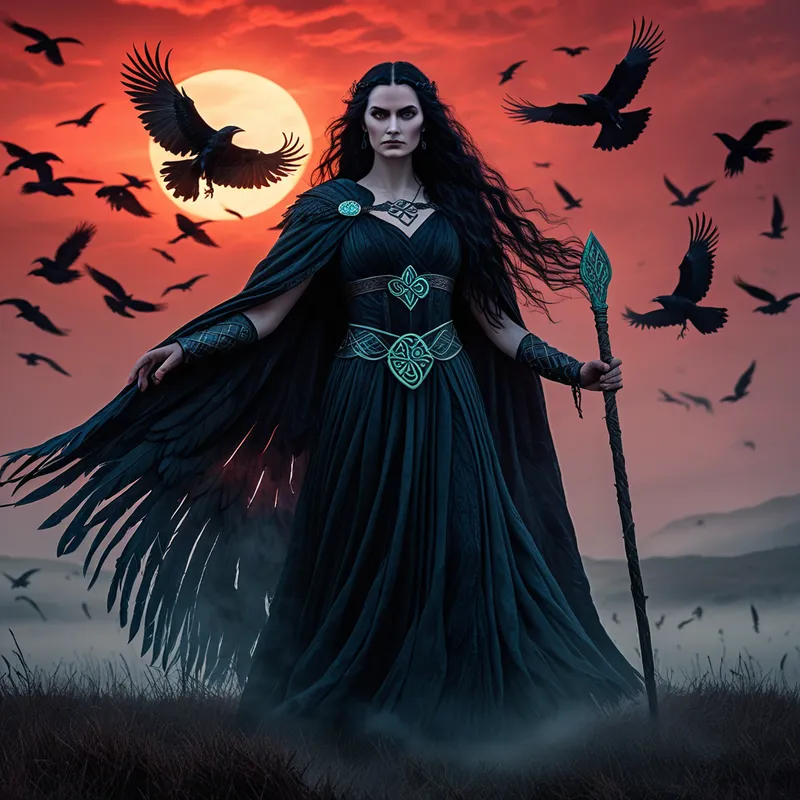
They called it the Táin Bó Cúailnge. A queen’s pride, a stolen bull, armies gathering like thunderheads. But before the first spear was cast, a figure emerged from the morning mist where the river fords. She was a woman of impossible presence, tall and fierce, her hair the colour of a raven’s wing under a winter moon. She found the champion, Cú Chulainn, honing his weapons. Her eyes held the depth of bog pools and the sharpness of flint.
“A blessing on you, Cú Chulainn,” she said, her voice a rustle of dry reeds and distant battle-cries. “I bring you a gift. My love, and with it, victory.”
Cú Chulainn, bound by his own fiery code, did not look up from his spear. “I have no need of a woman’s love to secure my victory. The time for such things is not now.”
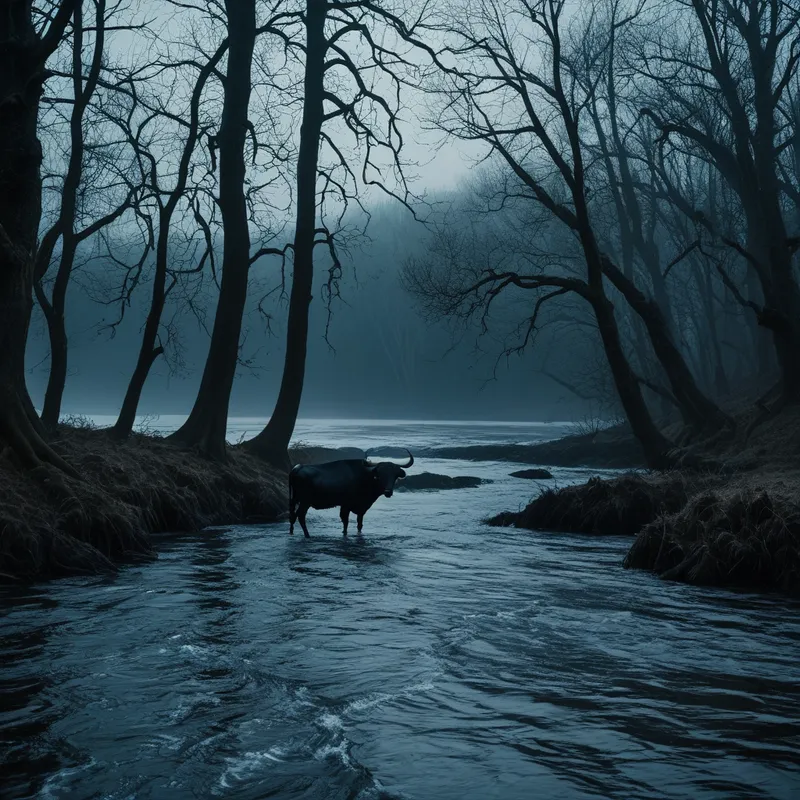
A silence fell, colder than the river’s heart. The woman’s form seemed to ripple. “You reject me,” she said, and it was not a question. “Then know this: I shall be against you when you are in greatest need. I will be the eel that trips you in the ford, the she-wolf that harries your herd, the hornless red cow that leads your enemies to you.” And as she spoke, her shape flickered—a glimpse of slithering grey, a flash of tawny fur, a massive bovine form—before she was again the formidable woman. “I am The Morrigan. You have chosen your fate.”
And so it unfolded. As Cú Chulainn fought his legendary single combats, his ríastrad transforming him into a monster of war, she was there. At the ford, an eel coiled around his legs. On the bank, a wolf drove cattle into his path. In the field, a red cow led a battalion. Each time, he fought her off, wounding her manifestations. Yet the conflict was a dance, a terrible intimacy.
The climax came at another ford, his body a tapestry of wounds. The Morrigan appeared to him not as a foe, but as an old hag, washing his blood-soaked armour in the stream, the very image of the Washer at the Ford. He knew the omen. His death was upon him. In his final moments, bound to a standing stone to die on his feet, he saw a crow—her most sacred form—alight upon his shoulder. Only then did she drink his life’s essence, not as a victor gloating, but as a sovereign claiming what was always hers: his destiny, his story, his completed fate.
Cultural Origins & Context
The figure of The Morrigan emerges from the rich, oral tapestry of the Insular Celtic peoples, primarily preserved in medieval Irish manuscripts like the Lebor na hUidre and the Lebor Laignech. These texts, written by Christian monks, captured cycles of myths that were once the living breath of the fili and bards. She is not a singular, tidy goddess but a complex, often triple manifestation of feminine power connected to sovereignty, war, and prophecy.
Her name itself is telling: often interpreted as “Great Queen” (Mór-Ríoghain) or “Phantom Queen.” In the myths, she frequently appears as one of a triad of sisters—Badb, Macha, and Anand—each aspect reflecting a facet of her domain: the terrifying battle-cry (Badb), the sovereignty over the land (Macha), and the nurturing yet destructive abundance (Anand). Her societal function was profound. She was the divine embodiment of the land’s fate. Kings ruled through a sacred marriage to the sovereignty goddess; The Morrigan could grant or withdraw that power. In war, she was less a combatant and more the psychic atmosphere of conflict—the frenzy, the prophecy of doom, the chooser of the slain. She represented the inevitable cost of violence and the turning of fate’s wheel, a necessary, if terrifying, force in the cosmic order.
Symbolic Architecture
Psychologically, The Morrigan is the archetypal embodiment of the Shadow in its most potent, sovereign form. She is not merely personal unconscious material, but the transpersonal, fateful force that intersects with an individual’s life at critical junctures. Her rejection by Cú Chulainn is the classic ego’s refusal to acknowledge the deeper, often darker, currents of destiny and the unconscious.
To meet The Morrigan is to stand at the crossroads where personal will collides with impersonal fate. She is the question the soul must answer, not with a sword, but with recognition.
Her shapeshifting—into eel, wolf, cow, crow—symbolizes the protean nature of the unconscious itself. It cannot be pinned down or understood with a single definition. It trips us up (the eel), confronts us with our raw, instinctual nature (the wolf), provides the very substance of our life and culture (the cow), and ultimately delivers the omniscient perspective of death and transformation (the crow). The ford, the site of her key interactions, is a universal symbol of transition, a liminal space between one state of being and another. The battle is always at the crossing.
The Dreamer’s Resonance
When The Morrigan’s pattern stirs in the modern psyche, it often manifests in dreams of profound confrontation. The dreamer may encounter a powerful, intimidating, or mesmerizing feminine figure who issues a challenge or a cryptic offer. There may be dreams of being at a literal crossroads, paralyzed by choice, or of being pursued or tested by animals—particularly crows, wolves, or serpentine creatures. Somatic sensations often accompany these dreams: a feeling of being weighed down at a crucial moment (the eel in the ford), a surge of panicked energy (the harrying wolf), or a deep, chilling certainty of an ending (the crow’s landing).
Psychologically, this indicates a moment where the individual’s conscious attitude—their plans, their self-image, their “heroic” trajectory—is being confronted by a deeper, fate-laden current from the unconscious. The Morrigan-dream is an invitation, however terrifying, to engage with this shadow material. It is the psyche’s way of forcing a crisis of sovereignty: Who is truly in charge? The brittle, controlling ego, or the larger, more mysterious Self that understands destiny? The process is one of humbling and enlargement, often preceded by intense resistance and a sense of being cursed or thwarted by life itself.
Alchemical Translation
The alchemical journey modeled by The Morrigan myth is that of coniunctio with the shadow, leading to the acquisition of true sovereignty. Cú Chulainn’s initial path is one of solar egoic brilliance—undefeated, glorious, but ultimately rigid. His rejection of The Morrigan is the refusal of the anima in her most powerful, fateful aspect. The subsequent battles are the nigredo—the darkening, where the ego is systematically broken down by the very forces it denied.
The triumph is not in defeating the goddess, but in being defeated by her, for in that surrender, the illusion of the solitary hero dies, and the sovereign Self is born.
His final acceptance, seeing her as the Washer at the Ford and feeling her crow form upon him, represents the albedo. It is a moment of lucid, tragic clarity. He integrates the knowledge of his fate, and in doing so, transcends his mere heroic persona. For the modern individual, the alchemical translation is this: our greatest crises, our repeated “bad luck,” our haunting patterns, are often the Morrigan’s call. The work is to cease fighting her manifestations and to turn, with immense courage, to face her directly. To ask, “What sovereignty are you offering? What fate must I acknowledge to be whole?” This is not a passive surrender, but an active, conscious engagement with the deepest layers of one’s being. The prize is not eternal victory, but authentic sovereignty—the rule of one’s life from the centre of the Self, in full acknowledgement of both creative and destructive power, of life and its inevitable, transformative end.
Associated Symbols
Explore related symbols from the CaleaDream lexicon: