The Morrígan's Cloak Myth Meaning & Symbolism
A warrior confronts the Phantom Queen to claim a cloak of raven feathers, facing the terrifying gift of prophecy and the price of true sight.
The Tale of The Morrígan’s Cloak
Listen, and hear the tale whispered by [the wind](/myths/the-wind “Myth from Various culture.”/) in the bare branches, carried on the cry of the carrion crow. It is not a story for [the hearth](/myths/the-hearth “Myth from Norse culture.”/), but for the liminal space between the setting sun and the rising moon, where [the veil](/myths/the-veil “Myth from Various culture.”/) is thin and the shapes of power walk.
There was a warrior, Cú, whose strength was renowned, but whose sight was limited to the length of his spear. He sought a prize beyond cattle or gold: he sought the gift of true sight, to see the weave of fate itself. The fili told him such a gift was held by only one: the Mór-Rígain, the Phantom Queen. She who is a trio and a singularity, who washes the armor of the doomed at the ford, whose voice is the roar of battle and the sigh of the dying.
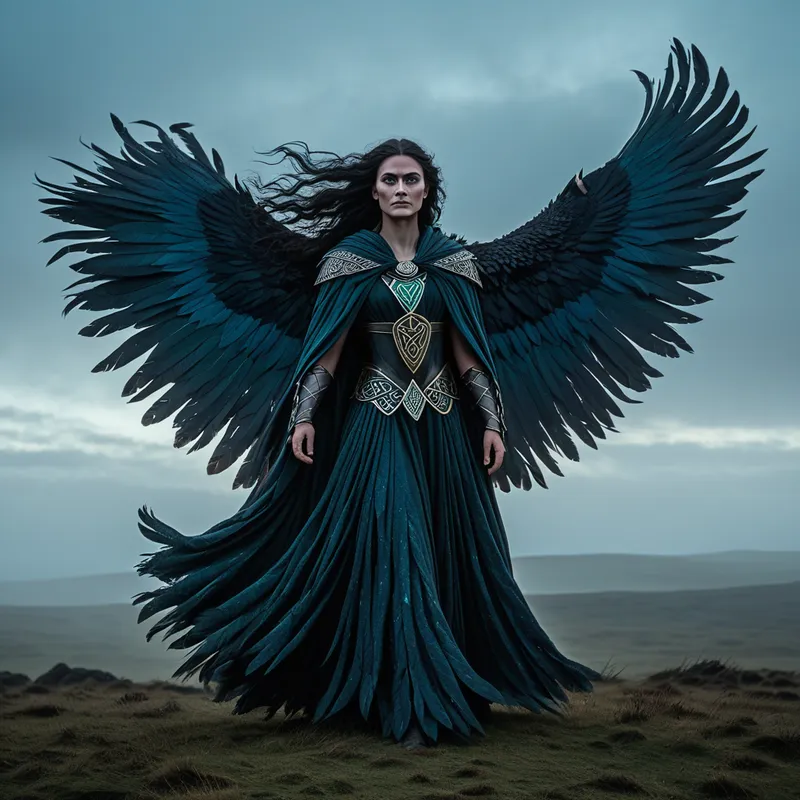
Cú journeyed to the [sídhe](/myths/sdhe “Myth from Celtic / Irish culture.”/) of the Túatha Dé Danann, not to steal, but to ask. He found her not on a throne, but at a crossroads where three paths met—one of earth, one of mist, one of blood. She stood with her back to him, shrouded in a cloak that was not a cloth, but a living piece of the night sky pierced by stars, or perhaps a storm of [raven](/myths/raven “Myth from Haida culture.”/) feathers, constantly in motion.
“You seek a burden, not a gift, son of mortality,” her voice echoed, not from her mouth, but from the very stones. “My cloak is the fabric of what is, what was, and what may be. To wear it is to feel the shudder of every death, the pang of every birth, the tangled threads of every choice. Your heart will break under the weight of knowing.”
Cú did not waver. “Better a broken heart that sees, than a whole one that is blind.”
[The Morrígan](/myths/the-morrgan “Myth from Celtic culture.”/) turned. Her face was beauty and terror, youth and age, compassion and merciless fury. “Then you must take it from me. Not by force of arm, but by will. Step into the weave.”
She spread the cloak. It billowed out, not with wind, but with visions—a cacophony of possible futures, echoing pasts, and the pulsing, painful present of all things. Cú felt his mind unraveling. He saw his own death in a dozen ways. He saw the loves he would never have, the sorrows of strangers as intimately as his own. The sensory assault was total: the metallic taste of spilled blood, the scent of damp earth after slaughter, the deafening silence of a field when the fighting is done.
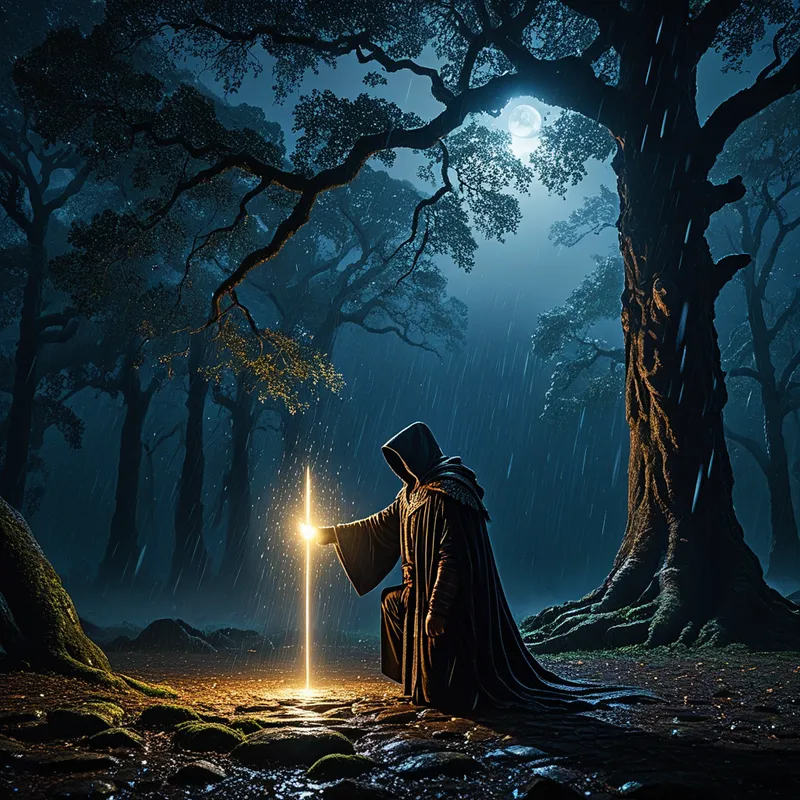
He did not reach for the cloak with his hands. He stood in the center of the storm of knowing, and instead of fighting the visions, he bowed his head. He acknowledged them. He felt the grief, the joy, the terror, and did not look away. This was the test. Not to seize, but to withstand. Not to conquer the goddess, but to hold space for the totality she represented.
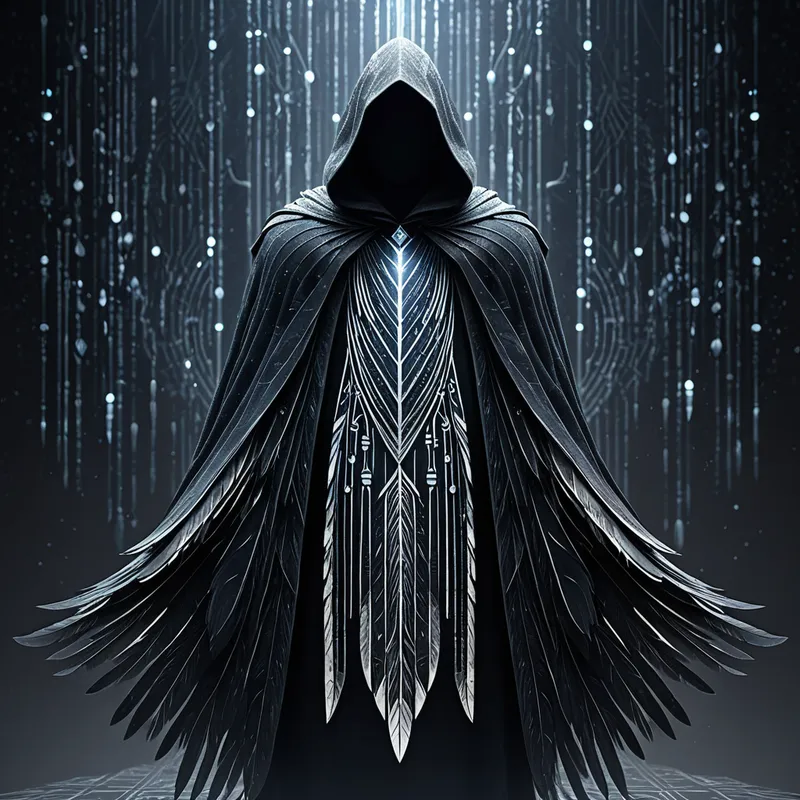
Slowly, the chaos stilled. The visions condensed. The vast, terrifying cloak settled, not upon her shoulders, but upon his. It was heavier than any chainmail, yet it was not a weight that crushed—it was a weight that anchored. He saw not just fragments, but connections. The path of the [spider](/myths/spider “Myth from Native American culture.”/), the flight of the raven, the root of the oak, and the fate of kings were all one pattern.
The Morrígan smiled a smile that held infinite sadness. “You have your sight. Remember, it is a cloak. You may take it off. But once seen, [the world](/myths/the-world “Myth from Tarot culture.”/) can never be unseen.” And she was gone, becoming a single raven that flew into the gathering dark, leaving Cú alone at [the crossroads](/myths/the-crossroads “Myth from Celtic culture.”/), clothed in the profound and terrible mantle of prophecy.
Cultural Origins & Context
This narrative pattern, woven around the figure of the Morrígan, emerges from the rich oral tapestry of early Irish literature, primarily preserved in manuscripts like the Ulster Cycle. It is crucial to understand that “Celtic” is a broad linguistic and cultural umbrella; this myth is specifically rooted in the Gaelic tradition of Ireland. These stories were the domain of the Aos Dána, the filid, who were not mere entertainers but custodians of history, law, and cosmic order.
The tale of the cloak would have functioned on multiple levels. Societally, it reinforced the concept of fírinne flatha—the truth of the sovereign. The rightful king or champion must, metaphorically, “wear the Morrígan’s cloak,” meaning he must understand the deep, often brutal, realities of life, death, and consequence to rule effectively. It was a warning against shallow leadership. On a spiritual level, it framed the acquisition of wisdom (imbas) not as a gentle study, but as a harrowing encounter with the divine in its most raw and amoral form. The myth was a map for navigating encounters with ultimate power, teaching that such power is not taken by force, but integrated through courageous acceptance.
Symbolic Architecture
At its core, the myth is an [allegory](/symbols/allegory “Symbol: A narrative device where characters, events, or settings represent abstract ideas or moral qualities, conveying deeper meanings through symbolic storytelling.”/) for the confrontation with the [Shadow](/symbols/shadow “Symbol: The ‘shadow’ embodies the unconscious, repressed aspects of the self and often represents fears or hidden emotions.”/) and the acquisition of [consciousness](/symbols/consciousness “Symbol: Consciousness represents the state of awareness and perception, encompassing thoughts, feelings, and experiences.”/). The Morrígan is not a [villain](/symbols/villain “Symbol: A character representing opposition, moral corruption, or suppressed aspects of self, often embodying fears, conflicts, or societal threats.”/), but the personification of a foundational psychic principle: the totality of [life](/symbols/life “Symbol: The symbol of ‘Life’ represents a journey of growth, interconnectedness, and existential meaning, encompassing both the joys and challenges that define human experience.”/) that includes creation and destruction, love and strife, [fate](/symbols/fate “Symbol: Fate represents the belief in predetermined outcomes, suggesting that some aspects of life are beyond human control.”/) and free will.
The cloak is the symbolic skin of reality itself, and to wear it is to consent to the full spectrum of existence, without denial or spiritual bypassing.
Cú, the [warrior](/symbols/warrior “Symbol: A spiritual archetype representing inner strength, discipline, and the struggle for higher purpose or self-mastery.”/)-ego, begins with a heroic but one-dimensional consciousness focused on [action](/symbols/action “Symbol: Action in dreams represents the drive for agency, motivation, and the ability to take control of situations in waking life.”/) and glory. His [quest](/symbols/quest “Symbol: A quest symbolizes a journey or search for purpose, fulfillment, or knowledge, often representing life’s challenges and adventures.”/) for “[sight](/symbols/sight “Symbol: Sight symbolizes perception, awareness, and insight, representing both physical and inner vision.”/)” is the [soul](/symbols/soul “Symbol: The soul represents the essence of a person, encompassing their spirit, identity, and connection to the universe.”/)‘s yearning for deeper meaning. The [cloak](/symbols/cloak “Symbol: A garment that conceals identity, protects from elements, or signifies authority and transformation in dreams.”/) represents the unconscious in its entirety—the personal and collective shadow, the network of archetypal patterns, the painful truths of [mortality](/symbols/mortality “Symbol: The awareness of life’s finitude, often representing transitions, impermanence, or existential reflection in dreams.”/) and limitation. His trial in the storm of visions is [the ego](/myths/the-ego “Myth from Jungian culture.”/)‘s [dissolution](/symbols/dissolution “Symbol: The process of breaking down, dispersing, or losing form, often representing transformation, release, or the end of a state of being.”/) in the face of this overwhelming content. His victory is not [dominance](/symbols/dominance “Symbol: A state of power, control, or influence over others, often reflecting hierarchical structures, authority, or social positioning.”/), but [the ego](/myths/the-ego “Myth from Jungian culture.”/)‘s humble [resilience](/symbols/resilience “Symbol: The capacity to recover quickly from difficulties, adapt to change, and maintain strength through adversity.”/) and its new [capacity](/symbols/capacity “Symbol: A measure of one’s potential, limits, or ability to contain, process, or achieve something, often reflecting self-assessment or external demands.”/) to contain [paradox](/symbols/paradox “Symbol: A contradictory yet true concept that challenges logic and perception, often representing unresolved tensions or profound truths.”/). He becomes a [vessel](/symbols/vessel “Symbol: A container or structure that holds, transports, or protects something essential, representing the self, emotions, or life journey.”/) for a consciousness larger than his personal [identity](/symbols/identity “Symbol: Identity represents the sense of self, encompassing personal beliefs, cultural background, and social roles.”/).
The Dreamer’s Resonance
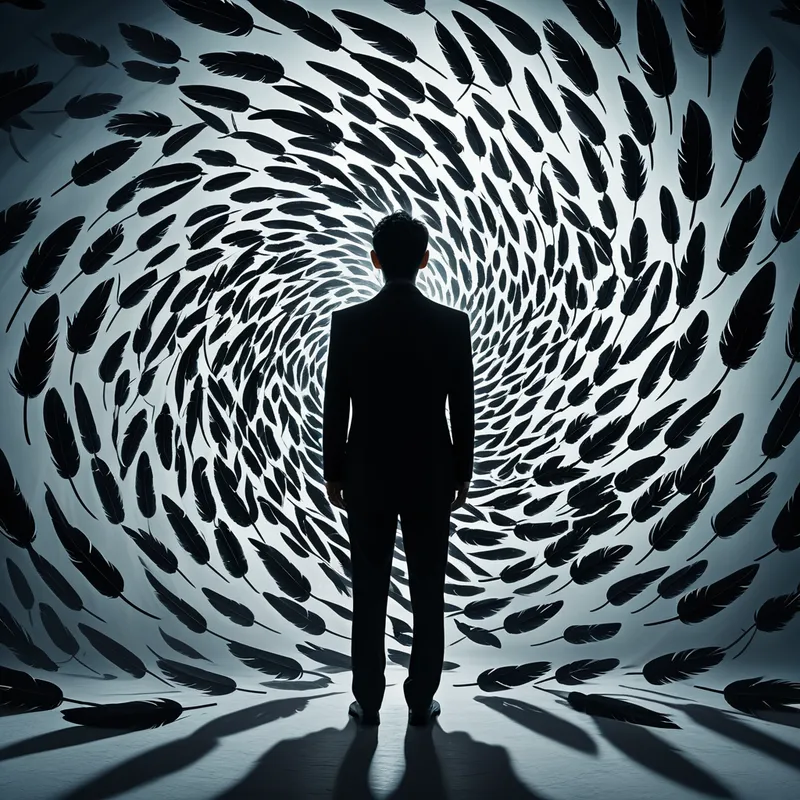
When this mythic pattern stirs in the modern [psyche](/myths/psyche “Myth from Greek culture.”/), it often manifests in dreams of overwhelming, chaotic information or confronting a powerful, fearsome feminine/masculine figure (the Great Mother in her transformative aspect). One might dream of being caught in a storm of papers, data, or voices; of being given a heavy, magnificent garment that feels both glorious and suffocating; or of standing before an authority figure of immense, ambiguous power.
Somatically, this can feel like anxiety, a tightening in the chest, or a sense of psychic overload. Psychologically, this marks a critical threshold in the individuation process. The dreamer is being called to move beyond a comfortable, but limited, self-concept. The unconscious is presenting its bill—all the ignored intuitions, repressed emotions, and denied aspects of fate and responsibility are demanding integration. The dream is the crossroads. The figure of the Morrígan is [the psychopomp](/myths/the-psychopomp “Myth from Various culture.”/) guiding—or goading—the dreamer toward a more complex, burdened, and authentic state of being.
Alchemical Translation
The alchemical process mirrored here is the [Nigredo](/myths/nigredo “Myth from Alchemical culture.”/)—the descent into the black, chaotic [prima materia](/myths/prima-materia “Myth from Alchemical culture.”/). Cú’s initial state is the unrefined metal of the naive ego. The confrontation with the Morrígan is the immersion in the solvent of the unconscious, which dissolves his old certainties.
The myth models that wisdom (the philosopher’s stone) is not found by avoiding the dark, but by submitting to its transformative corrosion.
His act of “withstanding” the visions is the crucial passio, the patient suffering of the process. By not fleeing, by acknowledging the totality of what is shown (the good, the terrible, and the ambiguous), he performs the alchemical coniunctio. He marries his conscious will to the unconscious content. The cloak settling upon him is the Albedo—the emergence of a new, clarified consciousness from the blackness. He is now “cloaked in knowing.”
For the modern individual, this translates to those life moments where we are forced to see a painful truth about ourselves, our relationships, or our world. It is the end of innocence. The alchemical work is to not dissociate from this knowledge, but to “wear” it—to allow it to change us, to let it become the very fabric from which we perceive and act. We become, like Cú at the story’s end, both burdened and anchored, capable of navigating the world not with the blindness of certainty, but with the sober, compassionate sight of one who has seen the weave and chosen to remain within it.
Associated Symbols
Explore related symbols from the CaleaDream lexicon: