The Moon's Lover Myth Meaning & Symbolism
A celestial archer falls in love with the Moon, embarking on an impossible quest that forever alters the balance between the earthly and the divine.
The Tale of The Moon’s Lover
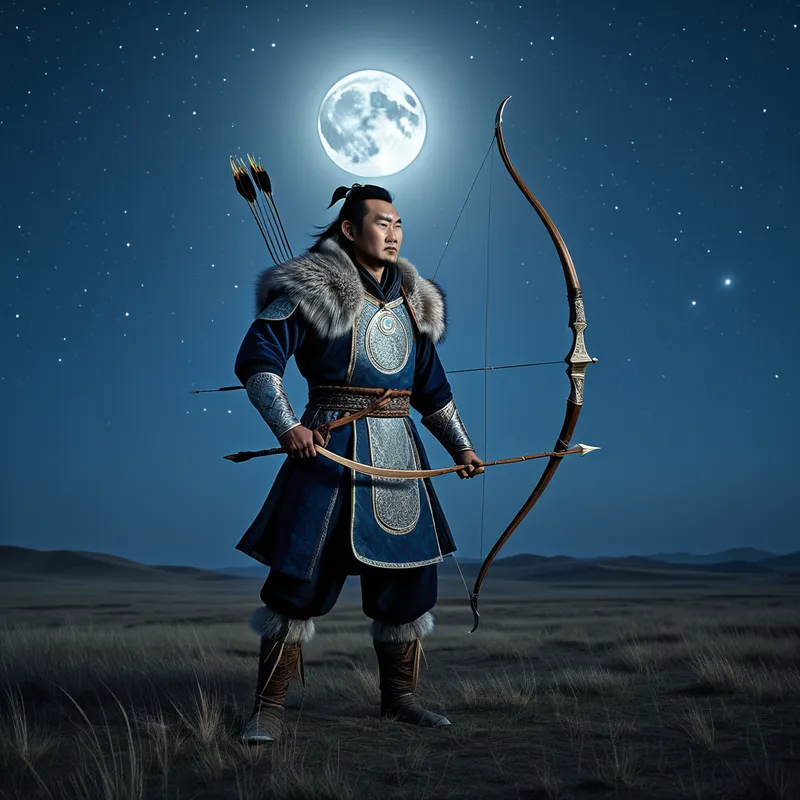
Listen, and let the wind of the eternal steppe carry you back. Before time was counted in years, when the sky was a closer tent and the stars were the eyes of watching spirits, there lived an archer. He was no ordinary man. His arrows flew with the certainty of fate, and his heart beat in time with the great, silent pulse of the world. His name is lost to the whispering grass, but his deed is etched upon the night itself.
Night after night, as the herds slept and the fire died to embers, he would stand alone beneath the vault of heaven. His gaze was not for the jealous, watchful stars, nor for the swift, coursing planets. It was held, utterly captive, by the Moon. He watched her wax from a shy sliver to a bold, luminous disc, bathing the rolling hills in her milk-pale light. He saw her wane, retreating into shadow as if carrying a secret sorrow. In her serene passage, he saw not a cold stone, but a being of profound and silent beauty—a queen of the quiet hours, a goddess of reflective peace.
A fire kindled in his chest, a longing more vast than the steppe itself. It was a Love that could find no earthly echo. He spoke to her on the wind, offered prayers with the smoke of sacred juniper, but she remained silent, distant, eternally untouchable. The impossibility of his desire became a Journey he had to undertake. If he could not join her, he would at least touch her, make her know of his devotion.
From the heart of a fallen star, he forged an arrow. Its shaft was of polished birch, its fletching from the feather of a snow eagle. The tip he crafted not from iron, but from a single, perfect Moonstone Orb, honed to a point that gleamed with captured moonlight. On a night when the moon hung full and heavy, a perfect silver Circle in the sky, he drew his great bow. The sinew cord thrummed with the tension of his soul. He did not aim to harm, but to connect—a lover’s kiss across the void.
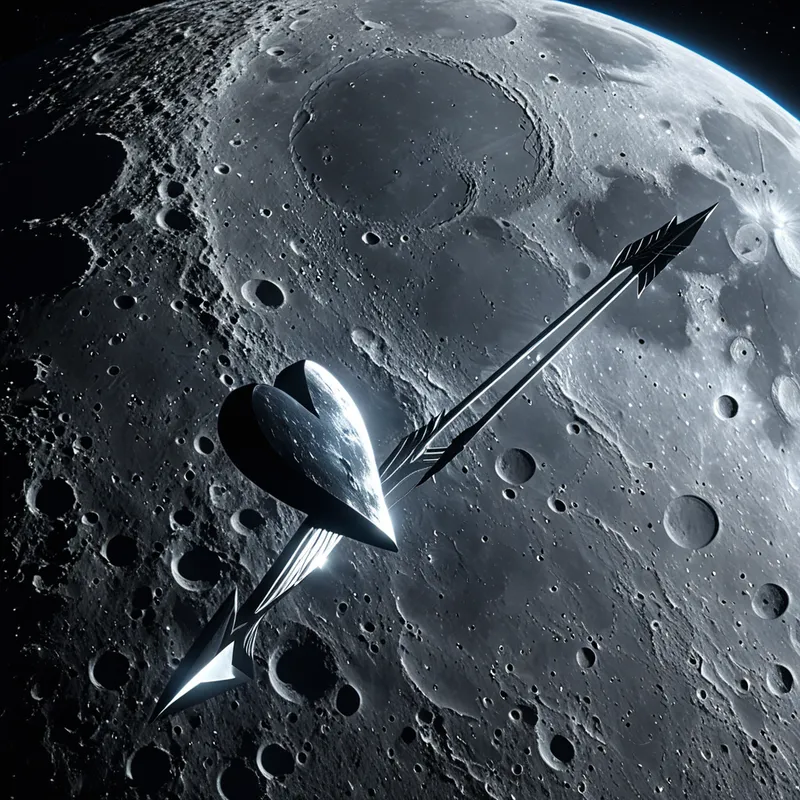
He loosed the arrow. It flew, a streak of silver against black, not arching down but soaring ever upward, drawn by the gravity of his longing. It crossed the unthinkable distance and struck. Not with violence, but with a sound like a single, clear chime that echoed through the chambers of the sky. The moonstone tip embedded itself in the heart of the moon.
And the moon… bled. Not blood, but light. A luminous, silvery fluid began to weep from the wound, cascading down in a shimmering stream towards the earth. The archer watched, his triumph turning to awe, then to dread. His act of love had become an act of violation. The moon’s perfect light was now fractured, flowing away. The celestial balance was broken.
The Sky Father, Tengri, roared in thunder. The archer was seized, not by hands, but by the very fabric of the world. For his audacious love, for reaching beyond the boundary set for mortals, he was given a punishment that was also a fulfillment. He was exiled to the moon itself. There he remains, the eternal Lover, a dark silhouette forever visible within her luminous sphere. He is both her companion and her captive, the cause of her waning and the witness to her waxing, forever close to the object of his desire, yet forever separated by the very substance of her being. And the silvery light that still sometimes drips from the moon? The people of the steppe know it as the dew, the tears of a celestial love that could never be.
Cultural Origins & Context
This myth, known in various forms across the Mongolian cultural sphere, is a cornerstone of the rich oral tradition nurtured under the vast Sky. It belongs not to a single text, but to the collective memory carried by storytellers, or ulgerchins, around nomadic campfires. Its roots are deeply entangled with the animistic and shamanistic worldview of Tengriism, where the natural world is alive with spirit (sülde) and the cosmos is a sacred, interactive web.
The function of the tale was multifaceted. On one level, it was an etiological myth, explaining the lunar phases (the wound waxing and waning) and the origin of dew. On a deeper, societal level, it served as a profound cautionary narrative about yos, or cosmic order and law. It illustrated the dangerous consequences of overreaching, of a mortal passion so intense it disrupts the harmony between the human, natural, and divine realms. The archer’s fate was a lesson in accepting one’s place within the great chain of being, while simultaneously honoring the sublime beauty of that which is beyond reach. It gave poetic form to the human experience of sublime, unattainable beauty and the bittersweet ache of longing itself.
Symbolic Architecture
At its core, the myth is a powerful depiction of the [soul](/symbols/soul “Symbol: The soul represents the essence of a person, encompassing their spirit, identity, and connection to the universe.”/)’s aspiration for the numinous—the divine, transcendent [aspect](/symbols/aspect “Symbol: A distinct feature, quality, or perspective of something, often representing a partial view of a larger whole.”/) of existence symbolized by the [moon](/symbols/moon “Symbol: The Moon symbolizes intuition, emotional depth, and the cyclical nature of life, often reflecting the inner self and subconscious desires.”/). The archer represents the [human](/symbols/human “Symbol: The symbol of a human represents individuality, complexity of emotions, and social relationships.”/) [Soul](/symbols/soul “Symbol: The soul represents the essence of a person, encompassing their spirit, identity, and connection to the universe.”/) ignited by a [vision](/symbols/vision “Symbol: Vision reflects perception, insight, and clarity — often signifying the ability to foresee or understand deeper truths.”/) of perfection, [beauty](/symbols/beauty “Symbol: This symbol embodies aesthetics, harmony, and the appreciation of life’s finer qualities.”/), or ultimate meaning that exists beyond the mundane world.
The arrow is the focused will of the ego, launched toward the unconscious divine. The wound it creates is the necessary rupture through which the transcendent can flow into the personal realm.
The Mirror-like moon reflects not light, but the archer’s own inner void, his profound lack. His [quest](/symbols/quest “Symbol: A quest symbolizes a journey or search for purpose, fulfillment, or knowledge, often representing life’s challenges and adventures.”/) is not for possession, but for communion. The tragic [outcome](/symbols/outcome “Symbol: Outcome symbolizes the results of actions or decisions, often reflecting hopes, fears, and the consequences of choices.”/)—his eternal, silhouetted [presence](/symbols/presence “Symbol: Presence in dreams often signifies awareness or acknowledgment of something significant in one’s life.”/) within the moon—symbolizes the paradoxical result of such deep yearning: a state of eternal [connection](/symbols/connection “Symbol: Connection symbolizes relationships, communication, and bonds among individuals.”/)-through-[separation](/symbols/separation “Symbol: A spiritual or mythic division between realms, states of being, or consciousness, often marking a transition or loss of connection.”/). He becomes part of the [mystery](/symbols/mystery “Symbol: An enigmatic, unresolved element that invites curiosity and exploration, often representing the unknown or hidden aspects of existence.”/) he sought, not as its master, but as its integral [shadow](/symbols/shadow “Symbol: The ‘shadow’ embodies the unconscious, repressed aspects of the self and often represents fears or hidden emotions.”/). The flowing moon-tears represent the creative, nourishing, yet often melancholic outpouring that occurs when the conscious mind (the archer) successfully petitions, or wounds, the unconscious (the moon), allowing its contents (silver light/dew/[insight](/symbols/insight “Symbol: A sudden, deep understanding of a complex situation or truth, often arriving unexpectedly and illuminating hidden connections.”/)) to irrigate the earthly [plane](/symbols/plane “Symbol: Dreaming of a plane often symbolizes a desire for freedom, adventure, and new possibilities, as well as transitions in life.”/) of [life](/symbols/life “Symbol: The symbol of ‘Life’ represents a journey of growth, interconnectedness, and existential meaning, encompassing both the joys and challenges that define human experience.”/).
The Dreamer’s Resonance
When this mythic pattern stirs in the modern Dream, it often manifests as dreams of reaching for a luminous, beautiful, but distant object or person. One might dream of climbing an endless Mountain toward a glowing peak, or swimming in a dark Ocean toward a light that recedes. The somatic feeling is one of aching longing mixed with futility, a profound pull in the chest.
Psychologically, this indicates a process where the ego is being drawn toward a content of the unconscious—perhaps a latent talent, a spiritual calling, or an idealized aspect of the Anima/Animus (the inner contrasexual image). The “wounding” of the moon in the dream signals a necessary inflation, or even a minor psychic injury, where the ego’s directed effort makes contact with this numinous content. The dreamer may wake with a sense of beautiful sadness or awe, having touched a depth of feeling that everyday life cannot contain. It is the psyche working through the price of aspiration and the transformation that follows when we aim our deepest desires at the impossible.

Alchemical Translation
The myth models the alchemical opus, the great work of individuation. The archer’s initial state is one of separatio—he is painfully aware of his isolation from the celestial silver (the luna, the feminine, receptive principle). His forging of the arrow is coagulatio, the concretization of his longing into a focused intent (the conscious attitude).
The exile to the moon is not a failure, but the ultimate coniunctio—the sacred marriage. He is united with the object of his desire by becoming its eternal counterpart, its shadow. The Self is realized not in conquest, but in sacred containment.
The launching of the arrow is the daring act of the ego venturing into the unconscious. The wounding and the flowing tears represent the solutio—the dissolution of old boundaries and the release of transformative psychic energy. The final, frozen image of the silhouette within the moon is the state of rubedo, the final stage of alchemy. It is a state of permanent, dynamic tension. The individual is no longer just a mortal on the plain; they have internalized the cosmic dynamic. They carry the luminous, unattainable ideal within themselves, as a central, defining feature of their being. The longing does not cease; it becomes the very architecture of the realized psyche. One learns to live with the beautiful wound, understanding that the flow of creative life, insight, and soulful depth (the dew) comes precisely from that point of eternal, loving contact with the transcendent.
Associated Symbols
Explore related symbols from the CaleaDream lexicon:
- Moon — The central symbol of the numinous, the unconscious feminine, reflective beauty, and cyclical change, whose wounding by mortal desire sets the entire cosmic drama in motion.
- Love — Not merely romantic affection, but the profound, soul-directed yearning for union with the transcendent, which acts as the irresistible force motivating the hero’s impossible quest.
- Arrow — The focused will, intention, and ego-consciousness of the archer, launched across the abyss to make contact with the divine, representing a decisive, fateful act of the psyche.
- Journey — The archetypal path of the soul from longing to a transformed state of being, an inward ascent toward the celestial that results in eternal exile and integration.
- Sacrifice — The archer’s surrender of his earthly existence and autonomy, the price paid for touching the divine, which results in a new, bound state of being.
- Sky — The realm of Tengri and cosmic order, the boundary between mortal and divine that is transgressed by the arrow, representing the laws of the psyche and the universe.
- Circle — The perfect, whole, and distant form of the full moon, symbolizing the completeness of the unconscious Self before it is wounded and made dynamic by conscious desire.
- Wound — The crucial rupture in the celestial body, the point of contact and violation from which transformative “light” flows, symbolizing the necessary injury that allows for psychic exchange.
- Lover — The archetypal identity of the hero, defined entirely by his relationship to the desired Other, representing the part of the psyche that seeks completion through connection.
- Moonstone Orb — The captured essence of the moon itself, fashioned into the arrowhead, representing a concretized fragment of the divine used as the tool to reach back toward its source.
- Soul — The eternal aspect of the archer that is ultimately exiled and integrated with the moon, representing the individual essence undergoing a cosmic transformation.
- Shadow — The archer’s final form as a dark silhouette within the moon, representing the integrated personal unconscious that now forms a permanent part of the luminous Self.