The Monk's Alms Bowl Myth Meaning & Symbolism
A monk's simple alms bowl becomes the vessel for a cosmic trial, where the gods themselves test the depth of his non-attachment and emptiness.
The Tale of The Monk’s Alms Bowl
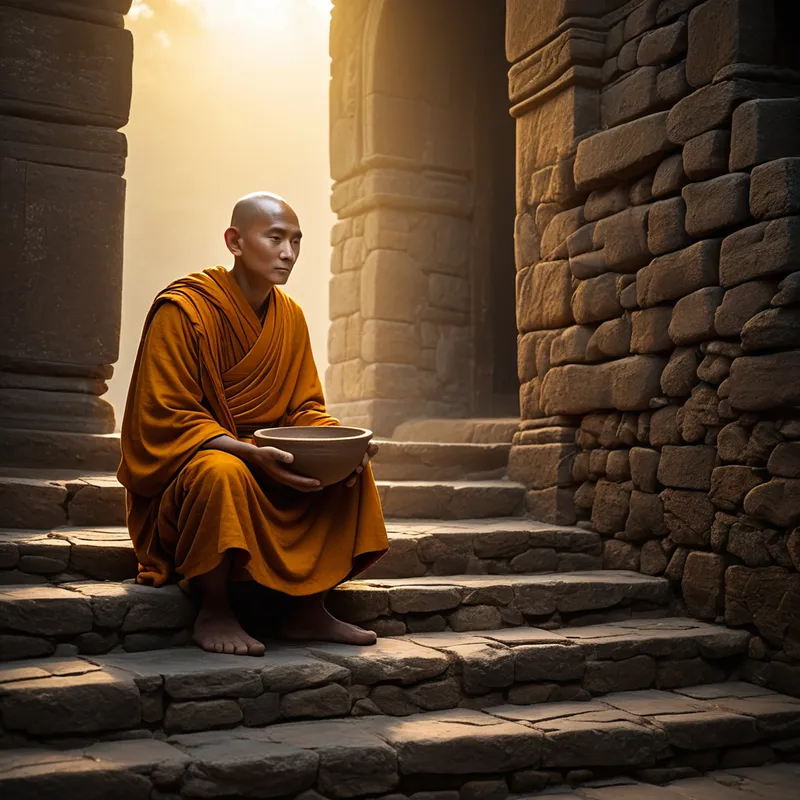
Listen, and hear a story not of conquest by sword, but of victory by emptiness. In the high, thin air where the mountains touch the realm of the gods, there lived a monk. His name is lost to [the wind](/myths/the-wind “Myth from Various culture.”/), for his story is not about a person, but about a vessel. His life was the rhythm of breath and step, his possession a single, unglazed clay bowl—his pātra. From this bowl, he ate the simple food offered by villagers in the valley below. Into this bowl, he poured his daily [water](/myths/water “Myth from Chinese culture.”/). It was an extension of his hands, a humble companion in his practice of śramaṇa.
But in the heavens, the gods took notice. Devas observed this mortal whose heart seemed untethered from [the world](/myths/the-world “Myth from Tarot culture.”/)’s glittering hooks. A debate arose in the celestial palaces: Was this detachment true, or merely untested? Was his bowl truly empty, or was it just waiting to be filled? The great god Śakra, lord of the Trāyastriṃśa, decided to descend. He would offer the ultimate temptation, to see if the monk’s bowl—and thus his mind—had any bottom.
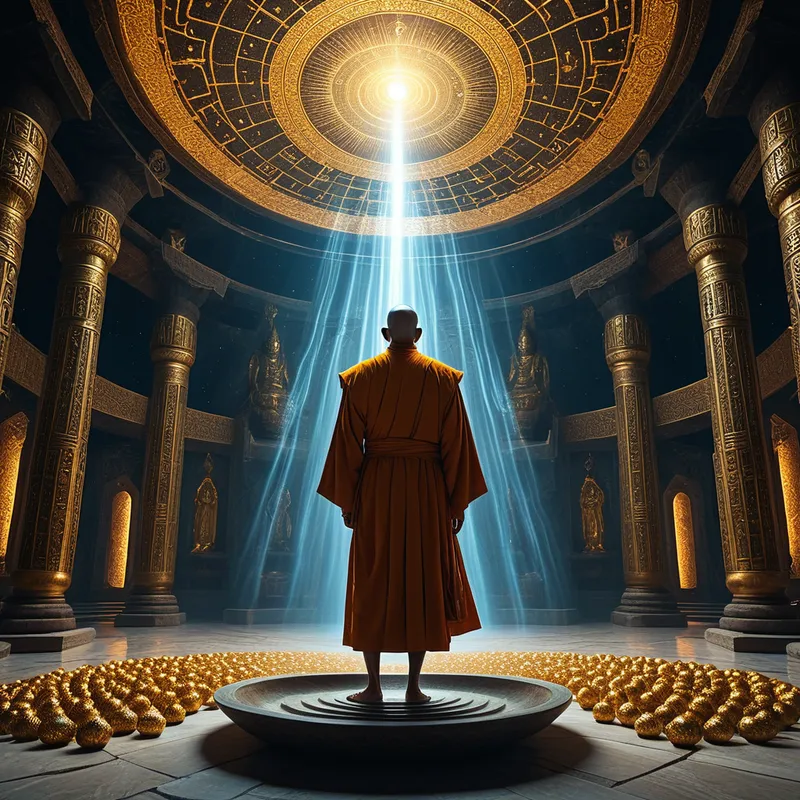
One dawn, as the monk sat in meditation, a radiant light filled his cave. Before him stood Śakra, not in wrath, but in sublime generosity. “Venerable one,” the god intoned, his voice like distant thunder, “your virtue shines. I would make an offering to sustain it.” And with a wave of his hand, [the cave](/myths/the-cave “Myth from Platonic culture.”/) dissolved. They stood in a palace of crystal and gold, where the very air was perfumed with ambrosia. Priceless jewels rained from the vaulted ceiling, forming glittering mounds. Divine musicians played, and apsarās of impossible grace descended, their smiles promising bliss beyond imagining.
“All this,” Śakra proclaimed, “is for you. Let your bowl receive it. Enjoy the fruits of your merit.”
The monk did not move. He looked at the swirling cosmos of wealth and pleasure, then looked down at his simple, dark pātra. A faint, knowing smile touched his lips. He did not refuse. He did not argue. He simply extended his bowl.
And a wonder occurred. The cascading jewels, the streams of gold coin, the enchanting apsarās—all were drawn toward the small, clay vessel. Not with a crash, but with the silent inevitability of water down a drain. The palace, the music, the divine scents, all were funneled into the bowl’s mouth. The monk stood as a still point in the vanishing storm. The more Śakra poured forth from his divine treasury, the more was consumed, until the god himself felt a tremor of awe. The bowl accepted everything, yet showed no change. It remained a bowl, seemingly empty, dark, and simple.
Finally, Śakra ceased. The vision of the palace flickered and was gone. They were back in the simple cave, the first rays of true dawn piercing the entrance. The monk’s bowl sat on the ground between them, unchanged. Śakra bowed low, his divine pride utterly dissolved. “Your bowl,” he whispered, “is truly empty. My offerings were not refused; they were unheld. You possess the victory that cannot be taken, for it is the victory of having nothing to lose.” And with that, the god returned to his heaven, bearing a lesson deeper than any he had come to give.
Cultural Origins & Context
This parable, found in various forms across the Pāli Canon and avadāna texts, is not a folk tale but a sophisticated teaching tool. It was told by monastics to monastics, a vivid illustration embedded in sermons on the Three Marks of Existence and the perfection of dāna. Its primary function was to define the pinnacle of renunciation. It answered the unspoken question: “How empty is empty?” For a novice, giving up worldly life is a first step. This story points to the final step: when not only objects but the very capacity for the mind to be claimed by an object is relinquished.
The figure of Śakra is key. In Buddhist cosmology, he is a powerful but still samsaric deity, subject to rebirth. His test represents the highest temptation the conditioned world can offer: not just base desire, but divine, meritorious, glorious reward. The myth asserts that true freedom must be proven even in the face of heaven itself. It was a story that fortified the Saṅgha, reminding them that their most powerful “possession” was the unassailable space of non-grasping.
Symbolic Architecture
The myth’s power lies in its flawless symbolic economy. The Alms [Bowl](/symbols/bowl “Symbol: A bowl often represents receptivity, nourishment, and emotional security, symbolizing the dreamer’s needs and desires.”/) (Pātra) is not just a container; it is the [symbol](/symbols/symbol “Symbol: A symbol can represent an idea, concept, or belief, serving as a powerful tool for communication and understanding.”/) of the mind itself. As a [receptacle](/symbols/receptacle “Symbol: A container that holds, receives, or stores something, often symbolizing the capacity to accept, contain, or process experiences, emotions, or resources.”/) for sustenance, it represents dependence on the world (alms), but its ideal state is one of functional [emptiness](/symbols/emptiness “Symbol: Emptiness signifies a profound sense of void or lack in one’s life, often related to existential fears, loss, or spiritual quest.”/)—receiving what is needed without clinging to it.
The ultimate vessel is not defined by what it holds, but by its capacity to remain fundamentally undefined by its contents.
Śakra and the Divine Temptations symbolize the most insidious [layer](/symbols/layer “Symbol: Layers often symbolize complexity, depth, and protection in dreams, representing the various aspects of the self or situations.”/) of attachment: not to evil, but to the good, the beautiful, the spiritually meritorious. This is the temptation of the higher self, [the ego](/myths/the-ego “Myth from Jungian culture.”/)’s desire for spiritual accomplishment and divine recognition. The Act of Offering Everything represents the [universe](/symbols/universe “Symbol: The universe symbolizes vastness, interconnectedness, and the mysteries of existence beyond the individual self.”/) presenting its final [bill](/symbols/bill “Symbol: A bill often signifies responsibility, obligations, and the pressure of financial concerns.”/), demanding the monk identify with something—even if it is [virtue](/symbols/virtue “Symbol: A moral excellence or quality considered good, often representing inner character, ethical principles, or spiritual ideals in dreams.”/) itself.
The Miraculous Consumption is the core symbol. The bowl does not reject; it dissolves. This is the critical psychological [insight](/symbols/insight “Symbol: A sudden, deep understanding of a complex situation or truth, often arriving unexpectedly and illuminating hidden connections.”/). Spiritual maturity is not about building a stronger [wall](/symbols/wall “Symbol: Walls in dreams often symbolize boundaries, protection, or obstacles in one’s life, reflecting the dreamer’s feelings of confinement or security.”/) against desire (which would be a form of conflict and thus engagement). It is about developing a [consciousness](/symbols/consciousness “Symbol: Consciousness represents the state of awareness and perception, encompassing thoughts, feelings, and experiences.”/) so porous, so empty of a “self” that needs to be defended or aggrandized, that temptations pass through it without finding purchase. The victory is one of non-[resistance](/symbols/resistance “Symbol: An object or tool representing opposition, struggle, or the act of pushing back against external forces or internal changes.”/), which is the highest form of transcendence.
The Dreamer’s Resonance
When this myth pattern stirs in the modern dreamer, it rarely appears as a monk and a god. It manifests as a profound somatic and psychological process of containment and dissolution. One might dream of a bottomless bag, a room that absorbs furniture, or a silent, dark pool that swallows objects without a ripple. The emotional tone is not of fear, but of awe and profound quiet.
This dream signals a [psyche](/myths/psyche “Myth from Greek culture.”/) undergoing a deep detoxification of identity. The “treasures” being drawn in are the dreamer’s cherished self-concepts: their accomplishments, their moral self-image, their intellectual frameworks, their relational roles. The psyche is conducting its own divine test, asking: “If I take everything you think you are, what remains?” The anxiety of such a dream is the ego’s terror of its own irrelevance. The peace that can follow is the soul’s recognition of the vast, silent space that exists when the mental furniture is finally cleared away.
Alchemical Translation
The myth models the alchemical [nigredo](/myths/nigredo “Myth from Alchemical culture.”/) and albedo for the modern individual seeking wholeness. Our initial state is one of a cluttered bowl—a mind filled with identities, traumas, ambitions, and opinions. The first alchemical step is the descent, the offering of these contents to the fire of awareness (Śakra’s test).
Individuation is not the curation of a perfect collection of self-parts, but the courageous maintenance of an inner vessel so empty it can faithfully reflect the totality of existence without distortion.
The “monk” within is not an ascetic who hates the world, but the observing consciousness that consents to see everything—our shadow, our glory, our deepest wounds and highest aspirations—without claiming any of it as a final definition of “me.” The miraculous consumption is the transmutation. As we stop fighting our contents, stop either clinging to or rejecting them, they lose their solidity. A painful memory, when fully allowed into the bowl of non-judgmental awareness, loses its toxic charge and becomes simply experience. A grand ambition, when placed in the bowl, is seen as a passing phenomenon, not the core of self.
The [triumph](/myths/triumph “Myth from Roman culture.”/) is not becoming a spiritual superhero, but becoming ordinary in the most profound sense: a clear, empty vessel through which life flows. The modern alchemist’s goal is to forge a consciousness like the monk’s pātra: deeply engaged with the world, yet fundamentally free, because it has discovered its own nature as unconditional space. The bowl is never full, because it is, in its essence, the very capacity to hold.
Associated Symbols
Explore related symbols from the CaleaDream lexicon: