The Monkey and the Ogress Myth Meaning & Symbolism
A compassionate monkey, emissary of Avalokiteshvara, unites with a rock ogress, forging the Tibetan people from the alchemy of wisdom and raw nature.
The Tale of The Monkey and the Ogress
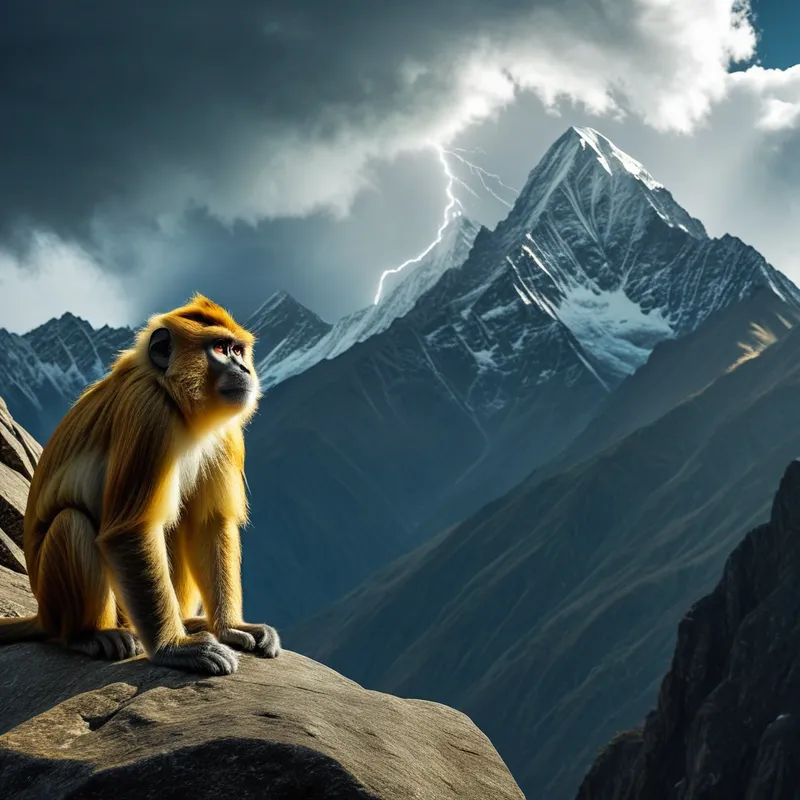
In the dawn of the world, when the Himalayas were young and sharp against a sky of purest lapis, a profound stillness lay upon the land of snows. It was a world of rock and wind, of immense potential waiting for a spark. High upon the sacred slopes of Potala, there dwelt a monkey. He was no ordinary creature. He was a disciple, a bodhisattva in simian form, who had taken a vow of celibacy and deep meditation under the guidance of the great Avalokiteshvara. His mind was a clear pool reflecting the wisdom of emptiness; his days were spent in silent contemplation, his only nourishment the fruits of his practice.
But the land itself held another power, raw and untamed. From the heart of the mountains, from the caves where primal forces slept, emerged a rock ogress. She was a spirit of the earth itself—wild, passionate, and bound by deep, insatiable longing. Her form was formidable, her strength that of avalanches, and in her eyes burned the fierce, lonely fire of a creature untouched by compassion. She saw the radiant monkey in his peaceful solitude, and a desperate craving awoke within her. It was not mere lust, but a profound, elemental hunger for the light of consciousness he carried.
She pursued him. She coiled around his meditation rock with promises and threats, her voice the grind of tectonic plates. “Union with me,” she implored, her words echoing through the valleys, “or I will take a demon for a mate, and from our lineage will spring countless beings who will devour this land, filling the world with suffering and darkness.” The monkey, plunged into a terrible dilemma, felt his vow tremble. To break his ascetic practice was a fall; to refuse her was to condemn the world to a future of carnage.
In his deepest meditation, he called out to his guide, Avalokiteshvara. The compassionate one, perceiving all, responded not with a command, but with a revelation of profound upaya. “Go, and unite with her,” the bodhisattva’s wisdom resonated within him. “This act is not a fall from grace, but a sacred descent. From your union, offspring will arise. I will bless them and provide for them. Through this, the people of the snows will be born, embodying both your compassionate wisdom and her fierce, nurturing strength.”
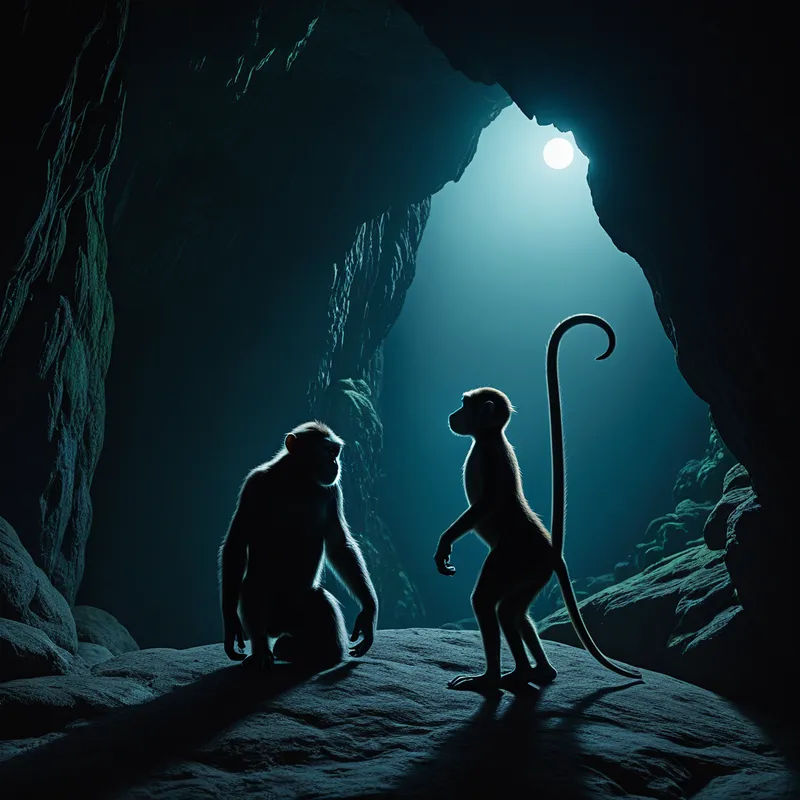
With a heart heavy with the weight of this cosmic duty, the monkey consented. He descended from his solitary peak and entered the ogress’s stony domain. Their union was the first great alchemy of Tibet: the marriage of luminous, disciplined awareness with the raw, fecund power of untamed nature. In time, six offspring were born. From these six, nurtured by the blessings of Avalokiteshvara with the grains of heaven, the tribes of the Tibetan people multiplied, their nature forever a tapestry woven from these two primordial threads.
Cultural Origins & Context
This origin myth is the foundational narrative of Tibetan ethnic and cultural identity. It is not a folktale in the casual sense, but a terma, a sacred history embedded within the cultural psyche. Its most famous literary recording is found within the Manji Kabum, a collection of works attributed to the great king [Songtsen Gampo](/myths/songtsen-gampo “Myth from Tibetan Buddhist culture.”/) (7th century CE). As such, it carries the authority of both spiritual revelation and royal chronicle.
The myth functioned as a powerful societal charter. It provided a divine and dignified origin for the Tibetan people, linking them directly to Avalokiteshvara, the national patron bodhisattva. It also served to integrate the pre-Buddhist, animistic substrate of Tibetan culture—represented by the chthonic ogress and the sacred landscape—with the incoming, systematized wisdom of Dharma. The story legitimizes the Tibetan character as a necessary and sacred synthesis: not a rejection of the wild, indigenous spirit, but its transformation through compassionate engagement.
Symbolic Architecture
The myth is a masterful map of psychic forces. The Monkey represents [the principle](/symbols/the-principle “Symbol: A fundamental truth, law, or doctrine that serves as a foundation for a system of belief, behavior, or reasoning, often representing moral or ethical standards.”/) of conscious, transcendent wisdom. He is [spirit](/symbols/spirit “Symbol: Spirit symbolizes the essence of life, vitality, and the spiritual journey of the individual.”/), mind, discipline, and compassionate [intention](/symbols/intention “Symbol: Intention represents the clarity of purpose and direction in one’s life and can symbolize motivation and commitment within a dream context.”/). He is the [capacity](/symbols/capacity “Symbol: A measure of one’s potential, limits, or ability to contain, process, or achieve something, often reflecting self-assessment or external demands.”/) for [reflection](/symbols/reflection “Symbol: Reflection signifies self-examination, awareness, and the search for truth within oneself.”/) and ethical restraint.
The Monkey is consciousness seeking its own ground, unaware that it is already part of the earth it observes.
The Ogress embodies the unconscious, instinctual, and [material](/symbols/material “Symbol: Material signifies the tangible aspects of life, often representing physical resources, desires, and the physical world’s influence on our existence.”/) base. She is the [body](/symbols/body “Symbol: The body in dreams often symbolizes the dreamer’s self-identity, personal health, and the relationship they have with their physical existence.”/), the passions, the [shadow](/symbols/shadow “Symbol: The ‘shadow’ embodies the unconscious, repressed aspects of the self and often represents fears or hidden emotions.”/), the fecund and terrifying creative/destructive power of [nature](/symbols/nature “Symbol: Nature symbolizes growth, connectivity, and the primal forces of existence.”/). She is not evil, but unintegrated—a raw force demanding recognition.
Their union is the central, alchemical act. It is not a conquest of one by the other, but a sacred [marriage](/symbols/marriage “Symbol: Marriage symbolizes commitment, partnership, and the merging of two identities, often reflecting one’s feelings about relationships and social obligations.”/) (coniunctio oppositorum). The [offspring](/symbols/offspring “Symbol: Represents legacy, responsibility, and the future self. Often symbolizes creative projects or personal growth.”/)—the Tibetan people—symbolize the emergent ego-[consciousness](/symbols/consciousness “Symbol: Consciousness represents the state of awareness and perception, encompassing thoughts, feelings, and experiences.”/) born from this union. They are not purely spiritual nor purely instinctual, but a new, third thing: a [human](/symbols/human “Symbol: The symbol of a human represents individuality, complexity of emotions, and social relationships.”/) consciousness that carries the [tension](/symbols/tension “Symbol: A state of mental or emotional strain, often manifesting physically as tightness, pressure, or unease, signaling unresolved conflict or anticipation.”/) and the potential of both lineages.
The intervention of Avalokiteshvara is crucial. It signifies that this [integration](/symbols/integration “Symbol: The process of unifying disparate parts of the self or experience into a cohesive whole, often representing psychological wholeness or resolution of internal conflict.”/) is not a personal, ego-driven endeavor, but is guided by a transpersonal, compassionate intelligence. The act is sanctified by a [purpose](/symbols/purpose “Symbol: Purpose signifies direction, meaning, and intention in life, often reflecting personal ambitions and core values.”/) greater than the individuals involved: the [birth](/symbols/birth “Symbol: Birth symbolizes new beginnings, transformation, and the potential for growth and development.”/) and sustenance of a world.

The Dreamer’s Resonance
When this myth stirs in the modern psyche, it often manifests as dreams of profound inner conflict or compelling, fateful unions. One might dream of being a serene figure relentlessly pursued by a wild, magnetic, or terrifying force—a storm, an animal, a passionate stranger. Alternatively, the dreamer may find themselves in a stark, beautiful, but lifeless landscape (the Monkey’s solitude) that is suddenly invaded by chaotic, fertile growth (the Ogress’s demand).
Somatically, this can feel like a tug-of-war between a desire for spiritual or intellectual purity and the urgent, often shameful, demands of the body, primal emotions, or unlived life. It is the tension between the head and the gut. The psychological process underway is the unconscious forcing a confrontation. The “ogress” of the psyche will not be ignored; she threatens to create a “demon lineage”—neuroses, compulsions, destructive patterns—if her energy is not met with conscious, compassionate engagement.

Alchemical Translation
For the individual on the path of individuation, this myth models the essential, terrifying, and creative step of shadow integration.
The first stage is the Monkey’s asceticism: the development of a conscious standpoint, a disciplined ego capable of reflection. But this, alone, is incomplete. It risks becoming sterile, disconnected from the vital life force. The Ogress arrives as the crisis that forces evolution. She represents all that has been repressed for the sake of this conscious identity: rage, desire, creativity, vulnerability, the animal body.
The descent to the rock ogress is not a regression, but the only path forward. One must become impure to become whole.
The “union” is the act of turning toward these contents with curiosity and compassion, rather than judgment and fear. It is allowing the feeling of shame to be felt fully, listening to the message of rage, honoring the wisdom of the body’s instincts. This is not an act of indulging them blindly, but of marrying them with awareness. Avalokiteshvara’s blessing represents the guiding function of the Self—the central, organizing principle of the total psyche—which assures us that this difficult integration serves a greater wholeness.
The “offspring” are the new capacities that emerge: genuine creativity (not just intellect), embodied wisdom, resilient empathy, and an authentic personality rooted in both spirit and nature. One is no longer at war with oneself, but has become a vessel for a more complete and fertile consciousness.
Associated Symbols
Explore related symbols from the CaleaDream lexicon:
- Monkey — The emissary of conscious compassion and disciplined wisdom, representing the transcendent mind that must descend into engagement with the world.
- Ogre — The primal, chthonic force of raw nature and the unconscious, whose integration is essential for creation and wholeness.
- Mountain — The sacred, immutable ground of being where this divine drama unfolds, representing the lofty goal of consciousness and the foundational power of the earth.
- Cave — The womb of the unconscious and the place of sacred union, where transformation occurs away from the light of ordinary awareness.
- Union — The central alchemical act of the myth, representing the sacred marriage of opposites that generates new consciousness.
- Seed — The potential for life and civilization born from the union, blessed by transcendent compassion to grow and flourish.
- Root — The deep, ancestral connection to both primal instinct and divine compassion that forms the foundational identity of a people or an individual.
- Shadow — The psychological aspect represented by the ogress, containing repressed qualities that demand integration for personal wholeness.
- Compassion — The guiding force of Avalokiteshvara, which transforms a potential tragedy into a sacred duty and a creative act.
- Stone — The unyielding, foundational nature of the instinctual world and the raw material from which the new is sculpted through relationship.