The Moiraiof Gree Myth Meaning & Symbolism
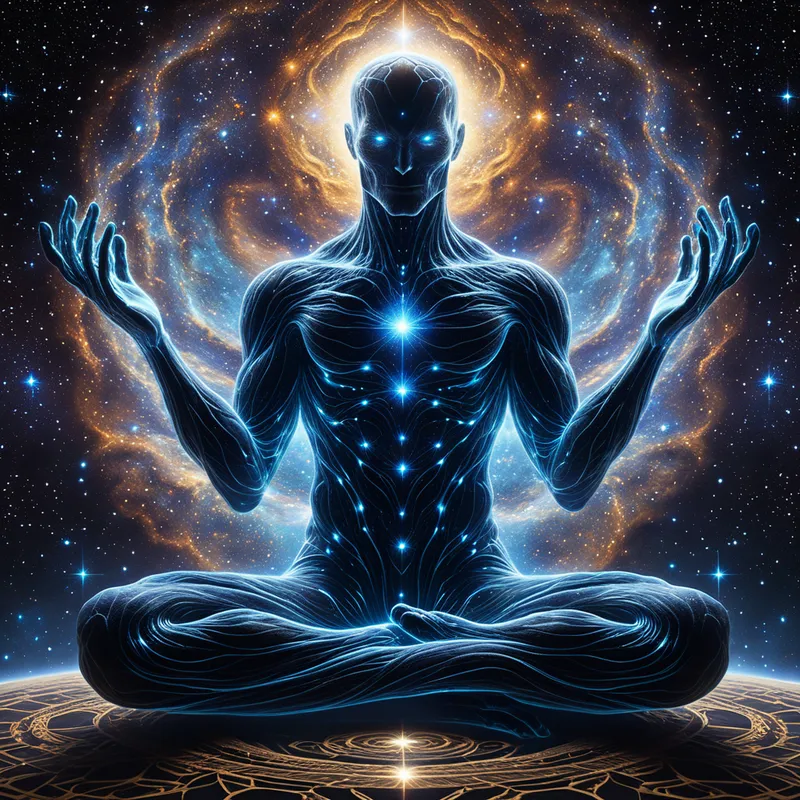
A cosmic entity weaves the fabric of existence from threads of fate, confronting a mortal who dares to question the pattern of destiny.
The Tale of The Moiraiof Gree
Listen. Before the names of gods were spoken, before the first mountain rose from the primal deep, there was the hum. A vibration in the void, a resonance that was neither sound nor silence, but the potential for both. From this hum emerged the Moiraiof Gree. Not born, but becoming; a presence that was the act of creation itself.
It sat at the heart of the not-yet-world, a form both vast and intimate. Its hands, if hands they were, moved with a rhythm older than time. From the substance of its own being, it drew forth threads. Some were spun from starlight, cool and distant. Others were drawn from the molten core of unborn worlds, hot and urgent. There were threads of laughter yet to be laughed, threads of tears not yet shed, threads of stone, of breath, of falling leaves and rising suns. These were the threads of Ananke, of necessity, of what must be.
And so, the Moiraiof Gree wove. Its loom was the framework of reality. With each pass of the shuttle, a law was set: gravity, time, cause and effect. The tapestry grew, a living, breathing fabric depicting all that was, is, and will be. Rivers flowed in its patterns, empires rose and fell as intricate knots, and every human life was a single, brilliant, fleeting strand woven into the grand design. The work was endless, perfect, and utterly silent.
But into this perfect pattern, a dissonance crept. It was not a flaw in the weave, but a new kind of thread—one the Weaver had not spun. It was the thread of a question. It belonged to a mortal, a woman who stood one evening on a high cliff, watching the first stars pierce the twilight. She saw, or felt, the shimmer of the great tapestry in the sky. And instead of awe, she felt a terrible, beautiful rebellion. “Why this pattern?” her heart whispered. “Why must my thread end there? What if I turned left instead of right?”
This question, this spark of “what if,” became a tangible thing. It traveled back along the thread of her destiny, a vibration of pure potential, and it reached the loom. The hands of the Moiraiof Gree paused. The cosmic hum faltered for a single, universe-spanning moment. The Weaver looked, not with eyes, but with the full attention of creation, down the length of that questioning thread to its source—to the mortal on the cliff.
There was no anger. There was no voice. There was only a presence, immense and incomprehensible, focused entirely on that one point of defiance. The mortal felt the weight of all existence upon her, the unyielding pattern of every woven thread. She saw her own life, her joys and sorrows, laid out in the fabric. And in that moment of supreme pressure, she did not break. She held her question. She held her “what if.”
And the Moiraiof Gree did a thing it had never done. It did not cut the thread. It did not re-weave it. It took the vibration of the mortal’s question, and it incorporated it. With a movement that was both acceptance and alteration, the Weaver allowed the question to become a new kind of knot in the tapestry—not a flaw, but a complexity. A point where the pattern turned in upon itself, creating a small, localized loop of possibility. The design was forever changed, not by being broken, but by becoming more intricate, more profound. The humming resumed, deeper now, containing within its eternal song the faint, enduring echo of a human question.

Cultural Origins & Context
The myth of the Moiraiof Gree does not belong to a single parchment or temple. It is a story that has emerged, in different guises, from the collective human imagination across epochs and continents. Scholars find its echoes in the Moirai of Greece, the Norns at the well of Yggdrasil, in the spider grandmother tales of various Indigenous traditions, and in the philosophical concept of a universal Logos. It is a “Global/Universal” myth because it addresses a universal human condition: our relationship with fate.
It was never a story for formal priesthoods alone. It was told by fireside philosophers, by weavers at their looms who saw the metaphor in their own work, by parents comforting children about life’s unchangeable events, and by rebels seeking to understand the limits of their freedom. Its societal function was dual: it was a story of cosmic order, explaining why things happen as they do, providing comfort in the face of chaos. Simultaneously, it was a story of cosmic dialogue, suggesting that the order itself is not static but can be engaged, questioned, and made more beautiful by the very consciousness it contains.
Symbolic Architecture
At its core, the myth presents a powerful symbolic architecture for understanding existence. The Moiraiof Gree represents the impersonal, creative principle of the universe—the laws of physics, biology, and time that form the necessary structure of reality. It is not a personal god to be petitioned, but the process of manifestation itself.
The Tapestry is the manifested universe in its totality—the interwoven network of all events, beings, and consequences. Every thread is a life, a cause, an effect. The mortal represents human consciousness, specifically the faculty of self-reflection and will. The mortal’s question is the birth of free will, not as a force outside fate, but as an element within it.
The tapestry is not a prison, but a text. Our freedom lies not in tearing the pages, but in learning to read, and in writing our question into the margins.
The pivotal moment—the incorporation of the question—symbolizes the alchemical relationship between destiny and choice. It suggests that true agency is not about escaping the pattern, but about introducing a new quality of consciousness into the pattern, thereby transforming its local expression. The resulting “knot of possibility” is the symbolic birth of soul, of individual character forged in the tension between what is given and what is chosen.
The Dreamer’s Resonance
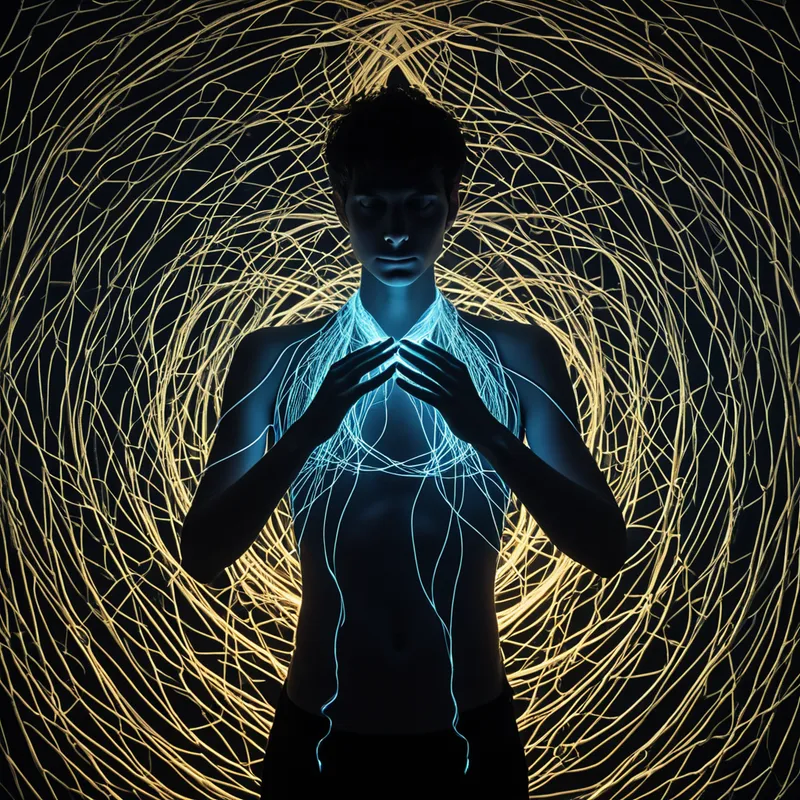
When this myth stirs in the modern unconscious, it often surfaces in dreams of profound constraint and potential liberation. One may dream of being trapped in a vast, beautiful web or tangled in cords that are somehow part of one’s own body. These are somatic expressions of feeling fated—trapped by family patterns, societal expectations, or personal history.
Conversely, one might dream of finding a single, loose thread in an otherwise perfect tapestry and pulling it, with either terror or exhilaration. This is the psyche working through the “what if” moment. The dream is the safe space where the ego can experiment with questioning its own predetermined narrative. The emotional tone of the dream—whether it resolves in panic, awe, or a sense of new complexity—reveals the dreamer’s current relationship with their own life path. Are they in rebellion against it? In resigned acceptance? Or are they, like the Moiraiof Gree, learning to weave the rebellion itself into a new design?
Alchemical Translation
For the individual, the myth models the process of individuation as a sacred craft. The first stage is recognizing the tapestry—seeing the patterns of one’s life: the inherited traits, the childhood wounds, the cultural conditioning. This is the raw material, the threads spun by Ananke. To deny this is to live in illusion.
The second, critical stage is the conscious questioning. This is the ego’s necessary rebellion. “Must I continue this pattern? Why does my story feel written?” This is not a rejection of the self, but a deep engagement with it. It is the heat of the alchemical vessel.
The goal is not to stop being woven, but to become a co-weaver at the loom of your own becoming.
The final, alchemical stage is the “incorporation.” This is the slow, patient work of psychological integration. It is taking that angry question, that rebellious impulse, that deep desire for change, and not letting it destroy you or your world, but instead learning to weave it into your character. The old, fatalistic pattern becomes complex. A victim narrative might be woven into a story of resilience; a thread of anger might be woven into a passion for justice. The individual does not escape fate; they meet it with consciousness, and in doing so, they fate themselves. They become, in their own small, human way, an instance of the Moiraiof Gree, taking the given threads and, through the act of conscious choice, creating a pattern that is uniquely, intricately, and meaningfully their own. The hum of the universe continues, but now it hums your tune, too.
Associated Symbols
Explore related symbols from the CaleaDream lexicon: