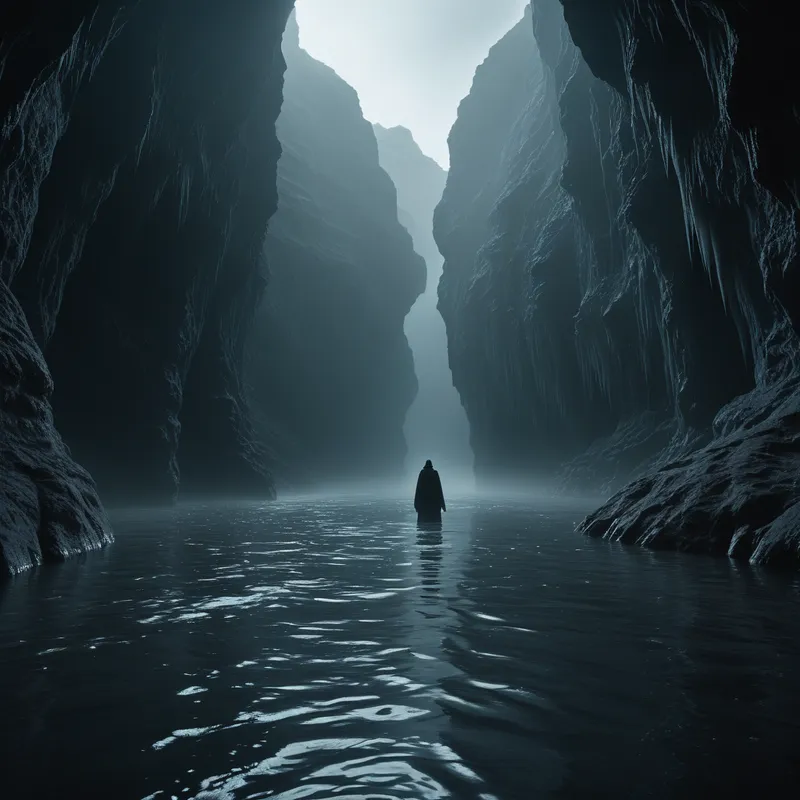
The Mist of Lethe Myth Meaning & Symbolism
The chilling myth of the river of forgetfulness, whose mist erases all memory, forcing souls to drink before rebirth, questioning the essence of self.
The Tale of The Mist of Lethe
Hear now of the final, most profound crossing. Not the journey of the sun, nor the voyage of the hero, but the quiet, inevitable drift into the land where memory itself is undone.
Beyond the grove of whispering poplars, past the adamantine gates where Cerberus keeps his silent, eternal watch, the land of [Hades](/myths/hades “Myth from Greek culture.”/) unfolds in shades of asphodel grey. Here, the souls of the departed wander the fields, their voices a murmur like wind through dry reeds. They are shades, eidola, pale imprints of who they once were. But their journey is not complete. A final river bars [the way](/myths/the-way “Myth from Taoist culture.”/) to the Elysian Fields or the plains of eternal rest.
This is [the river](/myths/the-river “Myth from Buddhist culture.”/) [Lethe](/myths/lethe “Myth from Greek culture.”/)</ab title=“The personification and goddess of oblivion and forgetfulness”>. Its waters do not roar; they do not even seem to flow. They exhale. A cold, clinging mist rises from its surface, a vapour that smells of damp stone and the inside of a long-sealed tomb. It is [the Mist](/myths/the-mist “Myth from Celtic culture.”/) of Oblivion.
The newly arrived soul, still trembling with the echoes of its life—the taste of wine, the warmth of a lover’s touch, the sting of a betrayal, the weight of a child in its arms—approaches the bank. Before them stands [the ferryman](/myths/the-ferryman “Myth from Various culture.”/), Charon, his work done. Now, a gentler, more terrible guide appears: the necessity of the cosmos itself. To enter the fields of peace, one must be made empty. One must be made ready.
The soul kneels. It has no choice. The mist coils around its form, cold tendrils seeping into the very fabric of its being. It cups its hands, and the [water](/myths/water “Myth from Chinese culture.”/), cold as [the void](/myths/the-void “Myth from Buddhist culture.”/) between stars, pools there. As it drinks, the process begins. It is not violent. It is an unmaking, a gentle dissolution. The face of a mother softens, then blurs, then is gone. The memory of a [triumph](/myths/triumph “Myth from Roman culture.”/)—the roar of a crowd, the weight of a crown—fades to a silent, grey blank. The pain of a wound, the joy of a sunrise, the intricate map of a lifetime’s experience… all are drawn out by the mist, siphoned away into the silent river.
The soul straightens. Its eyes, once windows to a complex history, are now calm pools reflecting nothing but the grey twilight. The weight is gone. The story is erased. It is no longer a hero, a villain, a parent, a child. It is simply a soul, pristine and blank, ready to be woven into the tapestry of rebirth or to wander the asphodel in perfect, painless neutrality. The mist closes over the bank once more, holding its secret. Forgetting is complete.

Cultural Origins & Context
The myth of Lethe is not a single story with a plot, but a fundamental piece of eschatological architecture—a belief about the fate of the soul. It finds its most detailed expression in the works of poets like Hesiod and, most pivotally, in Virgil’s Aeneid, where the hero Aeneas descends into [the underworld](/myths/the-underworld “Myth from Greek culture.”/) and witnesses the souls drinking from the river before being reborn. Earlier Greek sources, including Plato in his Republic, [reference](/myths/reference “Myth from Global/Universal culture.”/) the “Plain of Lethe” as part of the soul’s cyclical journey.
This concept served a profound societal and psychological function. For the ancient Greeks, memory ([mnemosyne](/myths/mnemosyne “Myth from Global/Universal culture.”/)) was sacred, the mother of [the Muses](/myths/the-muses “Myth from Greek culture.”/). To forget was a kind of death. The myth of Lethe provided an answer to the terrifying question of what happens to [the self](/myths/the-self “Myth from Jungian culture.”/) after physical death. It proposed a cosmic hygiene: the painful, burdensome, and identity-forming memories of a single lifetime must be cleansed to allow for a new beginning. It framed [reincarnation](/myths/reincarnation “Myth from Hindu culture.”/) not as a simple transfer, but as a necessary purification. The myth was told in mystery cults, like the Eleusinian Mysteries, and by poets, offering initiates and listeners a map of the afterlife that promised both [justice](/myths/justice “Myth from Tarot culture.”/) and mercy—justice through the sorting of souls, and mercy through the gift of forgetfulness.
Symbolic Architecture
The Mist of Lethe is arguably one of the most potent psychological symbols ever conceived. It represents the unconscious mind’s [capacity](/symbols/capacity “Symbol: A measure of one’s potential, limits, or ability to contain, process, or achieve something, often reflecting self-assessment or external demands.”/) for necessary forgetting.
The river Lethe is not a punishment, but a mercy. It is the psyche’s own profound wisdom that some memories must dissolve so that the core of being can remain intact.
The “[water](/symbols/water “Symbol: Water symbolizes the subconscious mind, emotions, and the flow of life, representing both cleansing and creation.”/)” is not merely a liquid but the substance of [dissolution](/symbols/dissolution “Symbol: The process of breaking down, dispersing, or losing form, often representing transformation, release, or the end of a state of being.”/). The “mist” is the agent of this process—pervasive, gentle, and utterly thorough. It symbolizes the way [trauma](/symbols/trauma “Symbol: A deeply distressing or disturbing experience that overwhelms the psyche, often manifesting in dreams as unresolved emotional wounds or psychological injury.”/), overwhelming joy, or even the simple [accretion](/symbols/accretion “Symbol: The gradual accumulation and layering of material over time, often forming larger structures through natural processes like sedimentation or cosmic dust collection.”/) of lived experience can be submerged beneath [the threshold](/myths/the-threshold “Myth from Folklore culture.”/) of conscious recall to protect the integrity of [the ego](/myths/the-ego “Myth from Jungian culture.”/). The [soul](/symbols/soul “Symbol: The soul represents the essence of a person, encompassing their spirit, identity, and connection to the universe.”/) drinking represents the self acquiescing to a force greater than individual will—the archetypal process of [death](/symbols/death “Symbol: Symbolizes transformation, endings, and new beginnings; often associated with fear of the unknown.”/) and [rebirth](/symbols/rebirth “Symbol: A profound transformation where old aspects of self or life die, making way for new beginnings, growth, and renewal.”/).
Psychologically, Lethe is the [shadow](/symbols/shadow “Symbol: The ‘shadow’ embodies the unconscious, repressed aspects of the self and often represents fears or hidden emotions.”/) [sister](/symbols/sister “Symbol: The symbol of a sister in a dream often represents connection, support, and the complexities of familial relationships.”/) of Mnemosyne. If [Memory](/symbols/memory “Symbol: Memory symbolizes the past, lessons learned, and the narratives we construct about our identities.”/) gives [birth](/symbols/birth “Symbol: Birth symbolizes new beginnings, transformation, and the potential for growth and development.”/) to art, [history](/symbols/history “Symbol: History in dreams often represents the dreamer’s past experiences, lessons learned, or unresolved issues that continue to influence their present.”/), and [identity](/symbols/identity “Symbol: Identity represents the sense of self, encompassing personal beliefs, cultural background, and social roles.”/), Forgetting makes [space](/symbols/space “Symbol: Dreaming of ‘Space’ often symbolizes the vastness of potential, personal freedom, or feelings of isolation and exploration in one’s life.”/) for new [life](/symbols/life “Symbol: The symbol of ‘Life’ represents a journey of growth, interconnectedness, and existential meaning, encompassing both the joys and challenges that define human experience.”/), for healing, and for the dissolution of a fixed and potentially paralyzing self-concept. The myth posits that to be eternally defined by one’s past is a kind of hell. Liberation requires a return to the [tabula rasa](/myths/tabula-rasa “Myth from Alchemical culture.”/), the blank slate.
The Dreamer’s Resonance
When the Mist of Lethe drifts into modern dreams, it rarely appears as a classical river. Its presence is felt in the sensation of erasure. A dreamer may find themselves in a familiar house where rooms suddenly have no doors, or they may look at the faces of loved ones which blur and become featureless. They might be trying to speak a crucial piece of information, but their voice makes no sound, or the words dissolve as they are formed.
These dreams signal a somatic and psychological process of dissociation and integration. The [psyche](/myths/psyche “Myth from Greek culture.”/) is actively metabolizing an experience that is too potent, too complex, or too painful to hold in conscious awareness. The “mist” is the dreaming mind’s way of applying a psychic anesthetic, creating a buffer between the conscious ego and the raw material of the unconscious. It is not a sign of failure, but of a deep, self-protective process at work. The dreamer is not losing themselves; they are being temporarily un-made so that a new configuration of the self can eventually coalesce. The anxiety in such dreams is the ego’s protest against its own necessary temporary dissolution.

Alchemical Translation
In the alchemical journey of individuation—the process of becoming one’s whole, unique self—the Mist of Lethe models the crucial stage of mortificatio and [solutio](/myths/solutio “Myth from Alchemical culture.”/): death and dissolution. The modern individual does not drink from a literal river, but confronts their own personal Lethe in therapy, in crisis, in meditation, or in profound life transitions.
The alchemical work is to not just drink the water of Lethe, but to later distill from that very mist the aqua permanens—the permanent water of true, integrated self-knowledge.
The first step is the courageous descent: acknowledging the parts of one’s history, identity, and self-narrative that are burdensome, outgrown, or founded on trauma. The “drinking” is the act of letting these identifications go—releasing the story of “I am my trauma,” “I am my past success,” or “I am what they said I was.” This is a terrifying ego-death. The mist rises, and for a time, one may feel a profound emptiness, a loss of direction, a sense of being unmoored. This is the psychic plain of asphodel.
But the alchemical secret, hinted at in the myth’s connection to rebirth, is that this dissolution is not an end. It is a purification. The memories are not destroyed; their affective charge and their power to tyrannize the present self are neutralized. From the blankness, a new consciousness can form—one that is not defined by the past, but informed by it, free to choose its own essence. The individual who has faced their Lethe does not become a blank shade. They become a sage who remembers everything but is enslaved by nothing, having transmuted the mist of forgetfulness into the clear water of wisdom. They have achieved not amnesia, but a liberated relationship to their own story.
Associated Symbols
Explore related symbols from the CaleaDream lexicon: