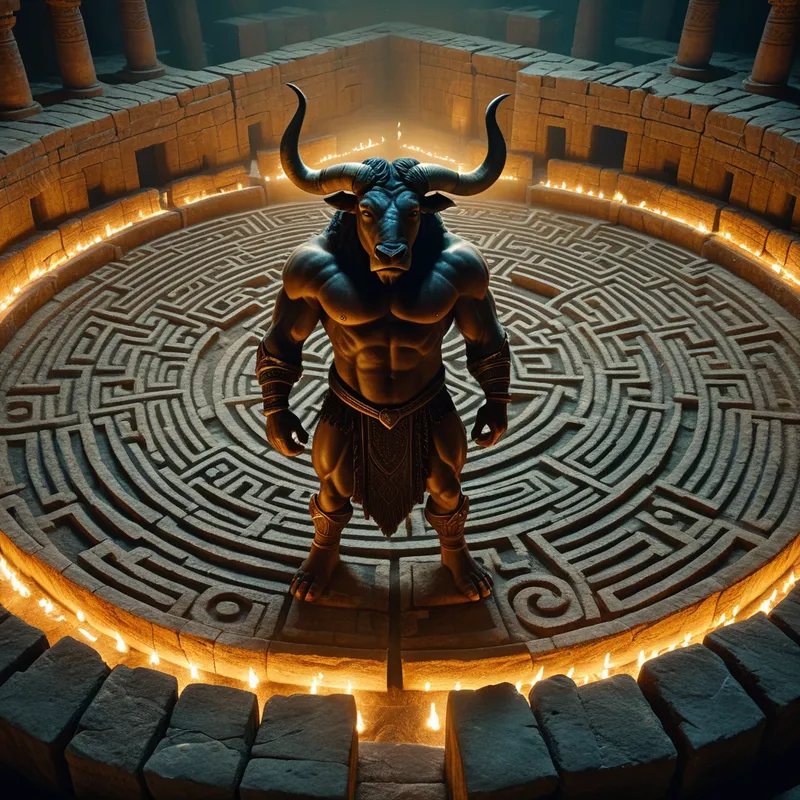
The Minotaur in the Labyrinth Myth Meaning & Symbolism
A monstrous half-man, half-bull is imprisoned in a maze, demanding human tribute, until a hero descends to face the beast and reclaim his soul.
The Tale of The Minotaur in the Labyrinth
Hear now a tale of stone and sorrow, of a curse born from the sun and the sea. In the age when gods walked close to mortals, Minos of Crete prayed to Poseidon for a sign of his rightful kingship. From the frothing waves, the god sent a bull, magnificent and white as sea-foam, a sacred gift to be sacrificed in his honor. But Minos’s heart was seized by greed; the bull was too beautiful to kill. He kept it, and sacrificed another in its place.
The sea is not so easily cheated. In divine wrath, Poseidon worked a terrible magic upon Pasiphaë, the queen, filling her with an unnatural, burning passion for the white bull. From their cursed union was born a creature of nightmare: Asterion, the Minotaur. His body was the powerful trunk of a man, but his head was that of a bull, and in his eyes shone a terrible intelligence, a soul trapped between natures. His roar was not of beast nor man, but of profound, exiled anguish.
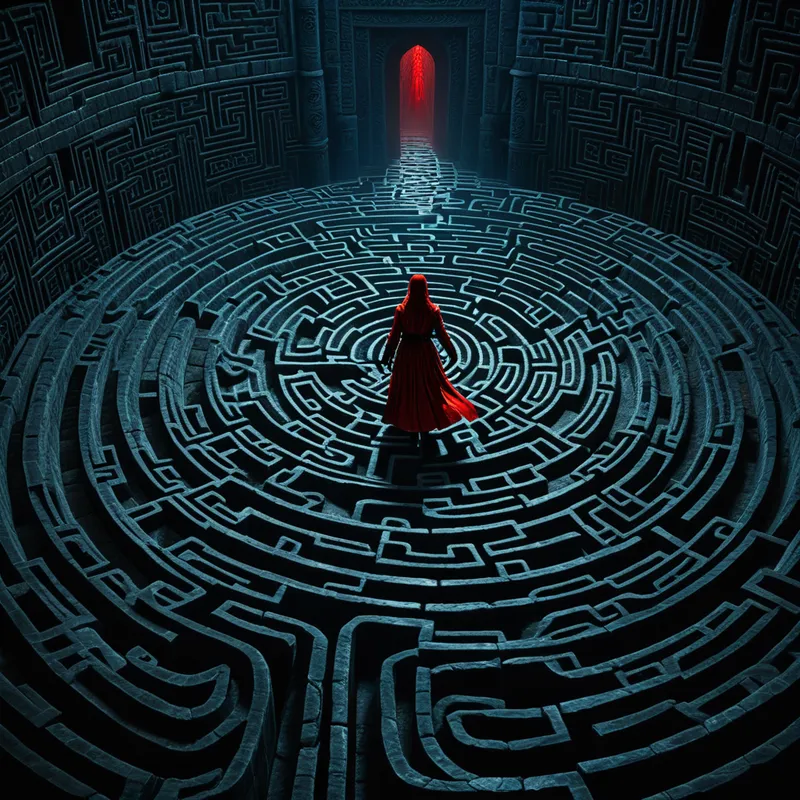
Shamed and terrified, Minos summoned the legendary artisan Daedalus, commanding him to build a prison from which the monster could never escape. Daedalus, in his genius, conceived not a cage but a labyrinth. A place of endless, winding passages, where walls of cold stone turned back upon themselves, where light died and sound was swallowed. Into this stone intestine, the Minotaur was cast, a secret at the heart of the kingdom.
But a monster must feed. When Minos’s son was killed in Athens, the king levied a cruel tribute: every nine years, seven Athenian youths and seven maidens were sent into the labyrinth’s mouth, lost to the darkness, to sate the Minotaur’s hunger. The labyrinth became a living tomb, its silence broken only by the scuffle of fearful feet and the eventual, inevitable bellow from the dark.
Then came the third tribute, and with it, a prince named Theseus. He volunteered to be among the sacrifices, vowing to end the horror. In Crete, Ariadne, seeing his noble bearing, was smitten. She gave him two gifts before he entered the stone throat of the maze: a sword to slay the beast, and a skein of glittering thread. “Tie one end here,” she whispered at the entrance, “and unwind it as you go. It will be your memory, your path back from forgetting.”
Theseus descended. The air grew thick and stale. Torchlight flickered against the endless, identical corridors, casting dancing, mocking shadows. The world narrowed to stone, silence, and the pounding of his own heart. Deeper and deeper he went, following the thread of hope, until he reached the silent, dusty center. There, in the gloom, the Minotaur waited. The fight was not with a mindless beast, but with a powerful, tragic embodiment of rage and isolation. With Ariadne’s gifts—the clue of consciousness and the blade of decisive action—Theseus prevailed. The monster fell. Then, hand over hand, he followed the slender, life-giving thread back through the winding darkness, leading the other Athenians out of the maze and into the blinding, liberating light of the sun.
Cultural Origins & Context
This is a core myth of the ancient Minoan and later Mycenaean world, preserved for us primarily through the epic cycles and the later compilations of writers like Ovid. It functioned as a foundational narrative for the Athenian city-state, explaining their historical (or perceived) subjugation to Minoan Crete and celebrating their eventual ascendancy through the figure of Theseus. The story was told in rituals, depicted on pottery, and performed in dramas, serving as a powerful metaphor for the civilized Greek world’s struggle against chaos, barbarism, and the terrifying, archaic forces of nature and the unconscious that preceded the Olympian order. It was a tale of political identity, but also, profoundly, a map of the human condition.
Symbolic Architecture
The myth’s power lies in its perfect, terrifying symbology. The Labyrinth is not merely a prison; it is the convoluted structure of the unconscious psyche itself. It is the maze of our own repressed traumas, shame, and unintegrated instincts—a place where one can be lost forever in repetition and confusion.
The monster is not at the end of the maze; the maze grows from the monster. It is the architectural manifestation of a psychic state.
The Minotaur is the ultimate shadow figure. Born of a transgression against the divine (Poseidon) and a perversion of natural love, it represents the bestial, instinctual, and “monstrous” half of our nature that society, family, or our own ego seeks to hide away. It is our rage, our primal sexuality, our untamed power—denied, imprisoned, and left to fester in the dark, where it inevitably turns destructive, demanding a bloody tribute from our conscious lives.
Theseus represents the ego-consciousness that voluntarily descends into this inner chaos. His weapons are crucial: the sword of discernment and the thread of Ariadne, which symbolizes the theoria—the guiding insight, the plan, the connection to the outer world (often seen as the anima, or soul-connection) that prevents total dissolution in the unconscious. The victory is not the annihilation of the instinct, but the conscious confrontation with it.
The Dreamer’s Resonance
When this myth stirs in modern dreams, the dreamer is at a critical juncture of inner confrontation. Dreaming of being lost in a maze, office complex, or endless hallway signals a feeling of psychic entrapment—caught in the winding logic of a problem, a relationship, or a depressive state with no visible exit. The somatic feeling is one of mounting anxiety, tightness in the chest, and a desperate search for orientation.
To dream of the Minotaur itself—whether as a pursuing figure, a silent presence behind a door, or even as the Minotaur—is a direct encounter with the embodied shadow. This is not a nightmare to be merely survived, but a profound call. The psyche is presenting the very thing that has been walled away, saying, “This, too, is part of you. You must turn and face it, or remain forever lost in the labyrinth of your own avoidance.” The dream is an initiatory threshold.
Alchemical Translation
The myth models the alchemical nigredo and albedo of individuation. The voluntary descent into the labyrinth is the nigredo: the confrontation with the blackness, the chaotic, rotting material of the un-lived life (the sacrificed youths and maidens). The Minotaur is the prima materia, the rejected, base substance that holds the key to transformation.
The hero does not bring light into the darkness; he discovers that the darkness itself holds a form that must be seen and named.
Slaying the Minotaur is not a act of murder, but of psychic integration. It is the moment of seeing the shadow clearly, naming its power, and, through conscious struggle, depriving it of its autonomous, terrifying control. The sword is the cutting power of consciousness itself, making a distinction: “This energy is mine, but I am not only this energy.”
The return by the thread is the albedo. It is the reintegration of the conscious ego, now tempered and informed by its encounter with the depths. The hero emerges not just from a physical maze, but from the identification with a single, “acceptable” self-image. He has reclaimed the vital, instinctual power (the bull-nature) that was imprisoned, freeing it to be used consciously rather than acted out compulsively. The labyrinth remains, but it is no longer a prison. It becomes a map of the soul’s complexity, a sacred space within, whose center is not a monster to be feared, but a source of transformative power to be known.
Associated Symbols
Explore related symbols from the CaleaDream lexicon: