The Mill of Hospitality Myth Meaning & Symbolism
A divine king's magical mill provides endless bounty, but when its sacred laws are broken, the world is plunged into a winter of the soul.
The Tale of The Mill of Hospitality
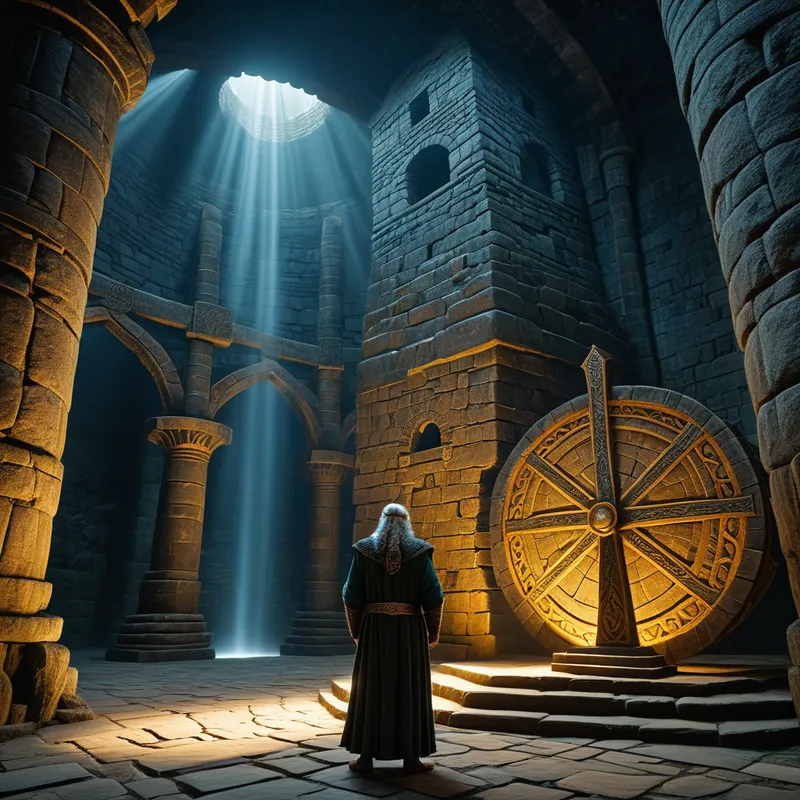
In the time when [the world](/myths/the-world “Myth from Tarot culture.”/) was younger and [the veil](/myths/the-veil “Myth from Various culture.”/) between the lands was thin, there ruled a king whose name was a blessing. He was [Nuada](/myths/nuada “Myth from Celtic culture.”/) Airgetlám, of the shining Tuatha Dé Danann. In his hall of timeless twilight, a treasure beyond gold was kept: the Mill of Hospitality.
It was no ordinary mill. Fashioned by the hands of the gods themselves, its stones were carved from the bedrock of [the Otherworld](/myths/the-otherworld “Myth from Celtic culture.”/). It required no oxen to turn it, no mortal hand to feed it. It answered only to the sovereign word of the true king, and its function was the purest magic: to grind out whatever the host and his people most desired. In times of peace, it ground sweet, golden grain for feasting. For a poet in need of inspiration, it might grind the dust of ancient stars into verse. For a healer, it produced rare herbs that bloomed only in dreams.
[The law](/myths/the-law “Myth from Biblical culture.”/) of the Mill was the law of the king’s own heart: it must only be turned for the sake of the tribe, for the strengthening of the bond between host and guest, for the nourishment of the whole. Under Nuada’s just and generous hand, the mill hummed with a low, contented song, and the land knew no winter of the spirit. Bounty flowed as freely as [water](/myths/water “Myth from Chinese culture.”/), and hospitality was not a custom but the very rhythm of life.
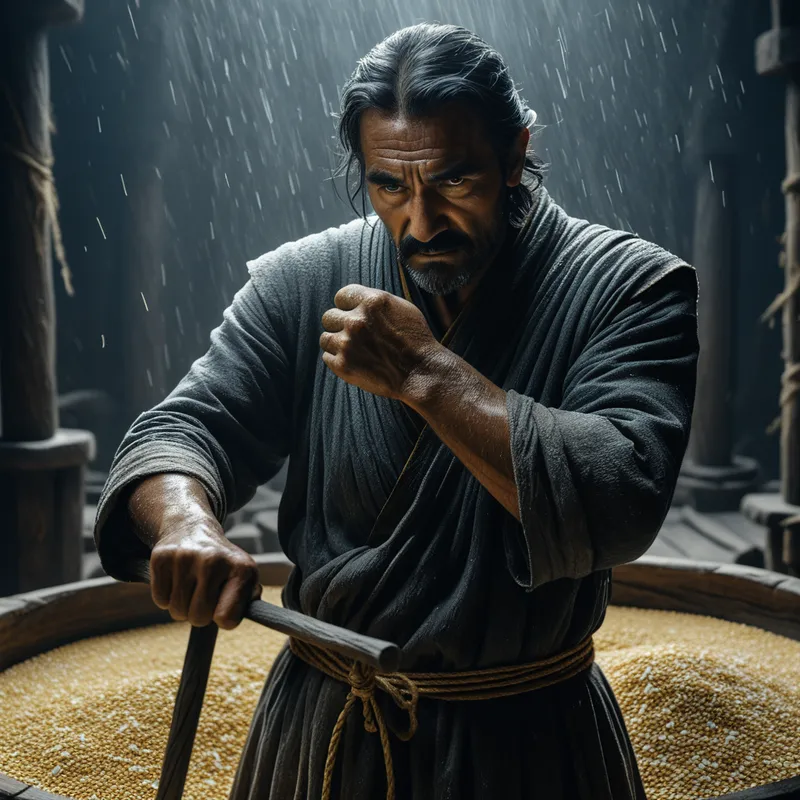
But kings are mortal in their temptations, and even divine halls can hear the whisper of a crooked thought. There came a man—a warrior of renown but hollow heart—who saw not the Mill’s sacred purpose, but only its infinite potential. He saw a tool for limitless gain. In the deep watch of the night, when the hall slept under a spell of contentment, this man crept to the Mill. His hands, used to gripping sword hilts, closed around the handle meant only for a king’s touch.
He did not wish for feast or healing or song. His desire, hissed into the silent air, was for gold. For wealth untold, for treasure to hoard in a dark pit where no guest would ever see it. He put his shoulder to the task and began to grind.
For a moment, the Mill obeyed. From its mouth poured a river of bright gold coin, a clattering, gleaming cascade that filled the floor. The man laughed, a sound like cracking ice. But the Mill, an instrument of cosmic balance, sensed the rupture in the sacred law. The gold began to tarnish, to blacken. [The river](/myths/the-river “Myth from Buddhist culture.”/) of coin thinned, and then from the same mouth came a new grinding—a sound of tearing, of bones breaking. What poured forth then was not gold, but a blight of grey, lifeless ash. Then salt, bitter and barren. Finally, a cold, white dust that was the essence of frost itself.
The song of the Mill became a shriek that shattered the peace of the hall. The endless summer within its walls died. A winter, deeper than any known, fell instantly. [The hearth](/myths/the-hearth “Myth from Norse culture.”/) fires guttered out. The laughter on the faces of the sleeping feasters froze. The bounty of the land locked itself under an invisible ice.
And the Mill fell silent. Its great stones, now cold and inert, would answer to no one. The price of turning it toward a private, hungry heart was the end of its turning altogether. The warrior was left standing in a hall of ghosts and frost, surrounded by the cursed, frozen proof of his desire, as the long night began.
Cultural Origins & Context
This haunting parable is preserved primarily in early medieval Irish texts, a fragment of the vast, orally-transmitted mythological corpus of the Insular Celts. It belongs not to the grand cycles of epic heroes like Cú Chulainn, but to the Mythological Cycle, which deals with the foundational acts of the otherworldly beings who shaped Ireland’s destiny. The story would have been told by fili, the poet-seers who were the custodians of history, law, and sacred lore.
Its function was deeply societal. In a culture where a leader’s worth was measured by his fír flathemon (the ruler’s truth), and where hospitality (oíged) was a sacred, legally-enforced duty, the myth served as a powerful teaching tool. It illustrated the cosmic consequences of violating the core social contract. The Mill is the symbol of the king’s sovereignty—it is the prosperity of the land itself, which flourishes only when the ruler’s will is aligned with the collective good. To pervert it for private gain is to break the world.
Symbolic Architecture
The Mill is a profound [symbol](/symbols/symbol “Symbol: A symbol can represent an idea, concept, or belief, serving as a powerful tool for communication and understanding.”/) of the generative principle of the [psyche](/myths/psyche “Myth from Greek culture.”/) and the [cosmos](/symbols/cosmos “Symbol: The entire universe as an ordered, harmonious system, often representing the totality of existence, spiritual connection, and the unknown.”/). It represents the transformative engine that turns the raw [material](/symbols/material “Symbol: Material signifies the tangible aspects of life, often representing physical resources, desires, and the physical world’s influence on our existence.”/) of experience ([grain](/symbols/grain “Symbol: Represents sustenance, growth cycles, and the foundation of civilization. Symbolizes life’s harvest, patience, and transformation from seed to nourishment.”/)) into the nourishing substance of [life](/symbols/life “Symbol: The symbol of ‘Life’ represents a journey of growth, interconnectedness, and existential meaning, encompassing both the joys and challenges that define human experience.”/) (flour). It is the alchemical [vessel](/symbols/vessel “Symbol: A container or structure that holds, transports, or protects something essential, representing the self, emotions, or life journey.”/) where potential becomes actual.
The Mill of Hospitality is the soul’s own capacity to metabolize the world into meaning, a process that must serve the whole self, not a single craving.
Nuada, the rightful [king](/symbols/king “Symbol: A symbol of ultimate authority, leadership, and societal order, often representing the dreamer’s inner power or external control figures.”/) with the silver hand, symbolizes the integrated ruler of the inner [kingdom](/symbols/kingdom “Symbol: A kingdom symbolizes authority, belonging, and a sense of identity within a larger context or community.”/). His silver [prosthesis](/symbols/prosthesis “Symbol: An artificial device replacing a missing body part, symbolizing adaptation, loss, and the integration of external support into one’s identity.”/)—replacing a hand lost in battle—signifies that true sovereignty often arises from a prior wound or limitation, integrated into a new, purposeful wholeness. He is the conscious ego in service to [the Self](/myths/the-self “Myth from Jungian culture.”/), turning the Mill in [harmony](/symbols/harmony “Symbol: A state of balance, agreement, and pleasing combination of elements, often associated with musical consonance and visual or social unity.”/) with the deeper, archetypal laws.
The greedy [warrior](/symbols/warrior “Symbol: A spiritual archetype representing inner strength, discipline, and the struggle for higher purpose or self-mastery.”/) represents the unintegrated [shadow](/symbols/shadow “Symbol: The ‘shadow’ embodies the unconscious, repressed aspects of the self and often represents fears or hidden emotions.”/): the part of the psyche that seeks to hijack the transformative process for the aggrandizement of a single complex—greed, power, narcissism. His act is not one of creation, but of exploitation. The Mill’s [response](/symbols/response “Symbol: Response in dreams symbolizes how one reacts to situations, often reflecting the subconscious mind’s processing of events.”/)—turning gold to ash, to [salt](/symbols/salt “Symbol: Salt represents purification, preservation, and the essence of life. It is often tied to the balance of emotions and spiritual cleansing.”/), to frost—is the psyche’s inevitable [reaction](/symbols/reaction “Symbol: A reaction in a dream signifies the subconscious emotional responses to situations we face, often revealing our coping mechanisms and fears.”/) to such a violation. When the life-giving process is forced to serve a dead-end desire, its [product](/symbols/product “Symbol: This symbol represents tangible outcomes of one’s efforts and creativity, often reflecting personal value and identity.”/) becomes [death](/symbols/death “Symbol: Symbolizes transformation, endings, and new beginnings; often associated with fear of the unknown.”/): ash (the end of life), [salt](/symbols/salt “Symbol: Salt represents purification, preservation, and the essence of life. It is often tied to the balance of emotions and spiritual cleansing.”/) (preservation without growth, [sterility](/symbols/sterility “Symbol: Represents inability to create, grow, or produce, often linked to emotional barrenness, creative blocks, or existential emptiness.”/)), and frost (emotional and spiritual coldness).
The Dreamer’s Resonance
When this myth stirs in the modern unconscious, it often manifests in dreams of broken or perverted machinery. One might dream of a beloved family kitchen—the heart of nourishment—where the oven now burns everything to cinder, or the refrigerator spews out only spoiled food. The dreamer may find themselves compulsively operating a device that produces something worthless or harmful, filled with a sense of dread but unable to stop.
Somatically, this can correlate with a feeling of “grinding oneself down”—chronic fatigue, digestive issues (the body’s own mill refusing to properly process nourishment), or a pervasive emotional coldness. Psychologically, it signals that the dreamer’s innate capacities for creativity, care, or generosity are being misdirected. They are “grinding” not for genuine sustenance or shared joy, but to feed an insatiable, isolating complex: perhaps workaholism for empty prestige, people-pleasing for validation, or artistic output for cynical gain. The dream is an alarm: the inner Mill is seizing up, and a winter of the soul is imminent.

Alchemical Translation
The myth charts the complete cycle of psychic alchemy, from the [prima materia](/myths/prima-materia “Myth from Alchemical culture.”/) of naive abundance, through the [nigredo](/myths/nigredo “Myth from Alchemical culture.”/) of catastrophic failure, to the potential for a new integration.
The initial state, with Nuada at the helm, is the psychic condition of healthy inflation. [The ego](/myths/the-ego “Myth from Jungian culture.”/), aligned with the Self, believes in its boundless capacity to give and create. The breaking of the law is the necessary crisis, the shattering of this inflation. It is the moment the individual confronts [the shadow](/myths/the-shadow “Myth from Jungian culture.”/)’s greed, the part that wants to own and hoard the magic for itself.
The freezing of the Mill is not a punishment, but the psyche’s most merciful act of self-preservation. It forces a stop to the pathological process. The resulting winter is the nigredo—the dark night of the soul, where all former nourishment is gone, and one is left alone with the ashes of failed desires.
This winter is [the crucible](/myths/the-crucible “Myth from Alchemical culture.”/) of transmutation. The task for the modern individual is not to find a new warrior to force the Mill back to life, but to become Nuada again—a ruler who has known loss (the silver hand) and failure (the frozen hall). One must approach the silent Mill not with demand, but with atonement. To re-learn the sacred law: the transformative power within must serve the integration and nourishment of the entire inner community—the vulnerable, the creative, the wounded, and the strong—not just the loud, hungry voice of a single ambition.
The grinding that may then begin again will be slower, perhaps, and more conscious. Its first product may not be golden grain, but simply the melting of the inner frost, the first drop of water that signals the return of flow. This is the alchemical gold: not endless bounty, but the restored, sacred function of the Mill itself—the capacity to transform the raw experience of a life, in all its seasons, into a sustenance that truly feeds the soul.
Associated Symbols
Explore related symbols from the CaleaDream lexicon: