The Menorah Myth Meaning & Symbolism
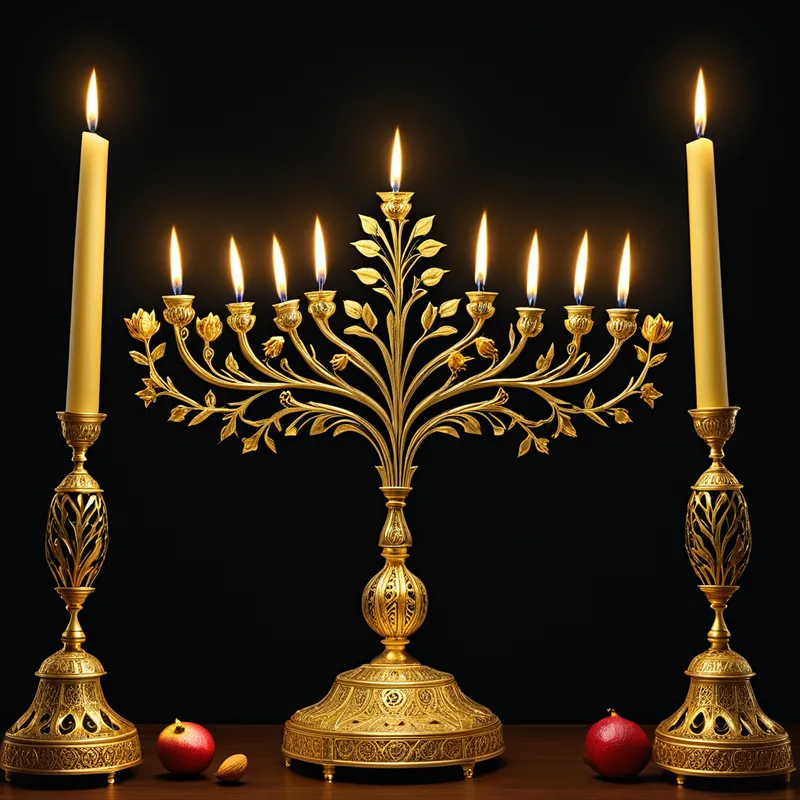
A sacred lampstand of pure gold, divinely revealed, holding seven flames as a testament to the light of wisdom in the heart of the wilderness.
The Tale of The Menorah
In the heart of the great and terrible wilderness, where [the wind](/myths/the-wind “Myth from Various culture.”/) speaks in sand and the sun is a hammer on anvil, a people walked. They were a people born from the furnace, shaped by the brick-kiln of bondage, and now freed into a vastness more terrifying than any chain. They carried with them a trembling promise, a covenant etched not on stone but on the very fabric of their collective soul. And in the center of their wandering camp, a space was cleared, a sacred emptiness veiled by fine linen and goats’ hair.
Into this emptiness, the voice spoke. It was not a sound of thunder, but a pattern of fire, a geometry of light whispered into the mind of [Moses](/myths/moses “Myth from Biblical culture.”/) on the mountain. The voice described a [thing](/myths/thing “Myth from Norse culture.”/) of impossible beauty and precision: a lampstand, but not as any smith had ever forged. It was to be a single, beaten mass of pure gold—no joins, no seams. From its central stem, six branches would ascend, three to the left and three to the right, each curving with the grace of an almond tree in first blossom. Upon these branches would be cups shaped like open almond flowers, with knobs and blossoms wrought in one piece. And there would be seven lamps, so that when lit, the light would shine forward, illuminating the table of presence.
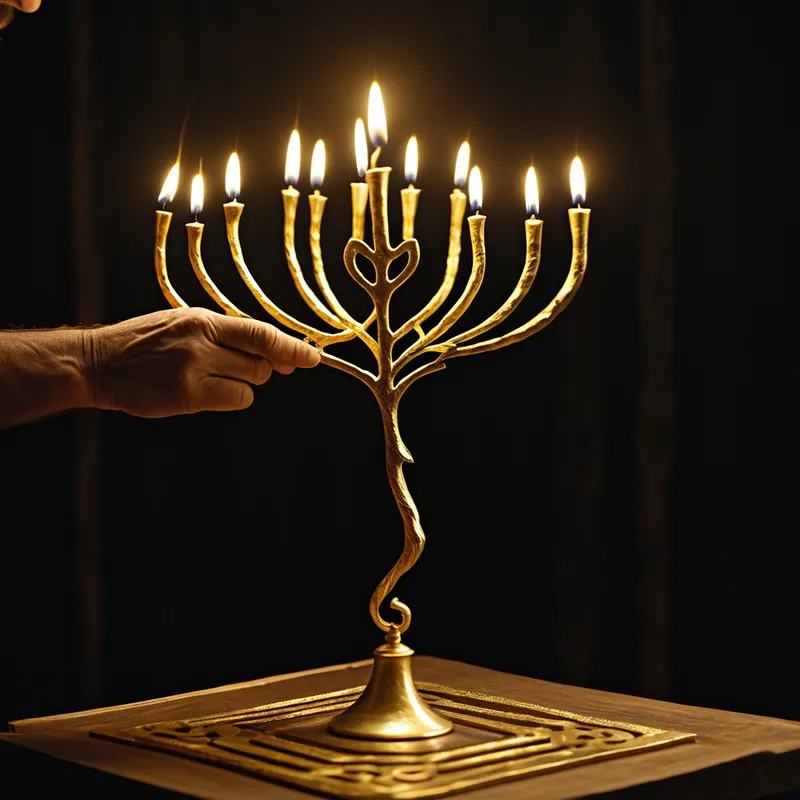
The task fell to Bezalel, a man in whose heart the spirit of wisdom, understanding, and knowledge burned. He took the gold, the offering of a people still shaking off the dust of Egypt. In the quiet of the tent of meeting, with the weight of [the wilderness](/myths/the-wilderness “Myth from Biblical culture.”/) pressing in from all sides, he began to work. There was no model, no clay sketch—only the living blueprint in his spirit. The hammer fell, not in violence, but in a kind of prayer. The gold did not yield like metal; it flowed like liquid light, remembering the shape whispered from the mountain. A stem grew under his hands. Branches unfurled, not welded, but born from the central core. Delicate petals of gold emerged around the cups. It was not construction; it was a careful midwifery of form from formlessness.
When it was done, they placed it in the [Tabernacle](/myths/tabernacle “Myth from Biblical culture.”/), in the outer chamber called the Holy Place. To its south. Before it was the table of [showbread](/myths/showbread “Myth from Biblical culture.”/), the bread of faces. Opposite, [the veil](/myths/the-veil “Myth from Various culture.”/) that trembled before the overwhelming presence of [the Holy of Holies](/myths/the-holy-of-holies “Myth from Biblical culture.”/). And there, in that perpetual twilight, the priests—Aaron and his sons—would tend to it. Each evening, they would clean the wicks, pour the purest beaten olive oil, and light the seven flames. The fire would catch, not with a roar, but with a soft whoosh of surrender. And light would bloom.
It was not a light to see by, not a practical light for mending sandals or reading scrolls. It was a light of witness. In the profound dark of [the desert](/myths/the-desert “Myth from Biblical culture.”/) night, inside the linen walls of the tent, this golden tree of fire stood. Its light fell upon the bread, upon the veil, upon the faces of the priests. It was a silent, burning answer to [the void](/myths/the-void “Myth from Buddhist culture.”/) outside. It said: Pattern exists. Wisdom has a shape. And in the very center of the journey, in the heart of the nomadic chaos, there is a fixed point of illuminated order. The wilderness howled, the people murmured, doubt was a constant companion—but every evening, the [Menorah](/myths/menorah “Myth from Judeo-Christian culture.”/) was lit. Its flames did not dance in frenzy, but burned straight and true, a testament to the pattern that holds [the world](/myths/the-world “Myth from Tarot culture.”/) together, even when, especially when, the world seems most intent on falling apart.
Cultural Origins & Context
The Menorah is not a myth in the classical sense of a narrative about gods and heroes, but it is a foundational symbol-myth, a sacred object whose origin story is woven into the legal and cultic instructions of the Book of Exodus. Its context is the formative moment of Israelite identity: [the Exodus](/myths/the-exodus “Myth from Abrahamic culture.”/) from Egypt and the subsequent covenant at Sinai. This was a culture defining itself in radical opposition to the static, idolatrous monument-culture of Egypt. They were creating a portable holiness, a divinity that journeyed.
The instructions for the Menorah (Exodus 25:31-40) are given as part of the Tabernacle blueprint. It was transmitted orally and in written law, maintained by the priestly caste (Kohanim). Its societal function was multifaceted: it was a central cultic object for the wilderness sanctuary and later the Temple in [Jerusalem](/myths/jerusalem “Myth from Biblical culture.”/); a national symbol (it appears on ancient Judean coins and later as a primary symbol of Jewish peoplehood); and a profound theological statement. In a world where divine images were commonplace, the Menorah represented the presence of the divine through the metaphor of light and wisdom, not through a fixed image. It was a focal point for ritual, ensuring the perpetual light (ner tamid) as a sign of the enduring covenant between the people and their god.
Symbolic Architecture
The [Menorah](/symbols/menorah “Symbol: A seven-branched candelabrum central to Judaism, symbolizing divine light, wisdom, and the enduring covenant between God and the Jewish people.”/) is a map of cosmic and psychic order. Its primary [material](/symbols/material “Symbol: Material signifies the tangible aspects of life, often representing physical resources, desires, and the physical world’s influence on our existence.”/), pure, beaten gold, symbolizes the highest value, incorruptibility, and a [nature](/symbols/nature “Symbol: Nature symbolizes growth, connectivity, and the primal forces of existence.”/) refined through pressure. Being fashioned from a single talent of gold signifies unity and intrinsic wholeness—the divine [source](/symbols/source “Symbol: The origin point of something, often representing beginnings, nourishment, or the fundamental cause behind phenomena.”/) from which all multiplicity emanates is one.
The [number](/symbols/number “Symbol: Numbers in dreams often symbolize meaning, balance, and the quest for understanding in the dreamer’s life, reflecting their mental state or concerns.”/) seven is the key. It is the number of divine completion and cosmic order (the days of creation, the celestial bodies known to antiquity). The seven lamps represent the full [spectrum](/symbols/spectrum “Symbol: A continuum of possibilities, representing diversity, transition, and the full range of existence from one extreme to another.”/) of wisdom, the complete light of [consciousness](/symbols/consciousness “Symbol: Consciousness represents the state of awareness and perception, encompassing thoughts, feelings, and experiences.”/). The six branches plus the central stem (the shamash, or “servant” [lamp](/symbols/lamp “Symbol: A lamp symbolizes guidance, enlightenment, and the illumination of truth, often representing knowledge or clarity in dark times.”/), though this [term](/symbols/term “Symbol: The term often represents boundaries, defined concepts, or experiences that have a specific meaning in a given context.”/) is later) suggest a central, unifying principle from which differentiated aspects emerge.
The Menorah is the archetype of the organized psyche: a central, guiding consciousness (the stem) from which the diverse faculties of intuition, sensation, thinking, and feeling (the branches) extend, each capable of holding the oil of experience and being lit by the spark of spirit.
The almond [blossom](/symbols/blossom “Symbol: A symbol of new beginnings, growth, and the unfolding of potential, often marking a transition or the start of a journey.”/) [motif](/symbols/motif “Symbol: A recurring thematic element, pattern, or design in artistic or musical works, representing underlying ideas or emotional currents.”/) is profoundly significant. The [almond tree](/symbols/almond-tree “Symbol: The almond tree symbolizes resilience and the duality of creation and destruction, often associated with the nurturing aspects of nature.”/) (shaqed) is the first to [bloom](/symbols/bloom “Symbol: Represents growth, vitality, and the flourishing of potential, often tied to emotional awakening or physical health.”/) in late [winter](/symbols/winter “Symbol: Winter symbolizes a time of reflection, introspection, and dormancy, often representing challenges or a period of transformation.”/) in the Levant, a sudden [eruption](/symbols/eruption “Symbol: A sudden, violent release of pent-up energy or emotion from beneath the surface, often representing transformation or crisis.”/) of [life](/symbols/life “Symbol: The symbol of ‘Life’ represents a journey of growth, interconnectedness, and existential meaning, encompassing both the joys and challenges that define human experience.”/) and promise. It symbolizes watchfulness, swift fulfillment, and resurrection. The Menorah is thus not a dead [artifact](/symbols/artifact “Symbol: An object from the past carrying historical, cultural, or personal significance, often representing legacy, memory, or hidden knowledge.”/), but a [tree of life](/symbols/tree-of-life “Symbol: Embodies the interconnectedness of all living things and the cycle of life, death, and rebirth.”/) in perpetual spring, its light a promise fulfilled each evening. The command that its light shine forward indicates that this wisdom is not for introspection alone, but must illuminate the [path](/symbols/path “Symbol: The ‘path’ symbolizes a journey, choices, and the direction one’s life is taking, often representing individual growth and exploration.”/) ahead, the “[table](/symbols/table “Symbol: Tables in dreams often symbolize stability, social interactions, and a platform for discussions, negotiations, or decisions in our waking life.”/)” of daily sustenance and [action](/symbols/action “Symbol: Action in dreams represents the drive for agency, motivation, and the ability to take control of situations in waking life.”/).
The Dreamer’s Resonance
To dream of a Menorah is to dream of one’s own inner structure seeking illumination. It often appears during periods of fragmentation, when the dreamer feels pulled in multiple directions, their energy scattered. The Menorah in a dream can manifest in many forms: a strange, intricate lamp in a childhood home; a tree with lights instead of leaves; a complex diagram that feels vitally important upon waking.
Somatically, this dream pattern correlates with a seeking of centering. There is a psychological process of gathering disparate parts of [the self](/myths/the-self “Myth from Jungian culture.”/)—the competing roles, the unresolved conflicts, the latent talents—and attempting to find the central stem from which they all arise. The lighting of the lamps in a dream can feel like a moment of integration, where a specific insight (one branch) connects to the core self, bringing warmth and visibility to a previously shadowed area. Conversely, a dream of a broken, unlit, or missing Menorah speaks to a crisis of meaning, a feeling that one’s inner guidance system or foundational worldview has failed. The dream-ego is then in the position of Bezalel: tasked with the daunting, spirit-guided work of re-forging that central, unifying symbol from the raw material of one’s own experience.
Alchemical Translation
The myth of the Menorah models the alchemical process of coagulatio—the bringing together of volatile elements into a fixed, enduring, and valuable form. The [psyche](/myths/psyche “Myth from Greek culture.”/) in its natural state is like the wilderness: vast, unstructured, containing both promise and terror. The divine instructions are the call to individuation, the imperative to create an inner sanctuary.
The “single talent of gold” is the [prima materia](/myths/prima-materia “Myth from Alchemical culture.”/), the raw essence of the Self, often buried under the “dust of Egypt”—the complexes, parental influences, and cultural conditioning of one’s personal history. The “beating” of the gold is the necessary suffering and discipline of psychological work—the hammer blows of analysis, the friction of confronting shadow, the heat of intense emotion that makes the psyche malleable.
The alchemical goal is not to become a person with seven separate lights, but to become the Menorah itself: a unified being whose very structure is illumination.
Bezalel, filled with “spirit of God, in wisdom, in understanding, and in knowledge,” represents the synthesizing function of consciousness that can hold the divine blueprint. He is [the ego](/myths/the-ego “Myth from Jungian culture.”/) in service to the Self. The final product, placed in the Holy Place, signifies the establishment of a permanent inner center. The daily tending—cleaning the charred wicks, replenishing the oil—is the ongoing work of mindfulness, self-reflection, and nourishing the soul with “pure beaten oil” (refined experience). The light that shines forward is the fruit of this work: a consciousness that no longer merely reacts to the outer wilderness, but actively illuminates it, revealing pattern, meaning, and a path through the dark. The Menorah does not eliminate the wilderness; it stands steadfast within it, a testament that the deepest order is born from the deepest journey.
Associated Symbols
Explore related symbols from the CaleaDream lexicon: