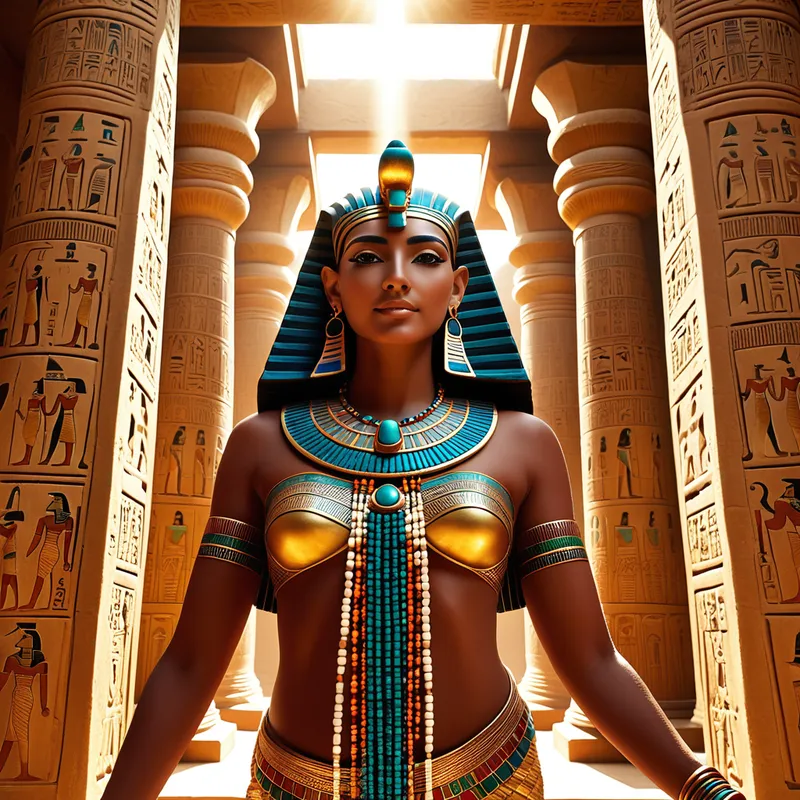
The Menat Necklace Myth Meaning & Symbolism
A sacred necklace wielded by goddesses, the Menat embodies the power to restore cosmic order, soothe chaos, and channel the generative forces of the universe.
The Tale of The Menat Necklace
Hear now the rustle of papyrus in the still, sacred air. Feel the heat of the Ra’s barque as it crests the horizon, and listen…
In the time when the world was young and the gods walked with a foot in the Kemet and a foot in the Duat, there existed a sound. Not a voice, but a resonance—the hum of the universe in balance. This sound was given form by the skilled hands of Thoth, who strung it upon cords of moonlight. He took the laughter of the Inundation, the fierce love of a lioness, the coolness of the northern breeze, and the joyful clamor of the sistrum. These he fashioned into beads of faience, carnelian, and lapis lazuli, each a note in a silent song. At its end, he placed a counterweight, a heavy menat itself, carved with the face of a goddess, a vessel for power.
This was the Menat Necklace. And it was placed in the hands of Hathor, the Golden One.
The conflict did not come with a roar, but with a silence—a crack in the harmony. The serpent Apep, from the depths of primordial darkness, would stir. His stirring was a discordant vibration that threatened to unravel the threads of Maat. The sun barque would falter. Hearts in the land below grew heavy with unrest, dreams turned sour, and the music of life threatened to fall into cacophony.
Then, Hathor would rise. Not with a sword, but with a sway. She would take the heavy Menat in her hands—hands that could cradle a child or summon a storm. She would begin to shake it. A soft rustle at first, like wind through reeds. Then stronger, a rhythmic shush-shush-shush that was the very sound of the cosmos righting itself. The beads would clatter, a counterpoint to the sistrum’s jingle she often carried. This was no mere noise. It was a wave, a tangible force of soothing. It poured over the land like a balm, calming frightened children, settling disputes in the market, and making the Nile’s flow steady and sure. In the celestial realm, the sound would reach the barque of Ra, strengthening its path against the chaos. The Menat’s power was the power of presence, of resonant, nurturing authority that did not destroy disorder, but embraced and transmuted it back into the song.
And in the hall of the dead, her father Osiris, the Green One, would feel its vibration. The Menat’s energy was one of restoration, a promise of renewal that echoed his own resurrection. The conflict was not slain; it was sung back to sleep. The resolution was not an end, but a return—a deep, collective exhale. The world, once more, hummed in tune.
Cultural Origins & Context
The Menat was not merely jewelry; it was a ritual instrument, a theological concept made wearable and wieldable. Its primary domain was the cult of Hathor, but it was also associated with other goddesses like Sekhmet (Hathor’s fierce aspect) and was offered to gods to invoke their generative, protective power. It was passed down not as a single, codified “myth” in the Greek sense, but as a living practice embedded in temple ritual, festival processions, and funerary rites.
Priestesses of Hathor, often of high royal status, would wear and shake the Menat during ceremonies to invoke the goddess’s presence, to bless, and to protect. In funerary contexts, the Menat was placed with the deceased—both men and women—as a tool of empowerment and a guarantee of rebirth, its nurturing energy meant to sustain the soul in the Duat. Its societal function was multifaceted: it was a symbol of divine authority channeled through feminine principle, a tool for maintaining cosmic and social order (Maat), and a tangible link between the joy of earthly life (music, fertility) and the solemnity of the eternal cycle.
Symbolic Architecture
The Menat is a perfect symbol of dynamic, embodied balance. Its form reveals its function: the heavy counterpoise (menat) represents the concentrated, potent source of power—the divine will, the stored potential, the deep, often unconscious, well of life force. The many strands of beads represent the manifestation of that power into the myriad complexities of the world—individual lives, events, sounds, and sensations.
To hold the Menat is to hold the tension between the singular, potent source and the plural, diverse expression. The power is not in the beads alone, nor the counterweight alone, but in the connection between them.
Psychologically, the Menat represents the archetype of the Nurturing Transformer. It is not the warrior who confronts chaos with violence, but the caregiver who meets disintegration with a resonant, rhythmic presence. The “conflict” with Apep symbolizes any force of psychic entropy: depression, anxiety, fragmentation, or meaninglessness. The Menat’s solution is not eradication, but resonance. It shakes the system, introducing a frequency of order, care, and life-affirmation that allows the chaotic elements to re-sync into a functional whole.
The Dreamer’s Resonance
When the pattern of the Menat appears in modern dreams, it often signals a process of psychic integration through nurturing authority. The dreamer may not see the necklace itself, but feel its themes.
One might dream of holding a heavy, beautiful object that feels both burdensome and empowering, unsure how to “use” it. This somatic sensation points to the dreamer encountering a source of personal power (a talent, a responsibility, a deep emotion) that feels unwieldy. The psyche is grappling with how to wield this power effectively, without being weighed down by it.
Another common pattern is dreaming of producing a sound or vibration that calms a turbulent environment—singing to quiet a storm, or a hum that mends broken glass. This is the Menat’s function in action: the dream ego is discovering its innate capacity to soothe internal or external chaos not by force, but by emitting its own authentic frequency of stability and care. The dream is a rehearsal for claiming one’s role as a restorer of inner Maat.

Alchemical Translation
The alchemical journey modeled by the Menat is one of transmutation through resonant care, a crucial, often overlooked stage in individuation. Our modern heroic impulse is often to “slay the dragon.” The Menat proposes an alternative: to sing the dragon to sleep, to integrate its energy.
The first operation is Recognizing the Counterpoise (The Source). This is identifying one’s own inner “weight”—the core values, the deep wounds, the ancestral strength, the authentic self that grounds us. It is often felt as a burden before it is recognized as a source of power.
The second is Stringing the Beads (The Manifestation). This is the conscious act of connecting that core source to the disparate elements of one’s life—relationships, work, creativity, daily habits. Each bead is an aspect of the self that must be linked back to the center.
The alchemy occurs in the shaking—the active, rhythmic application of the connected self to the areas of chaos. It is the practice of bringing one’s whole, resonant being to bear on fragmentation.
The final stage is Becoming the Channel. This is where the individual no longer just uses the Menat but becomes the instrument through which restorative harmony flows. The personal struggle for inner order becomes a capacity to contribute to order in the outer world, not from a place of egoic control, but from a place of aligned, nurturing resonance. The individual becomes a living Menat, a focal point where the weight of being is transformed into the music of becoming. They do not escape chaos; they learn to hold it, and through their steadfast, caring vibration, remind it how to return to the song.
Associated Symbols
Explore related symbols from the CaleaDream lexicon: