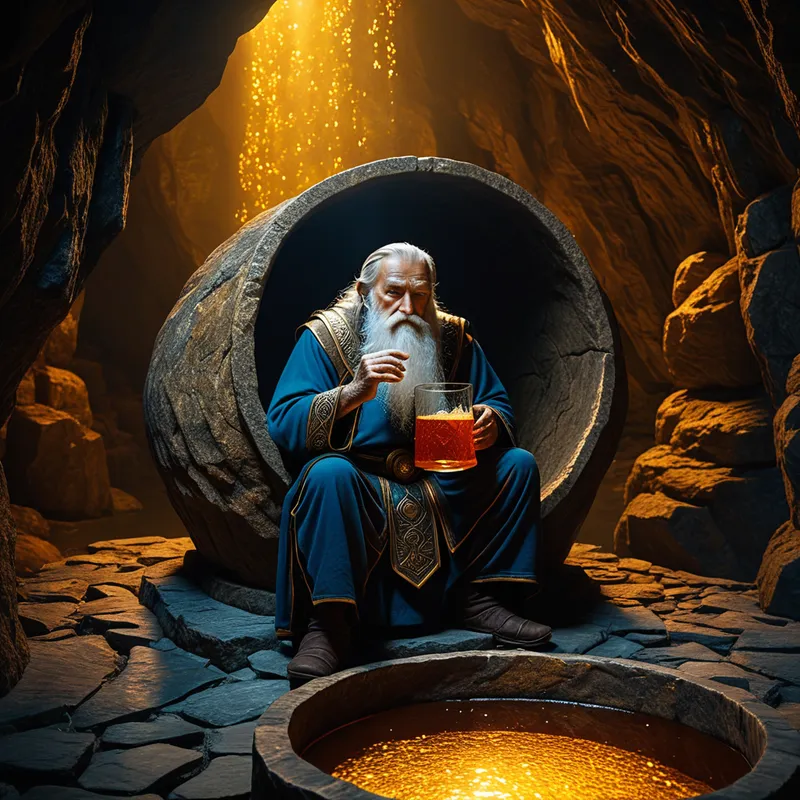
The Mead of Poetry Myth Meaning & Symbolism
A myth of stolen divine mead, brewed from blood and wisdom, granting poetic inspiration to those cunning and brave enough to seize it.
The Tale of The Mead of Poetry
Listen. This is a story of blood, betrayal, and the birth of song. It begins not with a god, but with a truce, and with treachery.
After the great war between the Æsir and the Vanir, the deities spat into a vat to seal their peace. From that mingled spittle, they fashioned a being of such profound wisdom they named him Kvasir. He wandered the nine worlds, answering every question posed to him. His wisdom was a light that drew dark moths. Two dwarven brothers, Fjalar and Gjalar, invited him to their shadowed hall. They did not seek his counsel. With cold iron, they slew him where he stood. They drained his blood, his essence, into two wondrous vats, Són and Boðn, and a pot called Óðrerir. They mixed the blood with honey, and a fermentation began—not of grain, but of genius itself. This was the first brewing of the Mead of Poetry.
The dwarves’ cunning was their curse. They soon offered hospitality to a giant, Gilling, and drowned him in a cruel jest. In revenge, the giant’s son, Suttungr, seized the brothers and marooned them on a reef at low tide. For their lives, they bartered the only treasure they had: the mead. Suttungr took it, carried it deep into the heart of the mountain Hnitbjörg, and set his daughter, Gunnlod, to watch over it. There it sat, a lake of liquid inspiration, locked in stone.
Word of this treasure reached the high seat of Odin. The god of ecstasy, of the fury of poetry, could not abide such a hoard. He took up his staff, donned a broad-brimmed hat, and walked into the world of men as Bölverk, the Worker of Misfortune. He came to a field where nine thralls scythed hay. With a whetstone from his pouch, he sharpened their scythes until they sang. They begged to buy it. He tossed it into the air. In their greed, they cut each other’s throats upon the blade.
Using this grim deed as his price, Odin secured work for the season with the thralls’ master, Baugi, Suttungr’s brother. His task: a single man’s work. Odin labored as a giant, and when the season ended, he asked for a single sip of Suttungr’s mead as his wage. Baugi, reluctant, agreed. They journeyed to Hnitbjörg. Baugi drilled into the mountain with an auger, claiming the rock was pierced. Odin, ever suspicious, blew into the hole. Stone dust blew back. He made Baugi drill true. This time, the dust flew inward. In an instant, Odin shifted his shape. He became a serpent, a slick, dark ribbon of life, and slithered into the dank, dark borehole.
He emerged into a cavern lit by the mead’s own golden glow. There sat Gunnlod, guardian of the deeps. For three nights, the wanderer stayed. He spoke not as a thief, but as a guest, perhaps even a lover. He offered her his stories, his presence, his attention. In return, she granted him three drinks. With the first, he drained the vat Són. With the second, Boðn was emptied. With the third, he consumed all that was in Óðrerir. The mead, the distilled blood-wisdom of Kvasir, flooded into him.
Then, he changed. He became an eagle, a storm-feathered shape of pure urgency, and burst from the mountain. The mead within him was a raging fire. Suttungr, seeing the theft, took his own eagle-form and gave chase. The sky became a race of shadows. As Odin-neagle crossed the walls of Asgard, he saw the Æsir had set out great vats. He retched, he spat, he poured the mead forth into the waiting vessels. But Suttungr was close upon him. In his panic, Odin let some drops fall backwards, out into the world of men. This became the poets’ portion, the flawed inspiration, the verse of the many. The pure stream that filled the gods’ vats was the true Óðrerir, reserved for the skalds and sages touched by the divine. And Odin, once again the Allfather, had secured the source of all song, all spell, and all wisdom for the gods.

Cultural Origins & Context
This myth is preserved primarily in the Prose Edda of Snorri Sturluson, a 13th-century Icelandic scholar, poet, and politician. Snorri’s work was, in part, a textbook for aspiring skalds (court poets), explaining the complex kennings that riddled their verse. To call poetry “Kvasir’s blood” or “Odin’s theft” was to tap into this shared mythological lexicon.
The story’s societal function was multifaceted. It was an etiological myth, explaining the divine and chaotic origin of poetic inspiration—why it feels stolen, ecstatic, and sometimes unreliable. It reinforced the value of cunning (seidr) and sacrifice over brute force, virtues embodied by Odin, the patron god of poets and kings. Furthermore, it established a hierarchy of inspiration: the pure mead for the god-touched masters, the spilled drops for the common versifiers. In a culture where a well-composed poem could save a life or win a feud, the mead was not mere metaphor; it was the perceived spiritual fuel of social power, memory, and legacy.
Symbolic Architecture
At its heart, this is an alchemical myth of distillation. The raw material—spittle of gods—becomes a wise being (Kvasir), who is then murdered. His blood, the essence of his being, is not lost but transmuted through a violent process (mixing with honey, containment in vats) into a potent elixir.
The journey of the soul’s wisdom is one of repeated death and transformation: from unity (spittle), to embodied form (Kvasir), to spilled essence (blood), to fermented spirit (mead), and finally to inspired breath (poetry).
Odin’s role is that of the psychopomp, the guide who retrieves treasure from the underworld of the unconscious (the mountain, the giant’s domain). His path is one of deception, labor, seduction, and metamorphosis. He must become lowly (a worker), animal (a serpent, an eagle), and use guile, not force. The mead is not won in battle; it is stolen in an act of radical, shape-shifting cunning. This reflects a profound psychological truth: inspiration cannot be commanded; it must be tricked, courted, or seized from its guarded place in the depths.
Gunnlod, the guardian, is a crucial figure. She is not simply an obstacle, but the gatekeeper of the treasure. Odin must relate to her, spend time with her, and earn her consent. She represents the aspect of the deep unconscious that must be engaged with respectfully, even intimately, for its contents to be released.
The Dreamer’s Resonance
When this myth stirs in the modern psyche, it often manifests in dreams of hidden treasures in caves or basements, of being chased after acquiring a precious fluid or secret knowledge, or of shape-shifting to escape a pursuer. The somatic sensation is one of a frantic, exhilarating flight with a burning, precious weight inside.
Psychologically, this signals a process of retrieving a long-buried or “stolen” part of the self—a talent, a memory, a creative spark that was lost through trauma (the murder of Kvasir) or locked away by protective, perhaps oppressive, structures (the giant’s mountain, the guardian). The dreamer is in the role of Odin-Bölverk: they must use cunning, endure menial labor (the daily work of analysis or introspection), and negotiate with their inner “giantess”—the complex of fear, sorrow, or obligation that guards the treasure. The ensuing flight represents the anxiety of integrating this powerful, destabilizing new energy into the conscious self (Asgard).

Alchemical Translation
The myth of the mead is a perfect map for the individuation process—the journey toward psychic wholeness. The initial “spittle of the gods” represents our latent, undifferentiated potential. The creation and murder of Kvasir is the necessary separatio and mortificatio: a talent or insight must be made conscious and then “killed” or deconstructed (through failure, critique, or life’s pressures) to release its essence.
The alchemical vessel is not just the vat; it is the entire ordeal—the mountain, the negotiation, the chase. The self is the retort in which base experience is transmuted into golden insight.
The hero’s labor for Baugi is the laboratorium, the hard, often demeaning work of ego discipline required before the descent. The seduction of Gunnlod is the coniunctio, the sacred marriage with the shadow or the anima/animus, where one engages the depths not as an enemy but as a partner. Finally, Odin’s transformation and flight embody the sublimatio—the raising of the unconscious content to consciousness, a volatile and dangerous process that feels like a frantic escape. The final act, vomiting the mead into the vats of Asgard, is the coagulatio: giving form to the inspiration, making it usable, social, and real in the world.
For the modern individual, the “mead” is one’s unique voice, one’s authentic creative spirit. The myth teaches that this is never simply born; it is forged through a circuitous path of loss, cunning, relation, perilous retrieval, and final, careful embodiment. We must all become thieves of our own divinity.
Associated Symbols
Explore related symbols from the CaleaDream lexicon: