The Mayan Creation from Maize Myth Meaning & Symbolism
The gods, after failed attempts, finally create true humans from sacred maize, establishing a covenant of reciprocity between humanity and the divine.
The Tale of The Mayan Creation from Maize
In the beginning, there was only the silent sea and the empty sky. The world was a vast, dreaming void, pregnant with potential but devoid of voice, devoid of praise. The Heart of Sky, Huracan, stirred in the stillness. Lightning cracked the silence. Thunder spoke the first word. And the gods gathered in the primordial twilight—the Maker, the Modeler, the Forefathers—and they conceived a great longing: to be seen, to be named, to be sustained by gratitude.
Their first attempt was of earth and mud. They shaped clumsy figures that could speak, but their words were meaningless. They dissolved in the water, formless and weak. Their second attempt was carved from wood. These manikins walked and multiplied, but they had no hearts, no minds, no memory of their makers. They were hollow. When the gods sent a great resinous rain to punish their emptiness, they were washed away, surviving only as the chattering monkeys in the trees—a mocking echo of failed creation.
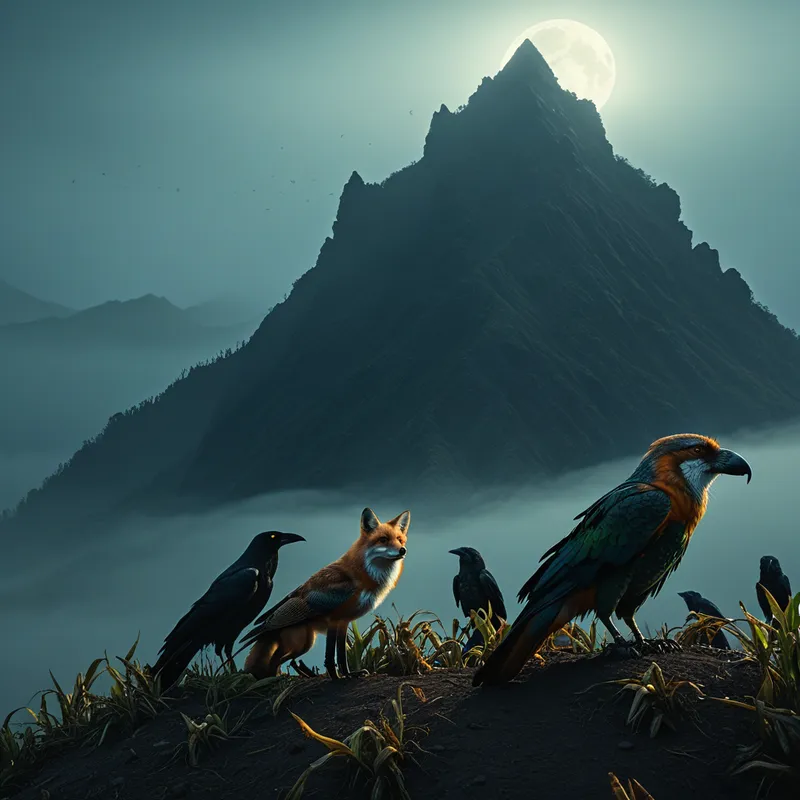
A great lament rose among the divine ones. What substance could hold a soul? What matter could birth a mind capable of memory, of offering, of true speech? The answer was whispered on the wind from the east, from the place of dawning. It spoke of a mountain, shrouded in mist and guarded by ancient powers: Paxil, the Mountain of Sustenance. And within it, hidden and ripe, was the sacred seed—yellow maize and white maize.
The gods sent their seekers: the swift fox, the cunning coyote, the bright parrot, the watchful crow. They found the mountain, but it was sealed. The guardians of sustenance, Xmucane and Xpiacoc, would not yield its bounty. So the gods called upon the twins, the divine heroes Hunahpu and Xbalanque, who had journeyed through the terrors of Xibalba. With wisdom and magical play, the twins softened the hearts of the guardians. The mountain split open, revealing rivers of yellow maize and silver-white maize, of ripe cacao and sweet fruits.
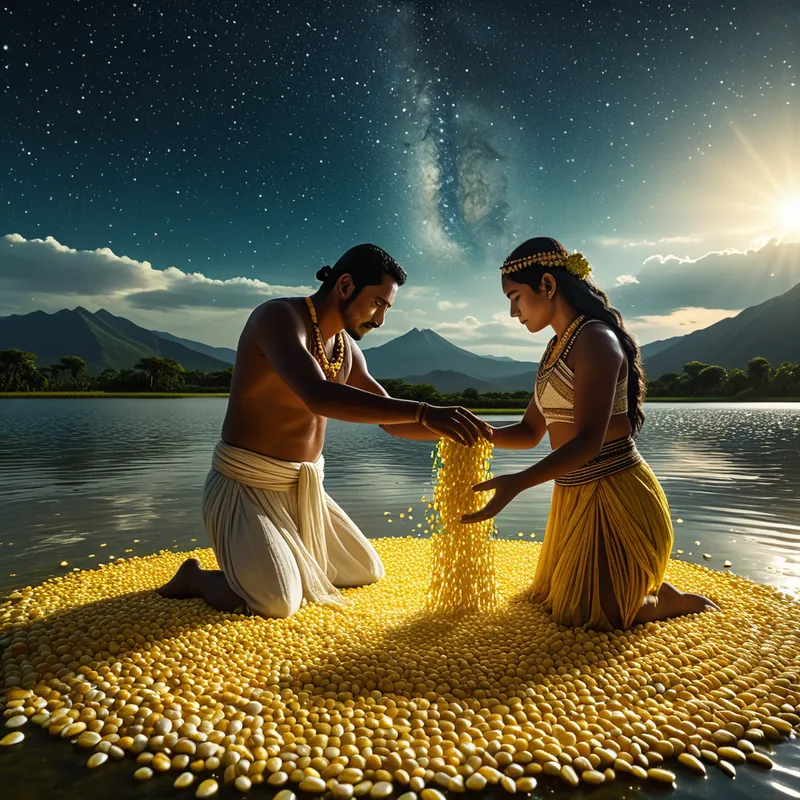
The divine grandmother, Xmucane, took nine grains of each. She ground the maize nine times on her sacred stone. The ground meal was as fine as starlight. She mixed it with water from a mountain spring, brought by the hummingbird. The liquid was as blue as the sky at dusk. Then, the Feathered Serpent, [Kukulkan](/myths/kukulkan “Myth from Mesoamerican culture.”/), poured the mixture, and the Forefathers breathed upon it.
From the liquid maize, the first flesh formed. Four men emerged, strong of limb and clear of sight. Their vision was so profound they could see through the world to its very foundations. This sight was too great, so the gods breathed a mist over their eyes, bringing them into the beautiful, partial focus of mortal life. Then, from the same sacred substance, the first women were fashioned. And as the first dawn broke over the world, these maize people looked upon the faces of the gods, their hearts filled with awe, and they spoke their first words—words of thanks, of recognition, of proper praise. The covenant was sealed. The world, at last, had a voice.
Cultural Origins & Context
This foundational narrative is the heart of the Popol Vuh, the sacred text of the K’iche’ Maya. Transmitted orally for centuries by priestly lineages and community elders, it was transcribed into the Latin alphabet in the mid-16th century to preserve it amidst cultural cataclysm. It was not mere entertainment; it was the cosmological charter for society. The myth established the ontological order: humans are not accidental, but intentional, born from the very substance that sustains life. It justified the central role of agriculture, particularly maize cultivation, as a sacred, life-sustaining ritual. It explained humanity’s purpose—to offer gratitude through ritual, speech, and sustenance—and our flawed, limited nature as a deliberate, compassionate act of the gods to allow us to live in the world, not just see through it.
Symbolic Architecture
The myth is a profound map of becoming. The failed creations of mud and [wood](/symbols/wood “Symbol: Wood symbolizes strength, growth, and the connection to nature and the environment.”/) represent incomplete modes of existence—purely [material](/symbols/material “Symbol: Material signifies the tangible aspects of life, often representing physical resources, desires, and the physical world’s influence on our existence.”/) or purely structural, lacking the essential spark of conscious [soul](/symbols/soul “Symbol: The soul represents the essence of a person, encompassing their spirit, identity, and connection to the universe.”/). The sacred maize is the perfect alchemical substance: it is both of the [Earth](/symbols/earth “Symbol: The symbol of Earth often represents grounding, stability, and the physical realm, embodying a connection to nature and the innate support it provides.”/) and transformed by culture (ground, mixed, cooked). It symbolizes the [synthesis](/symbols/synthesis “Symbol: The process of combining separate elements into a unified whole, representing integration, resolution, and the completion of a personal journey.”/) of [nature](/symbols/nature “Symbol: Nature symbolizes growth, connectivity, and the primal forces of existence.”/) and [spirit](/symbols/spirit “Symbol: Spirit symbolizes the essence of life, vitality, and the spiritual journey of the individual.”/), the raw [material](/symbols/material “Symbol: Material signifies the tangible aspects of life, often representing physical resources, desires, and the physical world’s influence on our existence.”/) of the [cosmos](/symbols/cosmos “Symbol: The entire universe as an ordered, harmonious system, often representing the totality of existence, spiritual connection, and the unknown.”/) refined into a [vessel](/symbols/vessel “Symbol: A container or structure that holds, transports, or protects something essential, representing the self, emotions, or life journey.”/) for [awareness](/symbols/awareness “Symbol: Conscious perception of self, surroundings, or internal states. Often signifies awakening, insight, or heightened sensitivity.”/).
To be human is to be a conscious intermediary, a being fashioned from transformed earth, tasked with translating the silent language of the world into the spoken language of gratitude.
The grinding by Xmucane is the act of cultural processing, of breaking down the raw gift of nature into a form that can sustain [consciousness](/symbols/consciousness “Symbol: Consciousness represents the state of awareness and perception, encompassing thoughts, feelings, and experiences.”/). The [breath](/symbols/breath “Symbol: Breath symbolizes life, vitality, and the connection between the physical and spiritual realms.”/) of the gods is the infusion of itz, the vitalizing spiritual essence. The dimming of perfect [sight](/symbols/sight “Symbol: Sight symbolizes perception, awareness, and insight, representing both physical and inner vision.”/) is not a [punishment](/symbols/punishment “Symbol: A dream symbol representing consequences for actions, often tied to guilt, societal rules, or internal moral conflicts.”/), but the necessary [condition](/symbols/condition “Symbol: Condition reflects the state of being, often focusing on physical, emotional, or situational aspects of life.”/) for the [human](/symbols/human “Symbol: The symbol of a human represents individuality, complexity of emotions, and social relationships.”/) [journey](/symbols/journey “Symbol: A journey in dreams typically signifies adventure, growth, or a significant life transition.”/)—we must explore, question, and seek meaning, not simply behold it.
The Dreamer’s Resonance
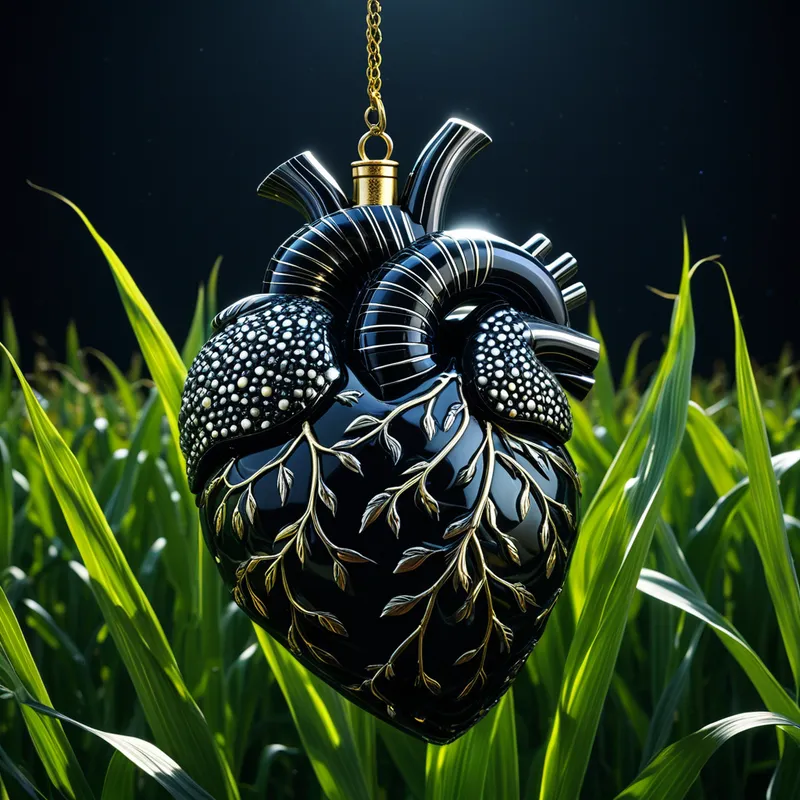
When this myth stirs in the modern psyche, it often manifests in dreams of profound material transformation. One might dream of their body being made of earth that turns to grain, or of finding a hidden, nourishing core within a barren landscape. These are dreams of resource identification. The psyche is signaling that the raw materials for a new phase of life or identity are present but require “divine” intervention—conscious effort, sacrifice, and processing.
Dreams of failed, crumbling forms (mud or wooden figures) may point to feelings of existential hollowness, of going through motions without heart. The emergence of the maize person is the dream symbol of achieving authentic substance, of finding the one nourishing truth or practice from which a resilient and grateful self can be built. It is the somatic feeling of becoming rooted in purpose.
Alchemical Translation
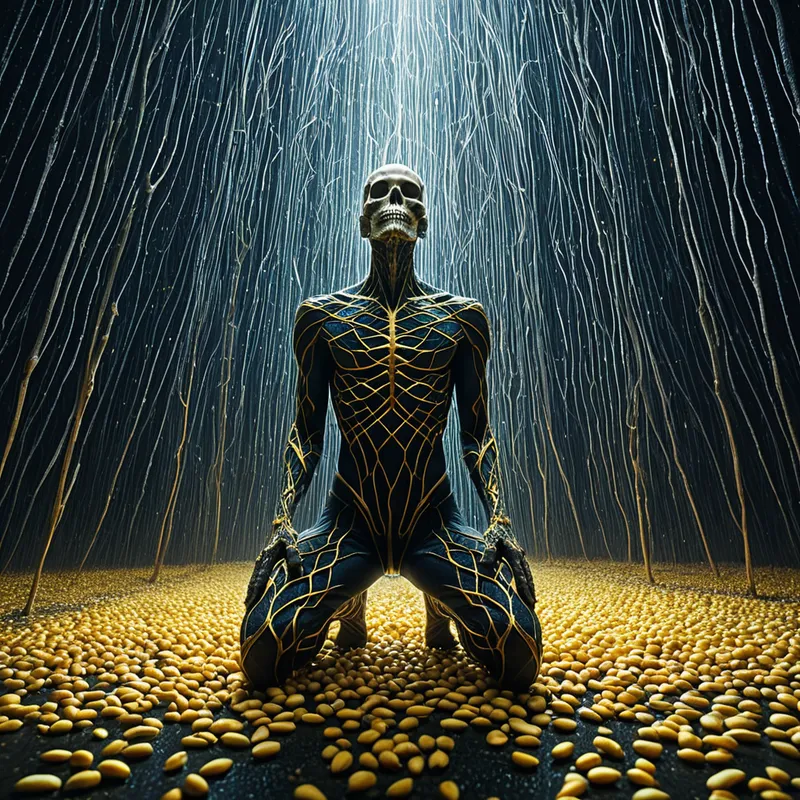
Psychologically, the myth models the individuation process—the creation of the conscious, integrated self. Our early, provisional identities (the mud and wood people) are necessary experiments, but they lack depth and sustainability. They dissolve under emotional floods or are hollowed out by life’s demands.
The journey to Paxil is the quest for the core, nourishing complex within the unconscious—the personal “sustenance” that is uniquely ours. The guardians who must be appeased are our own resistances, fears, and old wounds that protect this precious inner resource. Grinding the maize is the often-painful work of analysis, of breaking down experiences and insights into assimilable wisdom.
The final creation is not a return to a primal state, but the birth of a new entity: the conscious ego sustained by and in dialogue with the nourishing depths of the Self.
The gods’ breath is the moment of synthesis, where insight becomes embodied conviction. And the dimming of perfect sight is the acceptance of the human condition—we work with partial knowledge, which is what makes our seeking, our art, our love, and our gratitude meaningful. We become true humans not when we know all, but when we consciously offer thanks for the mystery of being itself, sustained by the sacred maize of our own hard-won understanding.
Associated Symbols
Explore related symbols from the CaleaDream lexicon:
- Maize Cob — The primordial substance of humanity, representing the perfect alchemy of earth, water, and spirit, and the foundation of sustainable life and consciousness.
- Mountain — The archetypal place of revelation and difficulty, specifically Paxil as the guarded source of ultimate nourishment and hidden truth.
- Water — The element of dissolution for the failed creations and the essential mixing agent with ground maize, symbolizing the fluid potential of life and the necessity of emotional and spiritual blending.
- Grinding Stone — The tool of Xmucane, representing the necessary, often laborious cultural and psychological processing required to transform raw potential into usable sustenance.
- Seed — The latent potential within the Mountain of Sustenance, the divine blueprint for true humanity waiting to be discovered and activated.
- God — The collective divine will (the Forefathers, Huracan, Kukulkan) that longs for relationship and executes the acts of sacrifice, seeking, and breath that make creation possible.
- Sacrifice — The fundamental exchange at the myth’s heart: the gods’ effort and the yielding of the mountain’s bounty to create beings capable of the reciprocal sacrifice of praise and sustenance.
- Vision — The original, all-penetrating sight of the first maize people, later softened, representing the tension between omniscience and the limited, questing awareness that defines the human experience.
- Earth — The raw material of the first failed creation and the essential origin of the sacred maize, grounding humanity in a physical, mortal reality connected to the soil.
- Rebirth — The core narrative arc from void to failed forms to the successful emergence of true humanity, modeling the psychological process of successive identity transformations leading to authenticity.