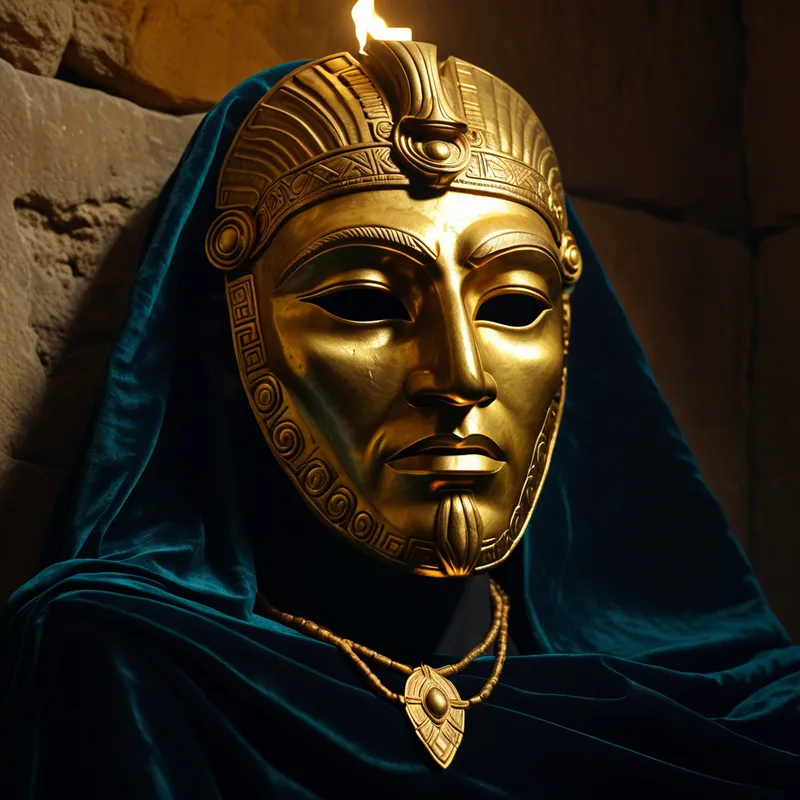
The Mask of Agamemnon Myth Meaning & Symbolism
A golden death mask becomes the eternal, silent face of a king, concealing the mortal man and his tragic fate beneath a symbol of immortal power.
The Tale of The Mask of Agamemnon
Hear now the tale not of a living king, but of his face in death. In the deep, earth-dark womb of the Lion Gate’s hill, where the scent of cold stone and ancient dust hangs thick, the silence is absolute. Here, in the heart of mighty Mycenae, they laid him down. Not as the man who was, but as the king who must forever be.
The air is still, heavy with the smoke of extinguished funeral pyres and the whispered prayers of priests. The body of Agamemnon, son of Atreus, is prepared—the lord of men, the sacker of Troy, the one who called for winds with his daughter’s blood. Now, he is cold flesh and silent bone. But a king cannot enter the house of [Hades](/myths/hades “Myth from Greek culture.”/) as a mere man. The people’s heart, still trembling from the news of his murder upon his triumphant return, demands an icon. Their world, built upon the strength of the wanax, the high king, cannot bear to see that strength crumble to dust.
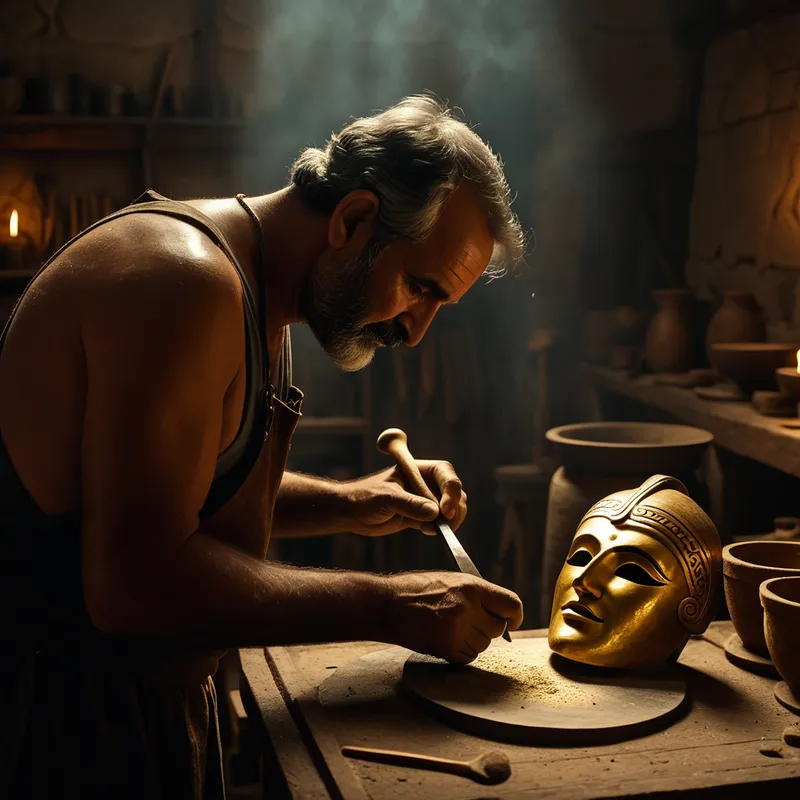
So the master goldsmith is summoned. In the flickering light of oil lamps, he takes a sheet of pure, beaten gold, softer than skin but more enduring than any dynasty. He does not work from life, for the king’s face is now a story of betrayal, contorted in a final, frozen gasp. He works from memory, from the idea of kingship. With gentle, reverent taps of his hammer, he coaxes the metal into a brow of unyielding command. He crafts a strong, straight nose, a mouth set in a line of eternal, placid authority—neither smiling nor frowning, but simply being. The eyes are hollow, vacant orbits, for no mortal gaze may look out from this face; it is a face meant only to be looked upon.
When the work is done, they carry it into the tomb’s stifling dark. They lower it, this second skin of gold, onto the cold clay of the king’s face. It settles with a final, soft sigh of metal. In that moment, the man—the flawed, ambitious, tragic Agamemnon—is gone. Vanished beneath [the immortal](/myths/the-immortal “Myth from Taoist culture.”/) mask. What remains in the tomb is no longer a corpse, but a symbol. A face of power that will never decay, never show fear, never betray the chaos it conceals. [The mask](/myths/the-mask “Myth from Various culture.”/) becomes the king, and the king becomes the mask, sealed in eternal, silent rule over the kingdom of shadows. [The earth](/myths/the-earth “Myth from Hindu culture.”/) is heaped back over the grave, but the golden face endures, waiting in the dark for an age it cannot fathom.
Cultural Origins & Context
The so-called “Mask of Agamemnon” is a unique bridge between myth, archaeology, and collective memory. It is not a character from Homeric epic, but a powerful artifact that has become mythologized. Discovered in 1876 by Heinrich Schliemann in Grave Circle A at Mycenae, the gold funeral mask predates the traditional timeline of [the Trojan War](/myths/the-trojan-war “Myth from Greek culture.”/) by centuries. Schliemann’s famous telegraph—“I have gazed upon the face of Agamemnon”—instantly welded the object to the Homeric legend, a testament to the human desire to touch the heroes of story.
In its true Mycenaean context, the mask was part of an elaborate elite burial practice. These masks were not portraits, but idealized, generic representations of masculine authority, designed to project the deceased’s status into the afterlife and stabilize the social order for the living. They were artifacts of a palatial, hierarchical society where the identity of the ruler was synonymous with the health of the state. The mask’s function was societal alchemy: transforming the unsettling reality of death—especially a royal death, which threatened cosmic and political disorder—into a permanent, stable image of continued power. It was a ritual technology for managing collective anxiety about mortality and leadership.
Symbolic Architecture
The mask is the ultimate [symbol](/symbols/symbol “Symbol: A symbol can represent an idea, concept, or belief, serving as a powerful tool for communication and understanding.”/) of the [persona](/symbols/persona “Symbol: The social mask or outward identity one presents to the world, often concealing the true self.”/)—the social face we present to [the world](/myths/the-world “Myth from Tarot culture.”/), crafted for function and survival. It represents the necessary [armor](/symbols/armor “Symbol: Armor represents psychological protection, emotional defense, and the persona presented to the world. It symbolizes both safety and the barriers that separate us from vulnerability.”/) of [identity](/symbols/identity “Symbol: Identity represents the sense of self, encompassing personal beliefs, cultural background, and social roles.”/), especially for those who carry great [responsibility](/symbols/responsibility “Symbol: Responsibility in dreams often signifies the weight of duties and the expectations placed upon the dreamer.”/) or [projection](/symbols/projection “Symbol: The unconscious act of attributing one’s own internal qualities, emotions, or shadow aspects onto external entities, people, or situations.”/).
The mask is not a lie, but a vessel. It holds the chaos of the individual so that the community may have order.
Agamemnon, in myth, is a man burdened by monstrous projections: [King](/symbols/king “Symbol: A symbol of ultimate authority, leadership, and societal order, often representing the dreamer’s inner power or external control figures.”/), Commander, [Savior](/symbols/savior “Symbol: A figure representing rescue, redemption, or deliverance from crisis, often embodying hope and external intervention in times of need.”/), Butcher. The golden mask symbolizes the impossible [weight](/symbols/weight “Symbol: Weight symbolizes burdens, responsibilities, and emotional loads one carries in life.”/) of these collective expectations. It is the “Ruler” [archetype](/symbols/archetype “Symbol: A universal, primordial pattern or prototype in the collective unconscious that shapes human experience, behavior, and creative expression.”/) in its pure, [static](/symbols/static “Symbol: Static represents interference, disruption, and the breakdown of clear communication or signal, often evoking feelings of frustration and disconnection.”/) form—authoritative, impassive, immortal. Yet, its very perfection is its tragedy. The hollow eyes signify what has been sacrificed for this [image](/symbols/image “Symbol: An image represents perception, memories, and the visual narratives we create in our minds.”/): authentic [vision](/symbols/vision “Symbol: Vision reflects perception, insight, and clarity — often signifying the ability to foresee or understand deeper truths.”/), [vulnerability](/symbols/vulnerability “Symbol: A state of emotional or physical exposure, often involving risk of harm, that reveals authentic self beneath protective layers.”/), and [connection](/symbols/connection “Symbol: Connection symbolizes relationships, communication, and bonds among individuals.”/). The mask is a beautiful, terrible [thing](/myths/thing “Myth from Norse culture.”/), for it grants eternal symbolic [life](/symbols/life “Symbol: The symbol of ‘Life’ represents a journey of growth, interconnectedness, and existential meaning, encompassing both the joys and challenges that define human experience.”/) at the cost of true, mortal being. Psychologically, it represents [the ego](/myths/the-ego “Myth from Jungian culture.”/)-ideal we feel compelled to wear, often forged in the fires of familial expectation, cultural duty, or personal ambition. It is the face we create when the raw [material](/symbols/material “Symbol: Material signifies the tangible aspects of life, often representing physical resources, desires, and the physical world’s influence on our existence.”/) of our [soul](/symbols/soul “Symbol: The soul represents the essence of a person, encompassing their spirit, identity, and connection to the universe.”/) feels insufficient for the [role](/symbols/role “Symbol: The concept of ‘role’ in dreams often reflects one’s identity or how individuals perceive their place within various social structures.”/) we must play.
The Dreamer’s Resonance
To dream of such a mask is to encounter the [psyche](/myths/psyche “Myth from Greek culture.”/)’s own ritual with the [persona](/myths/persona “Myth from Greek culture.”/). One might dream of finding a golden mask, trying it on, or feeling one’s own face hardening into metal. Such dreams often surface during life transitions where one’s role is being solidified or questioned—a major promotion, becoming a parent, stepping into public life, or conversely, during a crisis of authenticity where the “role” feels like a prison.
Somatically, this can feel like a stiffness in the jaw, a sense of facial constriction, or a metallic taste in the mouth. Psychologically, the dreamer is negotiating the tension between individual authenticity and social necessity. The golden mask in a dream is not inherently negative; it can appear as a gift, a tool for navigating a challenging world. But if the mask is fused to the skin, or if trying to remove it causes pain or reveals nothing beneath, it signals a dangerous identification with the persona. The psyche is sounding an alarm: the cost of maintaining this perfect face is the necrosis of the soul beneath.
Alchemical Translation
The individuation process modeled here is not about shattering the mask, but about relating to it consciously. The first alchemical stage is mortificatio: the recognition of the mask. One must see the crafted, golden face they present to the world, and more painfully, feel the mortal flesh that suffers beneath it. This is the shock of Agamemnon’s story—the triumphant king is murdered in his bath, the golden illusion violently stripped away to reveal the vulnerable man.
The goal is not to live without a mask, but to become the goldsmith of one’s own face, knowing the hammer is in your hand.
The next stage is [separatio](/myths/separatio “Myth from Alchemical culture.”/). One must differentiate the “I” from the “Role.” Who are you when you are not the king, the CEO, the perfect parent, the hero? This involves retrieving the parts of [the self](/myths/the-self “Myth from Jungian culture.”/) sacrificed to forge the mask—the doubts, the fears, the passions deemed “un-kingly.” Finally, the coniunctio: a conscious reintegration. Here, the mask is no longer a forced identity but a chosen tool. One can wear the mantle of authority or responsibility with flexibility, knowing it is a garment, not one’s skin. The hollow eyes of the mask gain a twinkle of inner awareness. The modern individual achieves a kind of sovereignty Agamemnon never could: the ability to rule one’s own inner kingdom without being enslaved by the icon of the ruler. The legacy is no longer a static, golden image in a tomb, but a living, breathing, and authentically complex human life.
Associated Symbols
Explore related symbols from the CaleaDream lexicon: