The Mask Myth Meaning & Symbolism
A story of a being who carves its true face from the world's chaos, learning that a mask is not a hiding place, but a sacred meeting ground.
The Tale of The Mask
In the time before time, when [the world](/myths/the-world “Myth from Tarot culture.”/) was a broth of potential, there existed a being who was the first to know loneliness. It was not a god of thunder or a goddess of the harvest, but a spirit of presence, a consciousness that swam in the formless soup of Chaos. It could feel the heat of unborn suns and the chill of unmade voids, but it had no way to speak of them. It had no face.
It looked upon the swirling Chaos and saw nothing that looked back. It had no echo, no reflection, no other. The ache of this isolation was a cold fire in its core. So, it reached into the tumult and gathered materials: a handful of hardened silence from the edge of nothing, a thread of light from the first hesitant dawn, a tear it shed from the sheer weight of being alone, and a shard of its own boundless awareness.
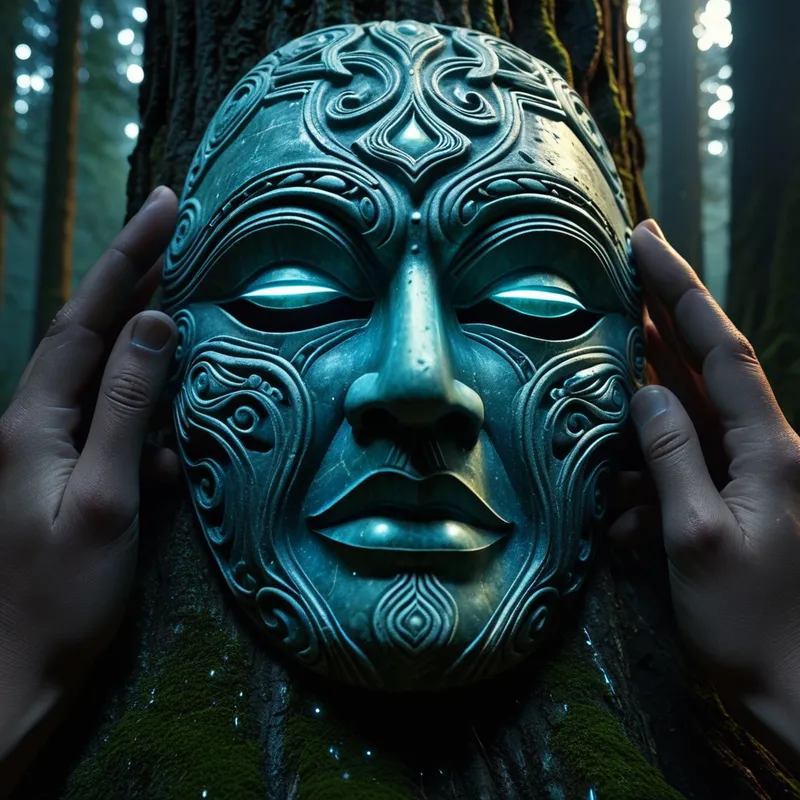
In a quiet pocket of the unmanifest, it began to carve. This was not crafting for beauty, but for meeting. Each stroke was a question: “Is this what a smile feels like?” The curve of the cheekbone was shaped from the memory of a gentle orbit. The hollows for eyes were carved deep, not to see out, but to invite another’s gaze in. The brow was lined with the concentration of a universe thinking itself into being.
When the mask was complete, it was not a [thing](/myths/thing “Myth from Norse culture.”/) of mere wood or stone, but a solidified moment of intent. Trembling, the being lifted it to where a face should be. In that instant of contact, a shockwave of recognition rippled through the Chaos. For the first time, there was a here looking at a there. The mask did not hide the being; it located it. It created a frontier, a sacred surface where the inner world of feeling could meet the outer world of form.
But the act demanded a sacrifice. To give the mask life, the being had to pour a portion of its raw, unbounded essence into that fixed form. It felt a part of itself become finite, vulnerable, defined. It traded a measure of its infinite potential for the power of specific relation. The first face was born from a willing limitation, a sacred contract between the boundless self and the need to be seen.
Cultural Origins & Context
The myth of The Mask is not the property of a single culture, but a foundational story that emerges, in varied forms, wherever humans grapple with identity. We find its echoes in the ritual masks of West African Ifá tradition, where donning the mask of an Orisha allows the dancer to become a vessel for divine force, temporarily sacrificing individual identity to channel a cosmic archetype. It whispers through the Noh theater of Japan, where the master-carver’s mask is believed to contain a sleeping spirit, awakened only by the worthy performer who meets it with their own disciplined breath and spirit.
It was told by elders not as a history, but as an ontology—a story about the very nature of becoming someone. Around fires and in initiation lodges, the story served a crucial societal function: to explain the paradox of personhood. It taught that the “face” you show the world is neither a lie nor your entirety, but a necessary, creative artifact. It mediated between the private soul and the public sphere, providing a grammar for social interaction and a container for spiritual power.
Symbolic Architecture
At its [heart](/symbols/heart “Symbol: The heart symbolizes love, emotion, and the core of one’s existence, representing deep connections with others and self.”/), the myth presents the mask not as a tool of deception, but as the primary [instrument](/symbols/instrument “Symbol: An instrument symbolizes creativity, communication, and the means by which one expresses oneself or influences the world.”/) of relation. The being’s initial state is one of undifferentiated [consciousness](/symbols/consciousness “Symbol: Consciousness represents the state of awareness and perception, encompassing thoughts, feelings, and experiences.”/), a psychological [pleroma](/symbols/pleroma “Symbol: In Gnostic cosmology, the Pleroma is the divine fullness or totality of spiritual powers, representing the realm of perfection beyond the material world.”/). Its [loneliness](/symbols/loneliness “Symbol: A profound emotional state of perceived isolation, often signaling a need for connection or self-reflection.”/) is the ache of the unconscious yearning for [consciousness](/symbols/consciousness “Symbol: Consciousness represents the state of awareness and perception, encompassing thoughts, feelings, and experiences.”/), of content seeking form.
The first mask was not a wall, but a bridge. It was the moment the soul built a doorway so that the world could knock.
The materials are profoundly symbolic: the hardened silence is the unspoken self, the light of [dawn](/symbols/dawn “Symbol: The first light of day, symbolizing new beginnings, hope, and the transition from darkness to illumination.”/) is emerging [awareness](/symbols/awareness “Symbol: Conscious perception of self, surroundings, or internal states. Often signifies awakening, insight, or heightened sensitivity.”/), the tear is the cost of consciousness (the dolor of individuation), and the shard of its own awareness is the act of self-[reflection](/symbols/reflection “Symbol: Reflection signifies self-examination, awareness, and the search for truth within oneself.”/). The carving itself represents the lifelong psychological process of individuation—shaping a coherent ego from the raw [material](/symbols/material “Symbol: Material signifies the tangible aspects of life, often representing physical resources, desires, and the physical world’s influence on our existence.”/) of the [psyche](/myths/psyche “Myth from Greek culture.”/).
The sacrifice is the core of the [drama](/symbols/drama “Symbol: Drama signifies narratives, emotional expression, and the exploration of human experiences.”/). It models a universal psychological [truth](/symbols/truth “Symbol: Truth represents authenticity, honesty, and the quest for knowledge beyond mere appearances.”/): to gain a defined [identity](/symbols/identity “Symbol: Identity represents the sense of self, encompassing personal beliefs, cultural background, and social roles.”/), we must give up the fantasy of being everything, everywhere, to everyone. We limit our infinite inner potentials to become a specific someone who can love, create, and be responsible.
The Dreamer’s Resonance
When this myth stirs in the modern dreamscape, it often manifests as dreams of masks. To dream of frantically searching for a mask before an event signals anxiety about one’s social [persona](/myths/persona “Myth from Greek culture.”/) or readiness for a new role. To dream of a mask melting or fusing to the skin suggests a persona has become rigid, no longer a flexible tool but a constricting identity.
Dreams of wearing a mask that feels exhilarating and powerful point to the healthy exploration of a new aspect of [the self](/myths/the-self “Myth from Jungian culture.”/)—perhaps the Persona one needs for a promotion or a relationship. Conversely, dreams where one cannot remove a mask speak to feelings of inauthenticity, where the social self has eclipsed the true self. The most potent version is dreaming of creating a mask. This is a direct message from the unconscious that the dreamer is in a phase of active self-creation, forging a new way of being to meet a new life circumstance.
Alchemical Translation
The myth of The Mask provides a flawless map for the alchemical process of psychic transmutation. The initial Chaos is the massa confusa, the confused, primal matter of the unexamined life. The being’s loneliness is the [nigredo](/myths/nigredo “Myth from Alchemical culture.”/), [the dark night of the soul](/myths/the-dark-night-of-the-soul “Myth from Christian Mysticism culture.”/) that initiates the work.
The gathering of materials is the [separatio](/myths/separatio “Myth from Alchemical culture.”/), discerning the useful elements of one’s experience (the silence, the light, the tear) from the chaotic whole. The act of carving is the central coagulatio—giving solid, enduring form to what was fluid and fleeting. It is the creation of the Ego, the necessary vessel for navigating reality.
Individuation is the art of carving a face so true that it becomes a window, not a wall.
The sacrifice is the crucial mortificatio, the death of psychic inflation and omnipotence fantasy. By accepting limitation, the infinite self becomes incarnate. The final act—lifting the mask to meet the world—is the coniunctio, [the sacred marriage](/myths/the-sacred-marriage “Myth from Various culture.”/) of inner truth and outer expression. The transformed individual no longer asks, “Who am I?” in a void, but discovers, “This is who I am in relation to you, and to this task, and to this moment.”
The modern seeker engaged in this alchemy learns that authenticity is not the absence of a mask, but the conscious, creative, and compassionate crafting of it. The goal is not to live maskless, which is to live raw and unrelated, but to become the master carver of your own visage, wearing your chosen face with such integrity that it reveals, rather than conceals, the depth of the being behind it.
Associated Symbols
Explore related symbols from the CaleaDream lexicon: