The Maroons and Nanny of the Maroons Myth Meaning & Symbolism
The story of a warrior queen and her people who forged a sovereign nation in the wilderness, defying enslavement through spiritual power and unbreakable will.
The Tale of The Maroons and Nanny of the Maroons
Listen. The story begins not on the shore, but in the deep, green belly of the island. In a time when the earth itself wept iron tears, when the air tasted of salt and sorrow, a people were brought across the Ocean in chains. But the spirit cannot be bound. It remembers the drumbeat of the homeland, the language of the river, the freedom of the open sky. From the plantations, they fled—not as fugitives, but as sovereign souls returning to a primal pact with the wild.
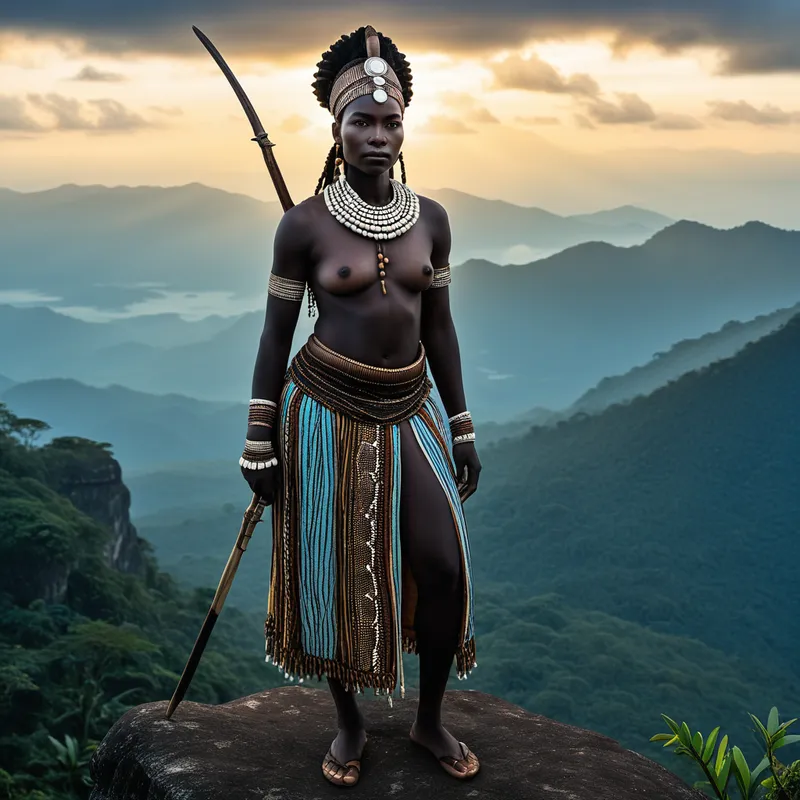
They vanished into the Cockpit Country, a labyrinth of limestone hills and razor-leafed foliage. There, in the green cathedral of the mountains, they became The Maroons. And from among them rose a woman who was more than a woman. They called her Nanny. She was of the Akan people, a daughter of warriors and priestesses. Her eyes saw not just the enemy’s camp, but the threads of fate woven in the smoke of the cooking fires. Her hands could till the stubborn earth and catch musket balls in the folds of her skirt, turning the weapons of oppression back upon themselves.
The conflict was the world itself. The colonial order, a monstrous machine of extraction and subjugation, sought to grind their freedom into dust. Soldiers in red coats pushed into the green maze, and the mountains themselves seemed to rise against them. Nanny’s genius was a tapestry of the seen and unseen. She mastered the art of ambush warfare, where her warriors, painted with river clay, became ghosts of the forest. But her true power was of the spirit. It is said she would stand at the mouth of her village, Moco Town, and speak incantations to the wind. She would blow upon the abeng, and its mournful, piercing cry would become a web of intelligence, telling of movements and betrayals.
The rising action was a symphony of resistance—a dance of survival choreographed over decades. They built a nation in the wilderness, with its own laws, its own farms, its own gods. They turned the tools of their captivity into instruments of liberation, mastering the musket they had stolen. Nanny was their heart, their general, their obeah woman. In the pivotal moment, legend tells of a great battle where, surrounded and outnumbered, Nanny stood her ground. As volleys of lead were fired at her, she caught the bullets in the folds of her buttocks, or deflected them with her hands, gathering the hot metal to be melted down and recast into shot for her own people’s guns.
The resolution was not a final conquest, but a hard-won treaty, a breath of sovereignty wrested from the jaws of empire. The Maroons, through relentless spirit and strategic brilliance, forced the British crown to recognize their freedom and their land. They carved out a space where the drum could beat without fear, where the ancestors could be fed, where the community could breathe. Nanny, it is said, never died of age or blade. She passed into the spirit of the mountains, becoming one with the roots of the cotton trees and the source of the hidden springs, a guardian presence forever woven into the land she helped to liberate.
Cultural Origins & Context
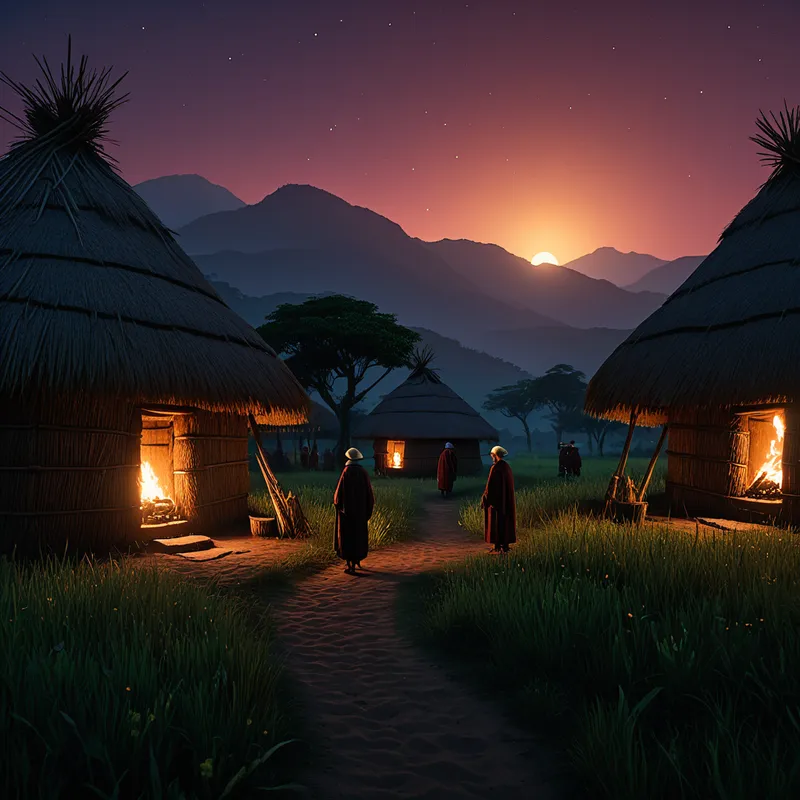
This is not a myth of a distant, forgotten age, but a living history and a foundational narrative of the African Diaspora in the Caribbean, specifically Jamaica. Emerging from the brutal reality of transatlantic chattel slavery in the 17th and 18th centuries, the stories of the Maroons and Nanny are oral epics, passed down through generations in Maroon communities like Accompong and Moore Town. They function as a sacred history—a record of identity, resilience, and political genesis.
Told by elders around fires, sung in work songs, and embedded in proverbs, these narratives served multiple vital societal functions. They were a practical guide to survival, encoding knowledge of local plants, guerilla tactics, and land navigation. They were a psychological bulwark against dehumanization, affirming that the enslaved were agents of their own destiny, capable of brilliant strategy and profound spiritual power. Most importantly, they were a charter of sovereignty, proving that a new African-derived society, autonomous and self-determining, could be forged on foreign soil against impossible odds. Nanny, today a National Hero of Jamaica, transcends history to become an archetypal figure—the mother of a nation, the warrior-priestess, the ultimate symbol of indomitable will.
Symbolic Architecture
At its core, this myth is a masterclass in the [symbolism](/symbols/symbolism “Symbol: The use of symbols to represent ideas or qualities, often conveying deeper meanings beyond literal interpretation. In dreams, it’s the language of the unconscious.”/) of psychic liberation. The plantation represents the oppressive, conscious Order of the ego that seeks to enslave the instinctual, ancestral, and creative parts of the Self. The [flight](/symbols/flight “Symbol: Flight symbolizes freedom, escape, and the pursuit of one’s aspirations, reflecting a desire to transcend limitations.”/) into the Cockpit [Country](/symbols/country “Symbol: Dreaming of a country often symbolizes a quest for belonging, identity, or exploration of one’s inner landscape through the metaphor of physical space.”/) is the necessary descent into the chaotic, uncharted territory of the unconscious—the [Forest](/symbols/forest “Symbol: The forest symbolizes a complex domain of the unconscious mind, representing both mystery and potential for personal growth.”/) of the [soul](/symbols/soul “Symbol: The soul represents the essence of a person, encompassing their spirit, identity, and connection to the universe.”/).
To become free, one must first become lost to the world that defined one’s captivity.
Nanny symbolizes the unifying and guiding principle that emerges from this [chaos](/symbols/chaos “Symbol: In Arts & Music, chaos represents raw creative potential, uncontrolled expression, and the breakdown of order to forge new artistic forms.”/)—the [Mother](/symbols/mother “Symbol: The symbol of ‘Mother’ represents nurturing, protection, and the foundational aspect of one’s emotional being, often associated with comfort and unconditional love.”/) as [creator](/symbols/creator “Symbol: A figure representing ultimate origin, divine power, or profound authorship. Often embodies the source of existence, innovation, or personal destiny.”/) of a new psychic order. She is not a [mother](/symbols/mother “Symbol: The symbol of ‘Mother’ represents nurturing, protection, and the foundational aspect of one’s emotional being, often associated with comfort and unconditional love.”/) of comfort, but of fierce protection and strategic wisdom. Her [ability](/symbols/ability “Symbol: In dreams, ‘ability’ often denotes a recognition of skills or potential that one possesses, whether acknowledged or suppressed.”/) to “catch bullets” is a profound [symbol](/symbols/symbol “Symbol: A symbol can represent an idea, concept, or belief, serving as a powerful tool for communication and understanding.”/) of psychic [resilience](/symbols/resilience “Symbol: The capacity to recover quickly from difficulties, adapt to change, and maintain strength through adversity.”/): the [capacity](/symbols/capacity “Symbol: A measure of one’s potential, limits, or ability to contain, process, or achieve something, often reflecting self-assessment or external demands.”/) to receive the projectiles of [trauma](/symbols/trauma “Symbol: A deeply distressing or disturbing experience that overwhelms the psyche, often manifesting in dreams as unresolved emotional wounds or psychological injury.”/), oppression, or criticism, and through a spiritual [alchemy](/symbols/alchemy “Symbol: A transformative process of purification and creation, often symbolizing personal or spiritual evolution through difficult stages.”/), transmute their destructive [energy](/symbols/energy “Symbol: Energy symbolizes vitality, motivation, and the drive that fuels actions and ambitions.”/) into a [source](/symbols/source “Symbol: The origin point of something, often representing beginnings, nourishment, or the fundamental cause behind phenomena.”/) of one’s own power and agency. The recast bullets represent the reclamation of narrative—turning the weapons of your wounding into the tools of your [testimony](/symbols/testimony “Symbol: A formal statement of truth, often given under oath, representing personal truth, accountability, and the act of bearing witness.”/).
The abeng is the symbol of [authentic voice](/symbols/authentic-voice “Symbol: The ‘Authentic Voice’ symbolizes the true expression of self, encompassing personal beliefs, emotions, and individuality.”/) and deep communication, a call that bypasses the logical mind to connect soul to soul across impossible distances. The negotiated treaty symbolizes the hard-won [integration](/symbols/integration “Symbol: The process of unifying disparate parts of the self or experience into a cohesive whole, often representing psychological wholeness or resolution of internal conflict.”/) where the once-rebellious, autonomous complex (the Maroon psyche) establishes a lasting, recognized [relationship](/symbols/relationship “Symbol: A representation of connections we have with others in our lives, often reflecting our emotional state.”/) with the broader governing [consciousness](/symbols/consciousness “Symbol: Consciousness represents the state of awareness and perception, encompassing thoughts, feelings, and experiences.”/), achieving not annihilation, but a respected autonomy.
The Dreamer’s Resonance
When this myth pattern stirs in the modern dreamer, it signals a profound somatic and psychological process of claiming inner sovereignty. To dream of fleeing into an impenetrable, wild landscape suggests a deep psyche initiating a necessary withdrawal from oppressive external structures or internalized “shoulds.” The dream-ego is being called to desert the “plantation” of a false persona or a life built on compliance.
Dreams featuring a formidable, Nanny-like guide—often an older woman of immense presence, or a figure associated with earth and strategy—indicate the activation of the inner strategist and protector. This archetype helps the dreamer navigate the confusing “cockpit country” of emotional turmoil or life transition. Somatic sensations might include a feeling of being tracked or pursued (the pressure of assimilation), coupled with sudden bursts of knowing or cunning (the guerilla wisdom of the unconscious breaking through).
Conversely, dreaming of being a Maroon builder, creating a hidden settlement, points to the active construction of a new psychic structure—a safe, authentic inner space where the soul’s own laws can be written. This is the psyche doing the hard, practical work of individuation, establishing a homeland for the exiled parts of the self.
Alchemical Translation
The myth of the Maroons models the complete alchemical cycle of psychic transmutation for the modern individual. The initial state (nigredo) is the experience of enslavement—to a job, a trauma, an addiction, a limiting belief system. It is the feeling of being owned by a force outside oneself.
The flight (separatio) is the crucial, often terrifying, first act of liberation: quitting the job, entering therapy, setting the boundary, beginning the creative project that has no commercial guarantee. It is a conscious leap into the unknown, away from the familiar prison.
The wilderness you fear is the womb of your becoming.
In the wilderness (mortificatio and solutio), the old identity dissolves. This is a period of disorientation, grief, and confrontation with inner “wild beasts” (fears, rages, shames). Here, the Nanny principle—the inner authority that blends spiritual intuition with practical cunning—must be cultivated. One learns to “catch bullets”: to face criticism, financial fear, or internal doubt, and through a process of inner work, not be destroyed by them but learn from their energy.
The building of the town (coagulatio) is the stage of re-formation. New habits are laid like foundation stones. A personal philosophy, a daily ritual, a community of chosen kin—these are the structures of the new sovereign self. Finally, the treaty (coniunctio) represents integration. The liberated self does not live in perpetual war with the world. It negotiates a sustainable relationship with it, bringing the power, wisdom, and authenticity forged in the wilderness back into a dialogue with society, now from a position of unassailable inner strength. The individual becomes, like the Maroon communities, a free-standing entity within a larger whole, their sovereignty rooted in the unconquerable spirit of the interior mountains.
Associated Symbols
Explore related symbols from the CaleaDream lexicon:
- Forest — The untamed wilderness of the unconscious and the natural world, representing both a refuge from oppression and the chaotic, fertile ground where a new self is forged.
- Mountain — The enduring, formidable symbol of inner strength, spiritual ascent, and the establishment of a sovereign perspective, high above the plains of conformity.
- Mother — The archetype of Nanny as the fierce, protective, and nurturing creator of a new psychic and cultural order, a mother who defends her children with strategic wisdom.
- Warrior — The embodiment of active resistance, courage, and the skilled application of force (both physical and spiritual) to defend one’s freedom and integrity.
- Spirit — The indomitable, ancestral life-force that cannot be enslaved, which guides, protects, and empowers the community through ritual, dream, and intuition.
- Freedom — The ultimate goal and core driving force of the myth, representing not just physical liberty but psychic autonomy and the right to self-determination.
- Journey — The perilous passage from captivity to liberation, an archetypal voyage that is both a physical escape and a profound inward migration of the soul.
- Fire — The transformative energy of rebellion and resilience, the cooking fires of the hidden villages, and the spiritual heat required to recast bullets of trauma into tools of power.
- Earth — The literal and symbolic ground of being, the land the Maroons fought to connect with and claim, representing rootedness, sustenance, and a sacred contract with place.
- Root — The connection to ancestral lineage and cultural memory that provides strength and identity, allowing new growth to emerge even in foreign soil.
- Drum — The heartbeat of the community and a direct line to the ancestral realm, a tool of communication, ceremony, and maintaining cultural rhythm against forces of silence.
- Circle — The shape of the Maroon community and their councils, representing wholeness, equality, protection, and the cyclical nature of struggle and renewal.